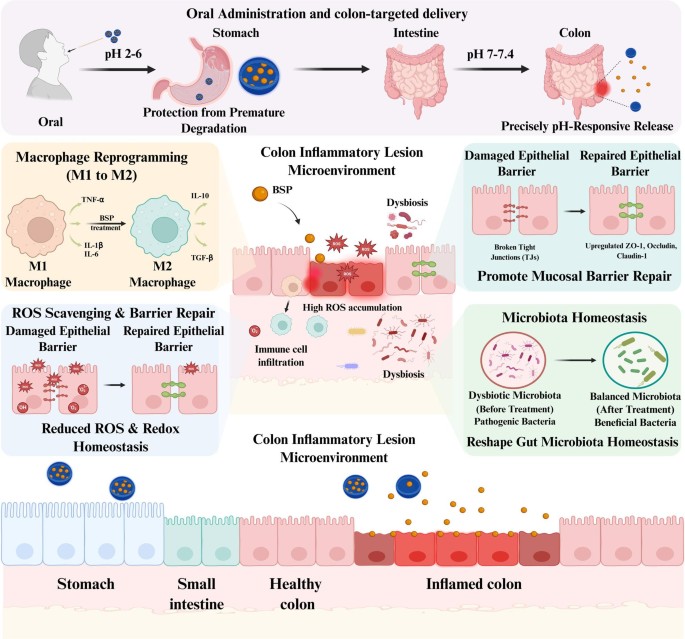
The study presents a new edible nanoparticle that delivers resveratrol to the colon and improved disease markers in a mouse model of ulcerative colitis, which could inform future delivery strategies for plant-derived therapies.
Who Should Pay Attention
Researchers and clinicians focused on IBD drug-delivery and microbiome research; adult patients interested in emerging preclinical therapies for ulcerative colitis.
Study Snapshot
Story typeResearch paper
Evidence typeResearch paper
Source depthJournal abstract
What To Know
The study developed Res@ZC-NPs (resveratrol encapsulated in a zein/citric acid complex) with small particle size and high encapsulation efficiency. In lab tests the nanoparticles reduced oxidative-stress signals and improved cellular uptake.
In mice with DSS-induced colitis the formulation reached and was retained in the colon, helped preserve tissue integrity, supported barrier function, and altered gut microbiota composition compared with controls. The research is preclinical: results are from cell studies and a mouse model, not from human trials.
This is an early-stage delivery-platform study demonstrating feasibility rather than a proven therapy.
Keep In Mind
This is an abstract-based summary of a preclinical study using DSS-induced colitis in mice. The results are promising for a delivery approach but do not demonstrate safety or efficacy in humans.
Source Details
Review the original publication for the complete reporting, methods, and context.
Funding disclosed by the source: National Natural Science Foundation of China, award 82374303; Xinglin Scholar Discipline Talent Research Enhancement Plan of Chengdu University of Traditional Chinese Medicine, award QJJJ2024013; Chengdu University of Traditional Chinese Medicine Joint University-Institute Innovation Fund, award LH202402055
This Cure8 brief is based on source text from the linked article. Cure8 is informational only and is not a substitute for professional medical advice, diagnosis, or treatment.
The study describes a new oral, colon‑targeted delivery system that improved outcomes in a mouse model of ulcerative colitis and shifted immune and microbiome markers—research that could inform future therapies focused...
Researchers are exploring plant-derived polysaccharides as potential therapies that might reduce inflammation and protect the intestinal barrier. For people with UC, therapies that reduce pyroptosis and restore...
Researchers are exploring plant polyphenols and new oral delivery systems that might reduce gut inflammation and modify microbiota — findings in mice suggest potential but are not directly applicable to patients yet.