Targeted release of mesalamine to the colon could increase local drug levels and reduce upper-GI exposure and systemic side effects. New delivery platforms may improve effectiveness for ulcerative colitis without changing the active drug itself.
Who Should Pay Attention
Researchers and clinicians interested in drug-delivery and formulation for IBD; adult patients curious about future approaches to improve mesalamine delivery.
Study Snapshot
Story typeResearch paper
Evidence typeResearch paper
Source depthJournal abstract
What To Know
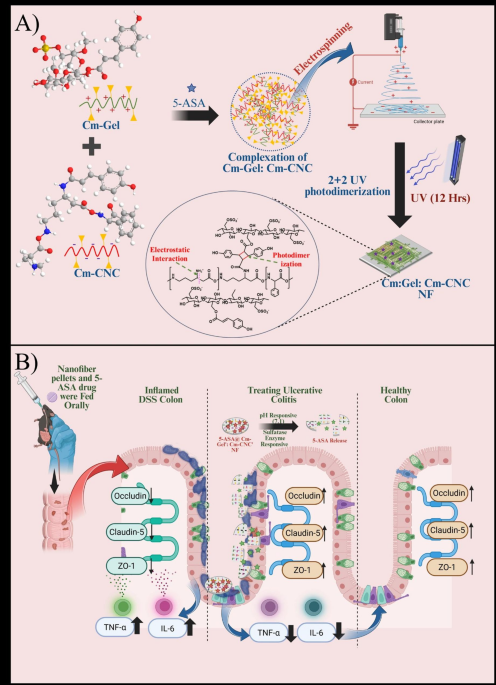
This paper reports an experimental, preclinical nanofiber delivery system (photo-crosslinked coumaroyl-modified gelatin and cellulose nanocrystals) designed to release 5-aminosalicylic acid (5-ASA, mesalamine) in the colon in response to pH and sulfatase enzyme.
In cell and DSS-colitis mouse models the authors found improved intestinal uptake and greater anti-inflammatory effects compared with free 5-ASA. The article is a laboratory and animal-study report (abstract-level).
It describes fabrication, in vitro characterization, cellular uptake and safety assays, and therapeutic testing in a mouse colitis model; it does not present human clinical data. The findings suggest a possible future drug-delivery approach to improve colonic targeting of mesalamine but remain at the preclinical stage.
If you follow IBD treatment research, this is an example of materials-science work aimed at colon-targeted delivery of an existing IBD drug rather than a new systemic therapy.
Keep In Mind
This is preclinical work reported in an academic journal abstract/full text and tested in cell systems and a DSS-induced mouse colitis model. It does not provide human safety or efficacy data, so clinical relevance remains provisional.
Source Details
Review the original publication for the complete reporting, methods, and context.
Funding disclosed by the source: Ministry of Education, award RS-2022-NR074969; Ministry of Education, award RS-2018-NR031068; Ministry of Science and ICT, South Korea, award RS-2022-NR070087
This Cure8 brief is based on source text from the linked article. Cure8 is informational only and is not a substitute for professional medical advice, diagnosis, or treatment.
The article explains how gut bacteria may contribute to IBD and summarizes common tests and treatments people are likely to encounter. It highlights emerging microbial therapies (probiotics and FMT) that some patients...
This mouse study identifies a novel peptide that reduced DSS-induced colitis and points to mast cells and fibroblast–mast cell interactions as potential therapeutic targets. It also showed additive benefit when combined...
This trial tests palmitoylethanolamide (PEA), a commercially available supplement with anti-inflammatory actions, as an add-on treatment for mild-to-moderate ulcerative colitis.