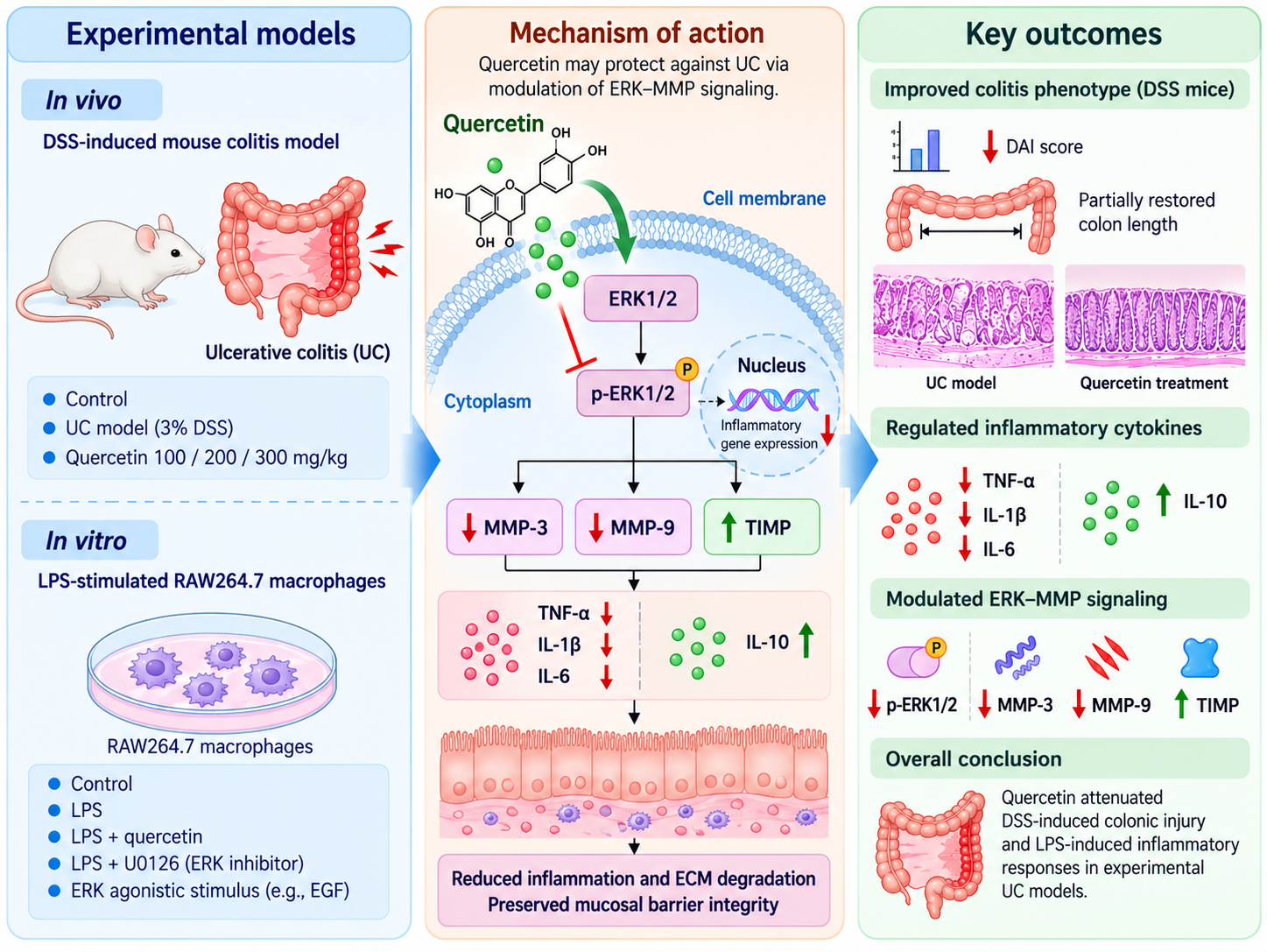
This study suggests quercetin reduced inflammation and tissue-damage signaling in experimental ulcerative colitis models, highlighting a potential mechanism (ERK–MMP) that could inform future preclinical work. If validated, it might guide research into novel adjunctive therapies or biomarkers.
Who Should Pay Attention
Researchers, preclinical pharmacologists, clinicians interested in IBD mechanisms, patients curious about dietary/flavonoid research
Study Snapshot
Story typeResearch paper
Evidence typeResearch paper
Source depthJournal abstract
What To Know
This preclinical study tested quercetin, a dietary flavonoid, in a mouse model of dextran sulfate sodium (DSS) colitis and in LPS-stimulated RAW264.7 macrophage cells.
The authors report that medium and high doses of quercetin improved colon appearance, reduced disease activity scores, lowered several pro-inflammatory cytokines, increased IL-10, and was associated with reduced ERK1/2 activation and lower MMP-3 and MMP-9 expression in tissues and cells.
The paper used standard laboratory assays (histology, ELISA, qRT-PCR, western blots) and compared quercetin’s effects in vitro with an ERK phosphorylation inhibitor (U0126) to explore pathway involvement. The authors note the study is exploratory and lacks genetic rescue experiments, pharmacokinetic data, or human validation.
This is early-stage, animal and cell-based research suggesting a possible mechanism (ERK–MMP signaling) by which quercetin may protect against experimental colitis. It does not provide evidence that quercetin is effective or safe for treating ulcerative colitis in people.
Keep In Mind
Findings come from mouse and cell models (exploratory). No human data, genetic rescue experiments, or pharmacokinetic analyses were provided; clinical translation remains speculative.
Source Details
Review the original publication for the complete reporting, methods, and context.
This Cure8 brief is based on source text from the linked article. Cure8 is informational only and is not a substitute for professional medical advice, diagnosis, or treatment.
The study suggests quercetin can reduce inflammation and tissue damage markers in lab models of ulcerative colitis, pointing to ERK–MMP signaling as a possible mechanism. That could inform future preclinical research...
The study suggests a new mechanism—blocking HSP90-mediated necroptosis of intestinal epithelial cells—that may reduce inflammation and tissue damage in ulcerative colitis, which could guide early drug-discovery efforts.
The study describes a mechanism by which Huaier granules reduced colitis-related inflammation in mice and cell models by targeting macrophage cGAS–STING signaling and altering the gut microbiome—information that could...