NIH RePORTER
Cure8 regulatory brief
Ultrasound Imaging Biomarkers of Crohn's Disease
Tests and monitoring
Biomarkers
Clinical study
Clinicians
Researchers
Patients On Biologics
Adult patients
Crohn's disease
Cure8 regulatory brief
Frequent, accurate assessment of bowel inflammation and fibrosis is critical for Crohn's disease care. Ultrasound is safe, accessible, and could provide a low-cost biomarker to monitor disease activity, fibrosis, and treatment response if validated.
Clinicians who manage Crohn's disease, researchers in imaging and IBD biomarkers, and patients interested in non-invasive monitoring options.
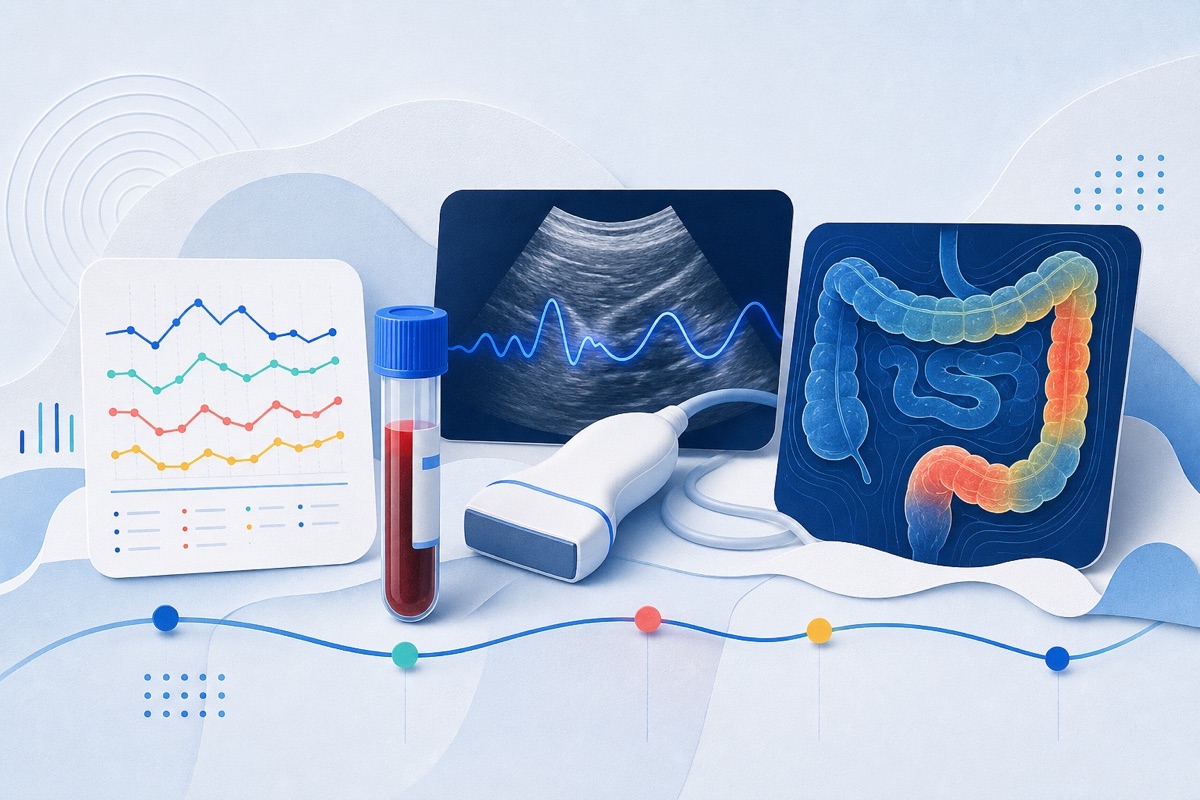
This NIH-funded project describes development and validation of a multiparametric ultrasound imaging approach (B-mode, Advanced Microvessel Imaging Technology, Echo Statistical Features) to characterize inflammation and fibrosis in Crohn's disease.
The study plans technical development, a pathology-correlated cohort (≈80 patients) for inflammation and fibrosis comparisons using surgical pathology as the reference standard, a longitudinal treatment-response cohort (≈100 patients) with imaging at baseline, week 6 and month 6 compared to MRI, and a reproducibility study (≈45 patients) to assess inter- and intra-sonographer variability.
The project aims to integrate the solution onto clinical ultrasound platforms (GE Logiq E10 and Verasonics 3D) and to evaluate ROC analyses, correlations with pathology scores, and the ability of early ultrasound changes to predict 6-month treatment outcomes.
The planned work is a funded research project (NIH Reporter project page) and describes study design, cohorts, planned imaging timepoints, and analytical approaches rather than reporting completed results.
If completed as described, the work could expand access to a radiation-free, lower-cost imaging biomarker for routine monitoring and for predicting therapy response in Crohn's disease. However, these are planned aims and not findings; clinical utility will depend on study results and external validation.
This is a project-record describing funded research and planned studies — it does not report completed results. The protocol includes pathology correlation and MRI comparison, but clinical impact will depend on the study outcomes and subsequent validation.
Review the original publication for the complete reporting, methods, and context.
Funding disclosed by the source: National Institute of Diabetes and Digestive and Kidney Diseases - R01DK145458 - $694,443
This Cure8 brief is based on source text from the linked article. Cure8 is informational only and is not a substitute for professional medical advice, diagnosis, or treatment.
Early intestinal ultrasound may predict one-year endoscopic remission in Crohn's disease, offering a noninvasive tool to guide treatment decisions and possibly reduce the need for some colonoscopies.
A reliable, accurate intestinal ultrasound could make routine monitoring easier, faster, and less costly than repeated MRI for people with Crohn’s disease. The study shows strong agreement between ultrasound scores and...
Non-invasive biomarkers that reflect mucosal inflammation and systemic disease activity could help reduce reliance on frequent endoscopy and guide monitoring for people with Crohn’s disease or ulcerative colitis.