NOD2 loss-of-function is a major genetic risk for Crohn’s disease, and this review highlights that gut microbes can modulate NOD2 signaling. That connection may help explain variation in disease risk and points to microbiome-focused therapeutic ideas.
Who Should Pay Attention
Researchers in IBD genetics and microbiome, clinicians treating Crohn’s disease/IBD, and informed patients interested in disease mechanisms.
Study Snapshot
Story typeResearch paper
Evidence typeResearch paper
Source depthJournal abstract
What To Know
This article is a review describing NOD2 biology: it covers NOD2’s role as an intracellular receptor for bacterial peptidoglycan, the significance of NOD2 loss-of-function variants for Crohn’s disease risk, and newer findings about how variation in the gut microbiota modulates NOD2 signaling.
The review shifts the focus from genes alone to a gene–microbiome interaction model and discusses implications for potential therapeutic strategies that target the microbiota–NOD2 axis. Because this is an abstract-level source record, the brief is grounded in the article abstract rather than a full-text appraisal.
Keep In Mind
This is a journal review presented at the abstract level on PubMed. It summarizes current knowledge and hypotheses rather than reporting new clinical trial results; it should be interpreted as a synthesis of existing studies.
Source Details
Review the original publication for the complete reporting, methods, and context.
Conflict statement: Compliance with ethics guidelines. Conflicts of interest Yuqing Wang, Jinglan Nie, Guowang Lin, Xiaolong He, and Hongwei Zhou declare no conflicts of interest. This manuscript is a review article and does not involve a research protocol requiring approval by the relevant institutional review board or ethics committee.
This Cure8 brief is based on source text from the linked article. Cure8 is informational only and is not a substitute for professional medical advice, diagnosis, or treatment.
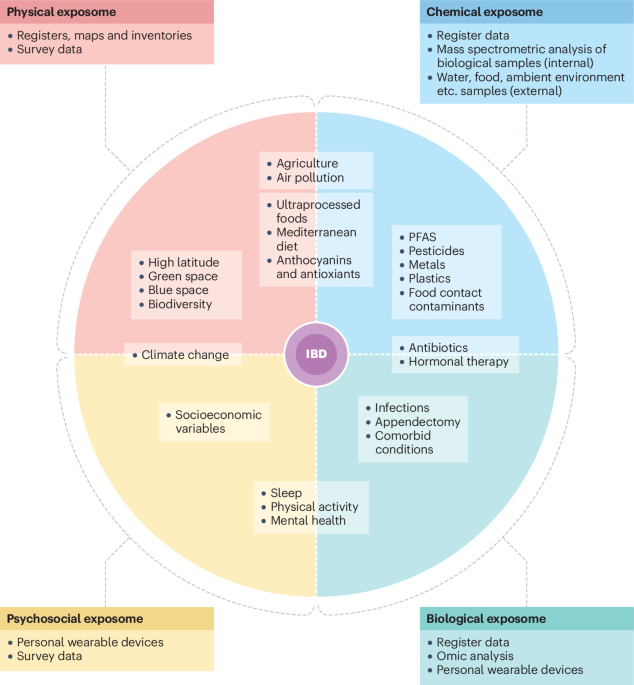
The exposome perspective emphasizes that many non-genetic, potentially modifiable environmental factors likely influence IBD risk. Understanding these factors could help guide prevention research and public-health...
The review highlights how microbial metabolites, epigenetic regulation, and mitochondrial metabolism interact to shape inflammation and barrier function in IBD. Understanding these links could help identify new...
The study synthesizes many stool metagenomes to find consistent microbial species, functional pathways, and strain-level differences linked to IBD and to distinctions between Crohn’s disease and ulcerative...