The Egyptian Journal of Radiology and Nuclear Medicine
Cure8 research brief
Cure8 research brief
IUS with the IBUS‑SAS score may offer a reliable, noninvasive way to monitor Crohn’s disease activity that correlates with clinical scores and biomarkers and aligns well with CT/MRI for most findings.
This could reduce reliance on cross-sectional imaging for routine follow-up, with caveats for perianal disease and obesity.
Clinicians, radiologists, researchers, and adult patients interested in noninvasive monitoring of Crohn’s disease
The paper evaluated IUS as a noninvasive monitoring tool in Crohn’s disease and found high sensitivity and specificity for detecting active and moderate-to-severe disease using IBUS‑SAS cutoffs reported by the authors.
Agreement between IUS and cross-sectional imaging (CT/MRI) was substantial to almost perfect for most parameters, but perianal disease was frequently missed by IUS. This brief is grounded in the article abstract provided by the journal; Cure8 did not review the full paper beyond the supplied text.
Findings come from a small prospective cohort and are based on the supplied abstract. IUS is operator-dependent and less sensitive for perianal/deep pelvic disease; MRI remains superior there.
Review the original publication for the complete reporting, methods, and context.
This Cure8 brief is based on source text from the linked article. Cure8 is informational only and is not a substitute for professional medical advice, diagnosis, or treatment.
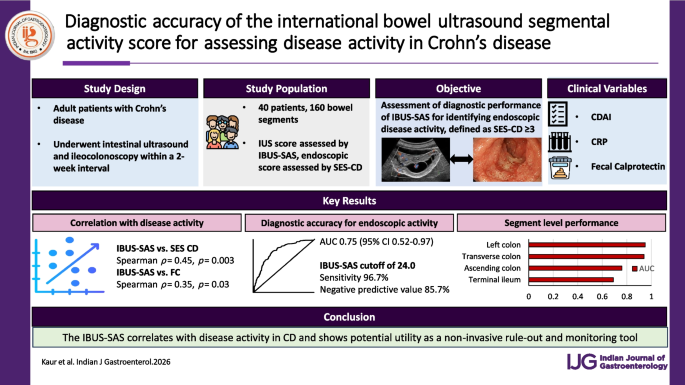
Standardized intestinal ultrasound scoring could help non-invasively monitor Crohn’s disease activity and reduce reliance on colonoscopy for some assessments. A high-sensitivity IUS score may be useful to rule out...
A multimodal, simpler activity score could improve practical disease monitoring when full ileocolonoscopy isn’t possible and help standardize treat-to-target practice across centers.
A non-invasive test (intestinal ultrasound) that predicts whether patients stay on biologic therapy could reduce the need for frequent endoscopy and help guide monitoring decisions.