International Journal of Molecular Sciences· via Crossref
Cure8 research brief
Chronic Ultrasound (‘Emotional’) Stress in Mice Exacerbates Colitis Through GSK3β-Mediated Neuroimmune Dysregulation and Is Ameliorated by Probiotic Intervention
The study suggests psychological (emotional) stress can worsen colitis-like inflammation via GSK3β-mediated neuroimmune changes, and that a probiotic (VSL#3) reduced many adverse effects in mice — relevant to understanding how stress and the microbiome might influence IBS-to-IBD progression.
Who Should Pay Attention
Researchers studying brain–gut interactions, immune mechanisms in IBD/IBS, and microbiome/probiotic interventions; clinicians interested in the biology of stress effects on gut inflammation; patients and caregivers interested in research on stress, probiotics, and gut inflammation (note: preclinical evidence).
Study Snapshot
Story typeResearch paper
Evidence typeResearch paper
Source depthJournal abstract
What To Know
The paper describes a preclinical model combining an ultrasound-based emotional stress paradigm with low‑dose DSS to produce IBD-like intestinal and behavioral changes in mice.
The authors measured gut inflammation, neutrophil infiltration, pro‑inflammatory cytokines, and increased Gsk3β expression in gut and brain regions (prefrontal cortex, hippocampus) and the vagus nerve. Mice given the probiotic VSL#3 showed attenuation of several physiological, inflammatory, and behavioral abnormalities in this model.
This is an animal (mouse) experimental study; findings show mechanistic links and point to GSK3β and microbiome/probiotic modulation as areas for further research, but do not directly translate into clinical recommendations for people with IBS or IBD.
Keep In Mind
This is a mouse model combining ultrasound-induced emotional stress with DSS colitis. Results are preclinical and mechanistic; they do not establish clinical efficacy or safety of probiotics or GSK3β-targeting interventions in people. The structured note is based on the article abstract (structured content depth: abstract).
Source Details
Review the original publication for the complete reporting, methods, and context.
Funding disclosed by the source: Ministry of Higher Education and Science of the Republic of Kazakhstan, award AP23485236; Ministry of Higher Education and Science of the Republic of Kazakhstan, award BR24992841; Ministry of Science and Higher Education of RF, award FGFU-2025-0004; Ministry of Science and Higher Education of RF, award FZWG-2021-0016; European Union’s Horizon 2020 research and innovation program, award H2020-MSCA-RISE-2020
This Cure8 brief is based on source text from the linked article. Cure8 is informational only and is not a substitute for professional medical advice, diagnosis, or treatment.
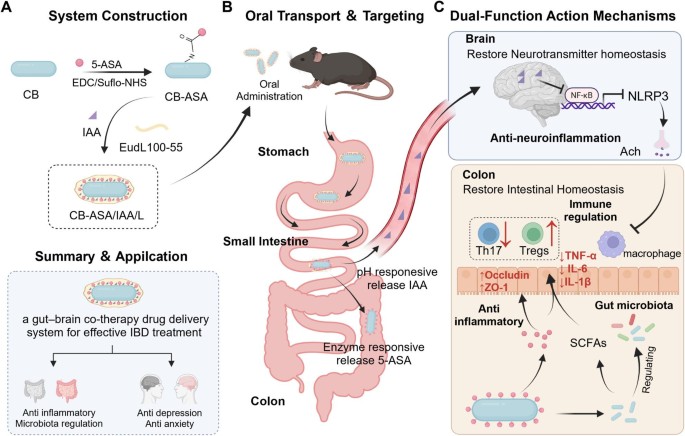
The study presents a novel probiotic-based delivery system that targets both intestinal inflammation and anxiety/depression through the gut–brain axis, a potentially relevant concept for people with IBD who commonly...
IBD is increasingly linked with anxiety, depression, and cognitive symptoms; this study suggests gut microbes may change tryptophan metabolism in colitis and contribute to those brain-related symptoms, which could point...
IBD patients often have depression and anxiety that current anti-TNF biologics do not adequately treat. An engineered probiotic that both neutralizes local TNFα and promotes GABA-producing microbes could address...