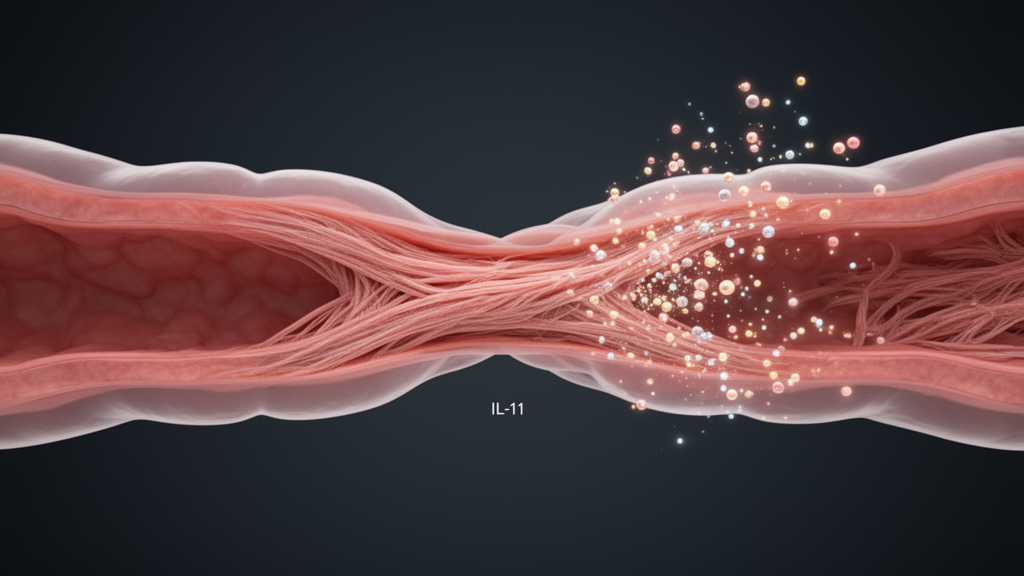
Fibrostenotic strictures are a major unmet need in Crohn’s disease because anti-inflammatory drugs often cannot reverse established scarring; IL-11 is a biologically plausible target that might selectively affect fibroblasts and reduce fibrosis without broad immunosuppression.
Who Should Pay Attention
Adult patients with Crohn’s disease (especially those with stricturing or anti-TNF nonresponse), clinicians who manage fibrostenotic disease, and researchers working on fibrosis, cytokine signaling, or single-cell profiling.
Study Snapshot
Story typeResearch news
Evidence typeClinical study
Source depthFull source text
What To Know
The authors frame a selective-inhibition hypothesis: blocking IL-11 or its alpha receptor might be more selective than inhibiting shared downstream pathways (gp130, JAK/STAT) and therefore could target fibrosis with fewer off-target effects.
The historical clinical trials tested recombinant human IL-11 as an agonist in the 1990s–2000s and did not select patients with imaging-defined strictures; those trials do not validate IL-11 inhibition for fibrostenosis.
Mouse genetics and gain- and loss-of-function experiments show context-dependent effects — IL-11 can protect epithelium during acute injury but also promote fibrosis depending on the cell type and timing.
Human tissue and single-cell data link IL-11 expression to fibroblast populations in strictured bowel and to patients with penetrating/stricturing disease or anti-TNF nonresponse, but these are associations that do not prove that blocking IL-11 will soften established strictures.
Keep In Mind
The article is a narrative review synthesizing animal studies, human tissue profiling, and older clinical trials; it does not present new clinical-trial results showing that IL-11 blockade reverses strictures.
Prior trials tested IL-11 as an agonist and did not enroll patients selected for fibrostenosis, so evidence specific to anti-IL-11 therapy for strictures is still preliminary.
Source Details
Review the original publication for the complete reporting, methods, and context.
Clinical studyArticle type assigned from Cure8 classification; confirm details in the original source.
Publicationbioengineer.org
Indexed viaGoogle News
Source typeWeb article
PublishedOct 17, 2026, 6:41 PM
Content availableFull source text
This Cure8 brief is based on source text from the linked article. Cure8 is informational only and is not a substitute for professional medical advice, diagnosis, or treatment.
FAP appears linked to both inflammation and fibrosis in IBD; distinguishing cellular versus extracellular FAP might help develop or validate fibrosis biomarkers that detect fibrostenotic disease.
A quantitative, biopsy-based measure of collagen architecture could help study intestinal fibrosis, which underlies stricture formation in Crohn’s disease. Feasibility data support further validation work that may lead...
The work links climate and sociodemographic context to IBD burden in tropical regions, which can influence diagnostic recognition, resource needs, and research priorities for communities where IBD is rising.