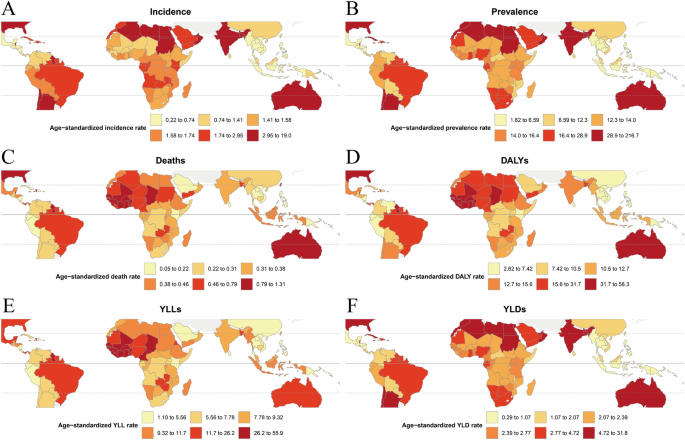
The work links climate and sociodemographic context to IBD burden in tropical regions, which can influence diagnostic recognition, resource needs, and research priorities for communities where IBD is rising.
Who Should Pay Attention
Researchers studying environmental and social determinants of IBD, clinicians and health planners in tropical and low- and middle-income countries, and patients and advocacy groups interested in global IBD trends and access to diagnosis and care.
Study Snapshot
Story typeResearch paper
Evidence typeResearch paper
Source depthMetadata only
What To Know
The authors used Global Burden of Disease (GBD) data from 1990–2023 combined with Koppen–Geiger climate classification and the Sociodemographic Index (SDI) to analyze trends, drivers, and forecasts of IBD (Crohn’s disease and ulcerative colitis) within countries lying between the Tropics of Cancer and Capricorn.
They describe how climate heterogeneity within the tropics (humid rainforests, monsoon regions, savannas, arid zones, highlands) and differences in SDI relate to variation in incidence, prevalence, DALYs, and likely diagnostic visibility.
The paper highlights interactions among genetics, microbiome, epithelial barrier function, immune responses, and environmental modifiers such as diet, antibiotics, infections, air pollution, sunlight, and temperature.
Methods and scope: This is an ecological, GBD-based analysis using established burden estimates, climate classification, SDI benchmarking, time-series forecasting, decomposition methods, and frontier analysis. It assesses population-level patterns and trajectories rather than individual-level causal effects.
Keep In Mind
This study analyzes population-level GBD estimates combined with climate and SDI metrics. Its findings describe associations and projected burden across regions; they do not prove individual-level causation.
Forecasts and burden estimates depend on GBD methods and the quality of underlying data, which vary between countries—diagnostic capacity and disease visibility may influence reported trends.
Source Details
Review the original publication for the complete reporting, methods, and context.
Funding disclosed by the source: Longyan City Science and Technology Plan Project, award 2022LYF17035
This Cure8 brief is based on source text from the linked article. Cure8 is informational only and is not a substitute for professional medical advice, diagnosis, or treatment.
Researchers are exploring whether gut microbes differ in patients who develop fibrous strictures — a common, surgery-prone complication of Crohn’s disease — because that could help predict risk or point to new prevention...
If correct, the paper points to a previously underappreciated immune cell (GzmK+ tissue-resident CD8+ T cells) as a potential driver of Crohn’s inflammation — which could lead to new biomarkers or therapies that work...
Fibrosis and stricturing are key problems in Crohn’s disease with limited therapies; this study identifies a microbiota–bile acid–GPBAR1 pathway by which a specific probiotic mix reduced inflammation and fibrosis in...