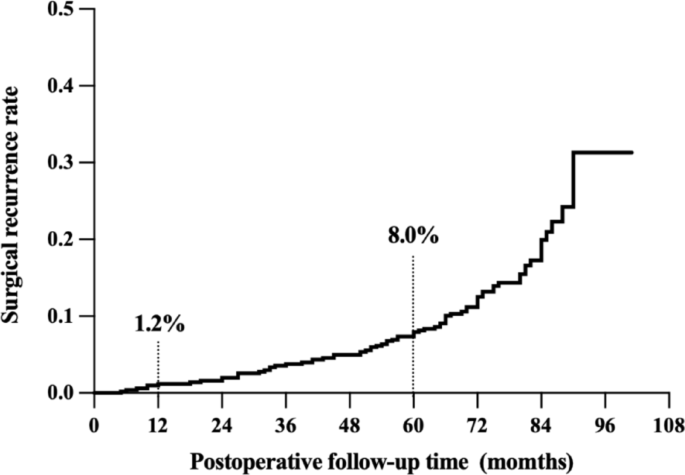
Long-term risk of needing another intestinal surgery is a major concern for people with Crohn’s disease. This study suggests laparoscopic resection may be linked to lower long-term reoperation risk compared with open surgery, and identifies smoking and positive microscopic margins as additional risk factors.
Who Should Pay Attention
Adults with Crohn's disease who are facing or recovering from intestinal resection, surgeons and gastroenterologists managing surgical decisions, and researchers studying surgical outcomes in IBD.
Study Snapshot
Story typeResearch paper
Evidence typeResearch paper
Source depthJournal abstract
What To Know
This study analyzed elective intestinal resections for Crohn’s disease performed from 1995–2020 and compared long-term reoperation rates by surgical approach. Laparoscopic surgery was associated with longer reoperation-free survival and a lower hazard of surgical recurrence in multivariable analysis.
Perioperative complication rates were lower after laparoscopy (3.3% vs 9.7% for open) but complications did not appear to predict later recurrence in this cohort. The authors highlight surgical approach, smoking cessation, and achieving microscopically clear margins as potentially modifiable factors to optimize long-term outcomes.
Study design note: this is a retrospective, single-center observational study rather than a randomized trial; associations do not prove causation.
Keep In Mind
As a retrospective single-center study, results may be influenced by selection bias, changing surgical techniques over the long study period (1995–2020), and unmeasured confounders. The finding is association-based and should not be interpreted as definitive proof that laparoscopy prevents recurrence; randomized trials or multi-center corroboration would strengthen confidence.
Source Details
Review the original publication for the complete reporting, methods, and context.
This Cure8 brief is based on source text from the linked article. Cure8 is informational only and is not a substitute for professional medical advice, diagnosis, or treatment.
The study highlights factors linked to needing another operation after ileocecal resection for Crohn’s disease and suggests postoperative biologic therapy may lower long-term reoperation risk. That directly affects...
Low muscle mass before ileocolic resection appears linked to higher short-term surgical complications and higher rates of endoscopic recurrence — information that could affect preoperative assessment and planning for...