The study suggests a natural compound (physcion) can protect against colitis in mice by targeting immune signaling and programmed cell death pathways, a potential lead for new therapies or biomarkers for ulcerative colitis.
Who Should Pay Attention
Researchers studying IBD mechanisms or drug discovery, clinicians interested in emerging preclinical mechanisms, and patients curious about basic-science progress (not clinical treatments).
Study Snapshot
Story typeResearch paper
Evidence typeResearch paper
Source depthJournal abstract
What To Know
The study used a standard chemical colitis model (DSS) in mice and intestinal epithelial cells in vitro to test physcion (PHY) and compared it with 5-ASA. Outcomes included disease severity, colon length, histology, barrier protein expression, measures of oxidative stress and inflammation, and markers of programmed cell death (PANoptosis).
PHY increased SIRT3 expression and reduced activation of the cGAS–STING pathway; knocking down SIRT3 removed PHY's protective effects, and co-immunoprecipitation supported an interaction between SIRT3 and cGAS. The work is preclinical (animal and cell experiments) and does not demonstrate safety or efficacy in humans with ulcerative colitis.
This identifies a possible mechanism (SIRT3 upregulation → cGAS–STING inhibition) that could guide future drug-discovery or biomarker research but is not clinical evidence that PHY is an effective treatment for patients.
Bottom line: Interesting mechanistic preclinical study suggesting physcion affects immune signaling and programmed cell death in UC models, but findings need replication and clinical testing before patient relevance is established.
Keep In Mind
This is an abstract/experimental study in mice and cultured cells (Journal of Ethnopharmacology). Preclinical findings do not establish safety or efficacy in humans; further work including dosing, toxicology, and clinical trials would be required.
Source Details
Review the original publication for the complete reporting, methods, and context.
Conflict statement: Declaration of competing interest The authors declare that they have no known competing financial interests or personal relationships that could have appeared to influence the work reported in this paper.
This Cure8 brief is based on source text from the linked article. Cure8 is informational only and is not a substitute for professional medical advice, diagnosis, or treatment.
This study highlights a potential microbiome–bile acid–immune pathway that could be relevant to ulcerative colitis and suggests a traditional herbal formula may influence that pathway in mice. Patients interested in...
The study suggests a novel plant-derived nanoparticle approach reduced inflammation and repaired barrier function in a mouse model of colitis and changed the gut microbiome — a potential early-stage route for new IBD...
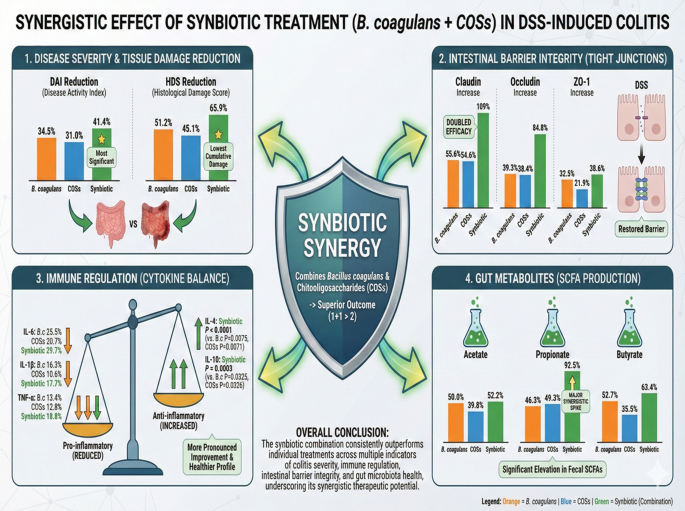
People with ulcerative colitis may be interested because synbiotic approaches aim to change the gut microbiome and intestinal barrier and therefore could become a future therapeutic option or adjunct. The paper...