Researchers increasingly implicate innate lymphoid cells in IBD inflammation and mucosal barrier breakdown — findings that could guide future diagnostics or therapies. For patients, this helps explain research directions that may eventually lead to new treatment targets.
Who Should Pay Attention
Researchers studying immune mechanisms in IBD, clinicians interested in emerging immunologic targets, and patients following research on future diagnostic or therapeutic approaches for Crohn’s disease and ulcerative colitis.
Study Snapshot
Story typeResearch paper
Evidence typeResearch paper
Source depthJournal abstract
What To Know
This is a systematic review (abstract-level) summarising human clinical evidence on innate lymphoid cells (ILCs) across autoimmune, allergic and infectious diseases through December 2025. Key IBD-relevant finding reported: a shift from IL-22+ ILC3s to IFN-γ+ ILC1s in IBD that may harm mucosal barrier integrity.
The review pooled 135 included human studies and highlights heterogeneous results across diseases but consistent patterns linking ILC plasticity to IBD pathogenesis. It frames ILCs as potential diagnostic or therapeutic targets while noting the need for consensus and more uniform study designs.
This brief is grounded in the source-provided abstract and does not represent Cure8 review of full papers cited by the review.
Keep In Mind
Structured-content depth: abstract. The article is a systematic review of human studies up to December 2025 and reports heterogeneous evidence; it synthesises many different study types and calls for more standardized research. The abstract-level summary cannot substitute for reading individual studies referenced in the review.
Source Details
Review the original publication for the complete reporting, methods, and context.
This Cure8 brief is based on source text from the linked article. Cure8 is informational only and is not a substitute for professional medical advice, diagnosis, or treatment.
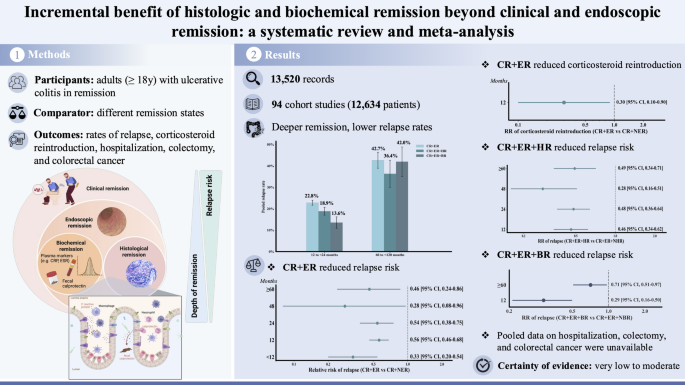
Achieving histologic or biochemical remission in addition to clinical and endoscopic remission was associated with substantially lower relapse risk in ulcerative colitis across multiple follow-up intervals, suggesting...
The study points to a specific immune cell type (pro-inflammatory CD4+ macrophages) and altered cellular interactions in rectal tissue that are linked to perianal fistulizing Crohn's disease, which may help explain...
The findings point to an immune-cell change that may happen before Crohn’s symptoms appear, which could help predict relapse or guide future therapies. That could eventually affect monitoring or new treatment strategies...