bioRxiv
Cure8 research brief
Cure8 research brief
This study identifies a fibroblast state tied to inflammation in both Crohn’s disease and ulcerative colitis and shows that restoring TCF21 in cells can reduce inflammatory signals, pointing to a new stromal-focused therapeutic concept.
Researchers in IBD and stromal biology; translational scientists developing RNA/LNP therapies; clinicians interested in emerging therapeutic targets.
This preprint reports a single-cell RNA-sequencing analysis identifying a conserved inflammation-associated fibroblast (IAF) population expanded in both Crohn’s disease and ulcerative colitis and a reduced TCF21/ADAMDEC1-expressing homeostatic fibroblast population in inflamed tissue.
The authors validated TCF21 depletion by multiplex immunofluorescence of human gastrointestinal tissues and used cytokine stimulation of human colonic fibroblasts to reproduce an IAF-like state in vitro.
They tested restoring TCF21 by delivering TCF21 mRNA in lipid nanoparticles to fibroblasts and observed partial suppression of inflammatory mediators (for example, reduced IL1B and IL6 expression) in these experimental systems.
Preprint on bioRxiv—results have not completed peer review. Findings are based on single-cell RNA-seq integration, tissue staining, and in vitro models; clinical relevance will need in vivo and clinical validation.
Review the original publication for the complete reporting, methods, and context.
This Cure8 brief is based on source text from the linked article. Cure8 is informational only and is not a substitute for professional medical advice, diagnosis, or treatment.
Researchers identified COPZ1 as a shared ferroptosis-related hub gene in Crohn’s disease, ulcerative colitis, and periodontitis, which could point to a new molecular pathway linking gut and oral inflammation and a...
The paper points to S100A8 as a potential link between immune-cell-driven inflammation and mitochondrial stress in Crohn’s disease, which could help researchers explore new biomarkers or targets for study.
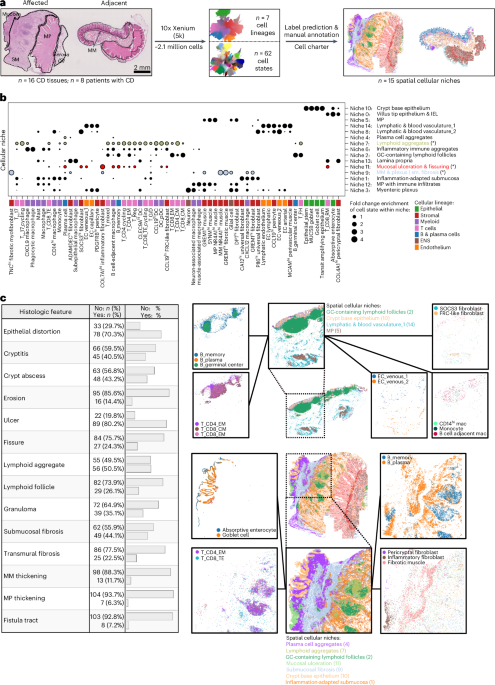
The paper maps distinct stromal cell states tied to inflamed versus fibrotic tissue niches in Crohn’s disease and shows that these states have different chromatin configurations and drug-modifiable properties — pointing...