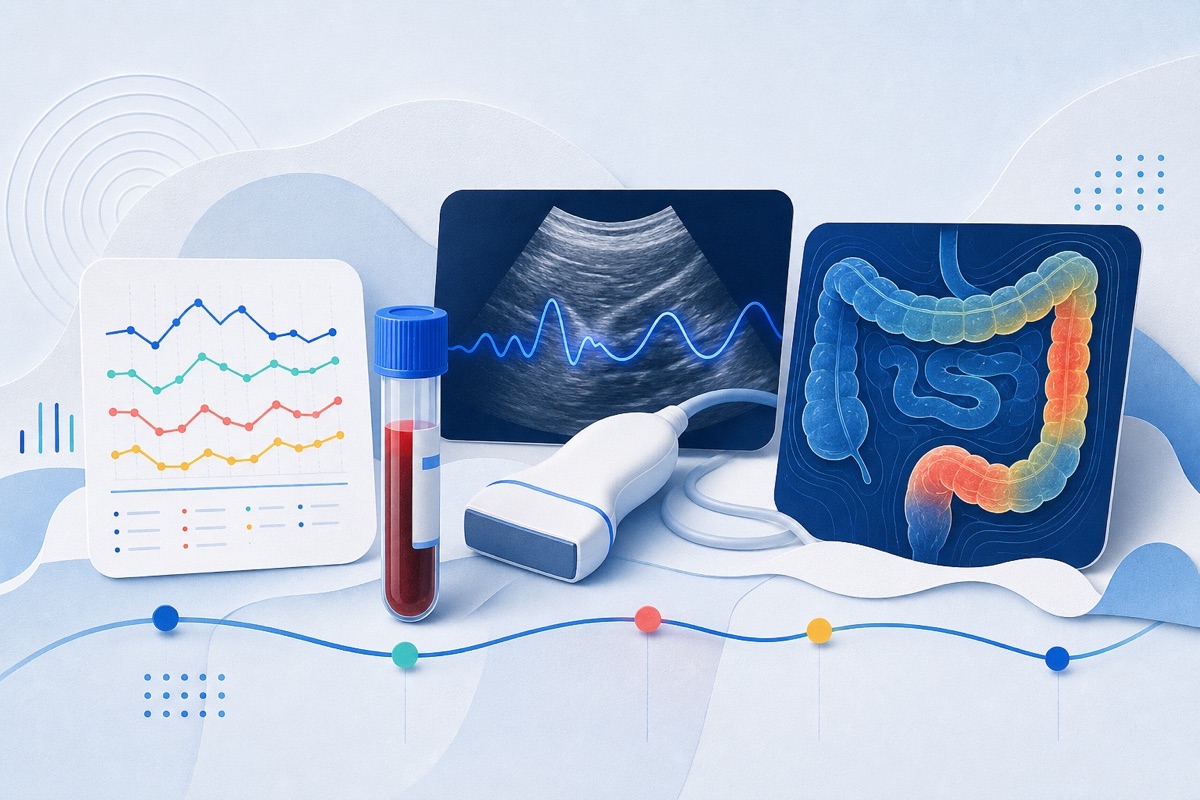
Children with autoimmune gastrointestinal diseases can have impaired bone health.
This study examines whether trabecular bone score (TBS) adds useful information beyond standard DXA in assessing bone quality and fracture risk — information that could affect monitoring strategies for pediatric IBD, celiac disease, or related conditions.
Who Should Pay Attention
Pediatric patients with Crohn’s disease, ulcerative colitis, or celiac disease; parents and caregivers of affected children; pediatric gastroenterologists, endocrinologists, and clinicians who manage growth and bone health; researchers studying pediatric bone outcomes in autoimmune GI disease.
Study Snapshot
Story typeResearch paper
Evidence typeResearch paper
Source depthJournal abstract
What To Know
This study compared trabecular bone score (TBS), lumbar spine and total-body DXA measures in 152 children (ages 5–18) including those with autoimmune gastrointestinal diseases (Crohn’s disease, ulcerative colitis, celiac disease), children with prior fractures, and healthy controls.
Low bone mass by DXA was observed in a subgroup, while TBS Z-scores ≤ −2 were uncommon and did not differ between groups in unadjusted analyses. Fracture history was independently associated with lower absolute TBS in multivariable analysis, but no independent predictors of TBS Z-score were found.
The authors conclude that the role of TBS for pediatric bone assessment in autoimmune GI disease is not established and recommend larger prospective studies. How this matters TBS is an imaging-derived metric intended to add information about bone microarchitecture beyond standard DXA BMD.
In this cross-sectional pediatric cohort, TBS did not clearly distinguish children with autoimmune GI diseases from controls, though it correlated with some DXA measures and related to fracture history in adjusted models. That suggests TBS might have limited additional utility over conventional DXA in this population, but evidence is not definitive.
Practical points TBS is calculated from lumbar-spine DXA images rather than being a separate test; interpretation in children requires adjustment for sex and pubertal stage. This study adjusted TBS for age/puberty and aBMD for height-for-age Z-score, which are important technical considerations when assessing bone health in growing children.
Next steps Larger, prospective studies are needed to test whether TBS adds clinically meaningful fracture-risk prediction beyond height- and age-adjusted DXA in pediatric autoimmune GI disease populations.
Keep In Mind
Structured-content depth: abstract. The supplied text is the article abstract; conclusions are based on cross-sectional data. The study is not a randomized trial and cannot establish predictive value for future fractures. Larger prospective cohorts are needed to clarify clinical utility of TBS in children.
Source Details
Review the original publication for the complete reporting, methods, and context.
This Cure8 brief is based on source text from the linked article. Cure8 is informational only and is not a substitute for professional medical advice, diagnosis, or treatment.
Kidney dysfunction can occur in people with IBD and may be under-recognized. A validated prediction model could help clinicians identify IBD patients at higher risk and prompt earlier monitoring or interventions.
People with celiac disease may have higher risks for several digestive cancers and for inflammatory bowel diseases (Crohn’s and UC) according to this large French cohort study. Knowing these associations can help...
Non-invasive biomarkers that reflect mucosal inflammation and systemic disease activity could help reduce reliance on frequent endoscopy and guide monitoring for people with Crohn’s disease or ulcerative colitis.