
bioengineer.org
Cure8 news brief
Cure8 news brief
Adherence to mesalazine matters because low adherence was common and linked with more treatment escalation (mostly systemic steroids) and hospitalizations — factors that can affect disease control and cost burden for people with ulcerative colitis.
The paper also provides updated prevalence and incidence estimates for UC and Crohn’s disease in Italy, which may be relevant for health planning and patients curious about disease frequency.
Adults with ulcerative colitis, caregivers, clinicians managing mild-to-moderate UC, health services researchers, and policymakers interested in real-world treatment patterns and healthcare costs.
This is a retrospective observational analysis of administrative health databases from six Italian Local Health Units (2010–May 2023) reported in Drugs – Real World Outcomes.
It estimates national prevalence and incidence for ulcerative colitis and Crohn’s disease, describes treatment patterns among mesalazine new users, measures adherence (proportion of days covered, ≥80% threshold), reports dose changes after induction, and documents common treatment escalations — notably systemic corticosteroids — among patients with low adherence.
Key points: the study focuses on real-world mesalazine use in Italy, finds suboptimal adherence particularly with pH-dependent formulations, a drop in average daily dose after the induction period, and frequent add-on or switching to systemic corticosteroids in nonadherent patients.
Hospitalizations are highlighted as major drivers of costs (reported in the title and supported by hospitalization data in the cohort).
Adherence was measured using dispensing records (proportion of days covered), which do not prove actual pill-taking and use an 80% cutoff common in database research but not specifically validated for mesalazine. The study is descriptive and not designed to compare formulations; observed differences may reflect patient selection or dosing practices rather than causal effects.
The source is a published observational analysis using administrative data.
Review the original publication for the complete reporting, methods, and context.
This Cure8 brief is based on source text from the linked article. Cure8 is informational only and is not a substitute for professional medical advice, diagnosis, or treatment.
A sizable minority of people newly diagnosed with IBD—about 1 in 5 with Crohn’s and 1 in 10 with ulcerative colitis—received no IBD-specific drugs within the first year. Understanding who is untreated and why could...
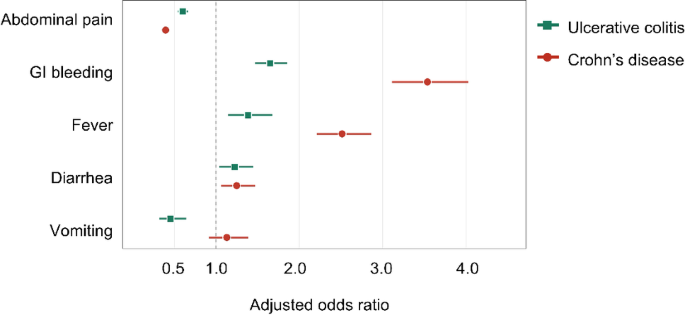
The study suggests ED presentation symptoms predict admission differently in UC versus CD, which could affect triage and short-term risk assessment for IBD patients. Knowing which symptoms are stronger predictors by...
Micronutrient deficiencies are common in IBD and can worsen anemia, healing, and neurologic function. This study shows inpatient testing focuses on B12 while missing other commonly deficient nutrients (B1, B6, zinc),...