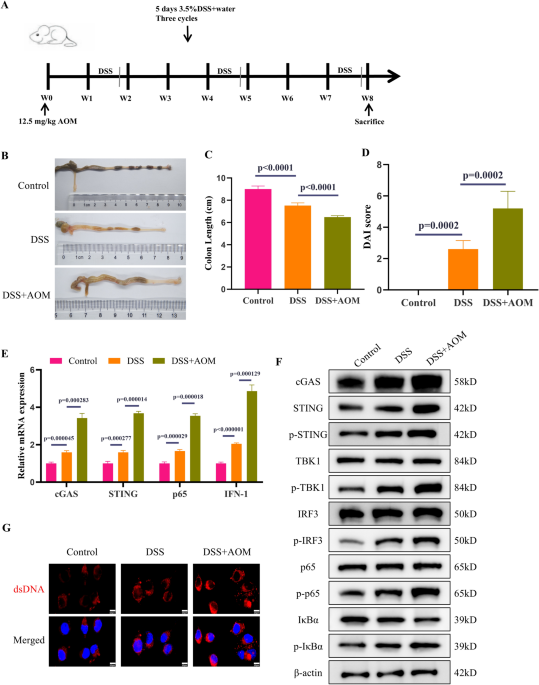
The study links cGAS–STING activation to NF-κB–driven inflammation and tumor formation in models of UC progressing to colitis-associated colorectal cancer, highlighting a pathway that could be relevant to understanding CAC risk.
Who Should Pay Attention
Researchers studying IBD-associated cancer mechanisms, clinicians interested in translational IBD research, and patients curious about biological research on how chronic UC can lead to colorectal cancer.
Study Snapshot
Story typeResearch paper
Evidence typeResearch paper
Source depthJournal abstract
What To Know
The authors measured cGAS–STING and NF-κB pathway activity in colon tissues, mouse models (DSS and AOM/DSS), and colon organoids. They tested a STING agonist (SR-717) and inhibitor (H-151), cGAS knockdown, and an NF-κB inhibitor (Bay11-7082).
Activating STING increased inflammation, p65 nuclear translocation, tissue injury, and tumor formation in the mouse CAC model; inhibiting cGAS/STING or NF-κB reduced those effects. The findings come from preclinical experiments (cell/organoid and mouse models) reported in a journal abstract; they do not demonstrate safety or efficacy in humans.
This study helps explain mechanisms and suggests potential molecular targets but does not change clinical care for patients at this time.
Keep In Mind
This is basic-science work using mouse models and organoids (abstract-level journal report). Results from animal and lab models do not directly translate to human benefit without further validation, safety testing, and clinical trials.
Source Details
Review the original publication for the complete reporting, methods, and context.
Research paperEvidence type derived from source or registry metadata.
PublicationDigestive diseases and sciences
AuthorsJian Wang, Anqing Luo, Yizhou Yao +2 more
InstitutionDepartment of General Surgery, Nanjing Drum Tower Hospital Group SuQian Hospital, No.138, South Huanghe Road, Sucheng District, Suqian City, 223800, Jiangsu Province, China.
Conflict statement: Declarations. Conflict of interest: The authors declare that they have no competing interests. Ethical approval: All animal experiments were performed in compliance with the ethical standards set by the Animal Ethics Committee of Zhejiang Luoxi Medical Technology Co., Ltd., Hangzhou, China, approval number LX4825030706.
This Cure8 brief is based on source text from the linked article. Cure8 is informational only and is not a substitute for professional medical advice, diagnosis, or treatment.
The study links activation of the cGAS–STING immune-sensing pathway to NF-κB–driven inflammation and tumor formation in UC models, which could help explain mechanisms behind colitis-associated colorectal cancer risk.
People with ulcerative colitis face a higher colorectal cancer risk driven in part by chronic inflammation; this review explains the molecular and immune mechanisms behind that risk and highlights biomarkers and...
The study will prospectively evaluate how often dysplasia occurs, how lesions look and behave after endoscopic resection, and what factors predict local or distant recurrence—information that could change surveillance...