Development of a Claims-Based Algorithm and Validation Through Medical Chart Review to Identify Patients with Crohn’s Disease-Related Fibrostenosis: A Retrospective Observational Study in the United States
A validated claims-based algorithm could enable larger, more efficient studies of fibrostenosis in Crohn’s disease using real-world data — helping researchers and clinicians better measure how often stricturing complications occur and their healthcare impact.
Who Should Pay Attention
Researchers using administrative claims or real-world data, clinicians interested in Crohn’s complications (fibrostenosis/strictures), health services researchers, and patients interested in outcomes research on stricturing disease.
Study Snapshot
Story typeResearch paper
Evidence typeResearch paper
Source depthMetadata only
What To Know
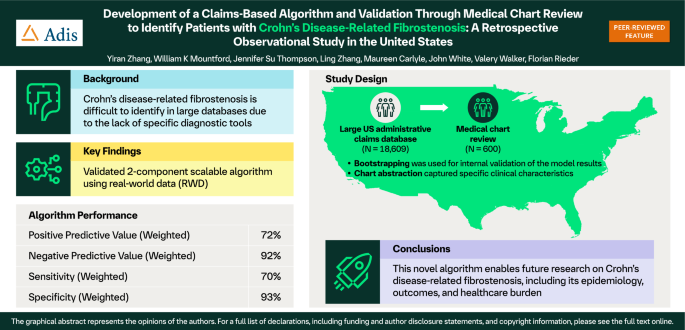
This paper reports development and chart-validated testing of a claims-based algorithm to identify Crohn’s disease–related fibrostenosis (fsCD) in a large US administrative database.
The algorithm combined a claims definition for CD-related intestinal obstruction and a regression-derived probability score, then was validated against medical-chart abstraction in a 600-patient sample.
The authors report that applied to the full algorithm-development cohort (n = 18,609) the method produced weighted positive predictive value ~72%, negative predictive value ~92%, sensitivity ~70%, and specificity ~93%.
The study is presented as a tool intended to enable scalable, real-world research on the epidemiology, outcomes, and healthcare burden of fsCD. The article is open-access and includes a plain-language summary and graphical abstract; Cure8 did not re-analyze the underlying data and is summarizing the authors’ reported methods and validation results.
Keep In Mind
This is an observational methods-validation study using US administrative claims and medical-chart review for validation. The reported performance metrics are those the authors calculated for their algorithm and reflect its performance in their datasets and validation sample; results may vary in other populations or coding systems.
Source Details
Review the original publication for the complete reporting, methods, and context.
Funding disclosed by the source: Boehringer Ingelheim
This Cure8 brief is based on source text from the linked article. Cure8 is informational only and is not a substitute for professional medical advice, diagnosis, or treatment.
People with Crohn's disease who develop symptomatic intestinal strictures currently often need endoscopic dilation or surgery. This trial tests an investigational oral drug (ontunisertib) aiming to improve...
Capsule endoscopy can be helpful for small-bowel assessment in Crohn’s disease but carries a risk of retention when strictures are present. Retained capsules may be asymptomatic yet still require surgery, so better...
Surgery remains an important treatment option for Crohn’s disease and may be considered earlier for some patients. Decisions about timing, technique, and perioperative care can affect long-term outcomes and recurrence...