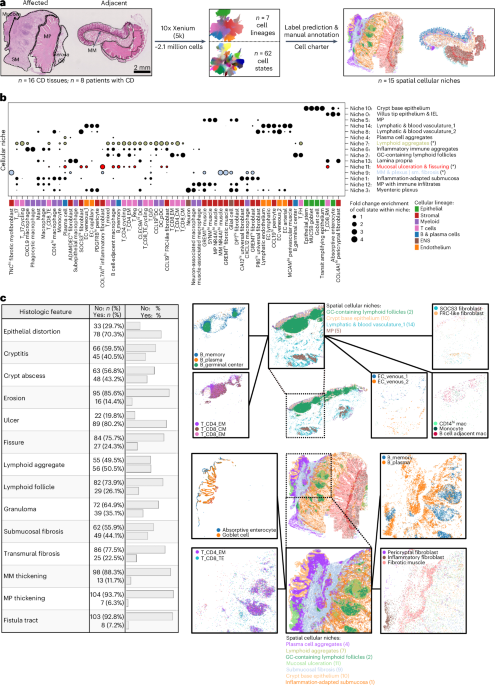
The study maps layer-specific gene programs in fibrostenotic Crohn's disease and pinpoints the submucosa as a hotspot for fibromuscular remodeling that underlies strictures and bowel obstruction risk.
Who Should Pay Attention
Researchers studying IBD pathogenesis, clinicians interested in mechanisms of Crohn's strictures, and translational teams developing biomarkers or anti-fibrotic therapies.
Study Snapshot
Story typeResearch paper
Evidence typePreprint
Study statusPreprint
Source depthJournal abstract
What To Know
The authors profiled mucosa, muscularis mucosae, submucosa, and muscularis propria from stenotic, non-stenotic inflamed, and non-inflamed ileum. The strongest differences distinguishing stenotic from non-stenotic tissue localized to the submucosa, with coordinated extracellular-matrix, contractile and cell‑matrix adhesion programs in stenotic areas.
Within stenotic submucosa they report molecularly distinct "fibrotic" and "muscularized" niches. The work is based on spatial transcriptomics (NanoString GeoMx) from a small sample set (4 patients) and is presented as a preprint; findings are exploratory and need replication and peer review.
This appears to be an abstract-level/full-text preprint rather than a completed peer-reviewed paper.
Keep In Mind
This is a medRxiv preprint (small sample size, n=4 patients) and has not completed peer review; results are exploratory and need replication before clinical translation.
Source Details
Review the original publication for the complete reporting, methods, and context.
This Cure8 brief is based on source text from the linked article. Cure8 is informational only and is not a substitute for professional medical advice, diagnosis, or treatment.
The paper maps distinct stromal cell states tied to inflamed versus fibrotic tissue niches in Crohn’s disease and shows that these states have different chromatin configurations and drug-modifiable properties — pointing...
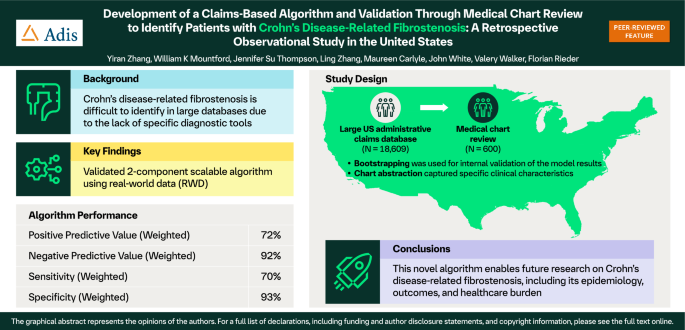
A validated claims-based algorithm could enable larger, more efficient studies of fibrostenosis in Crohn’s disease using real-world data — helping researchers and clinicians better measure how often stricturing...
The study maps cell types and signals linked to submucosal scarring in Crohn's disease, a complication without drug treatments that often requires surgery. Understanding these mechanisms could point to future therapeutic...