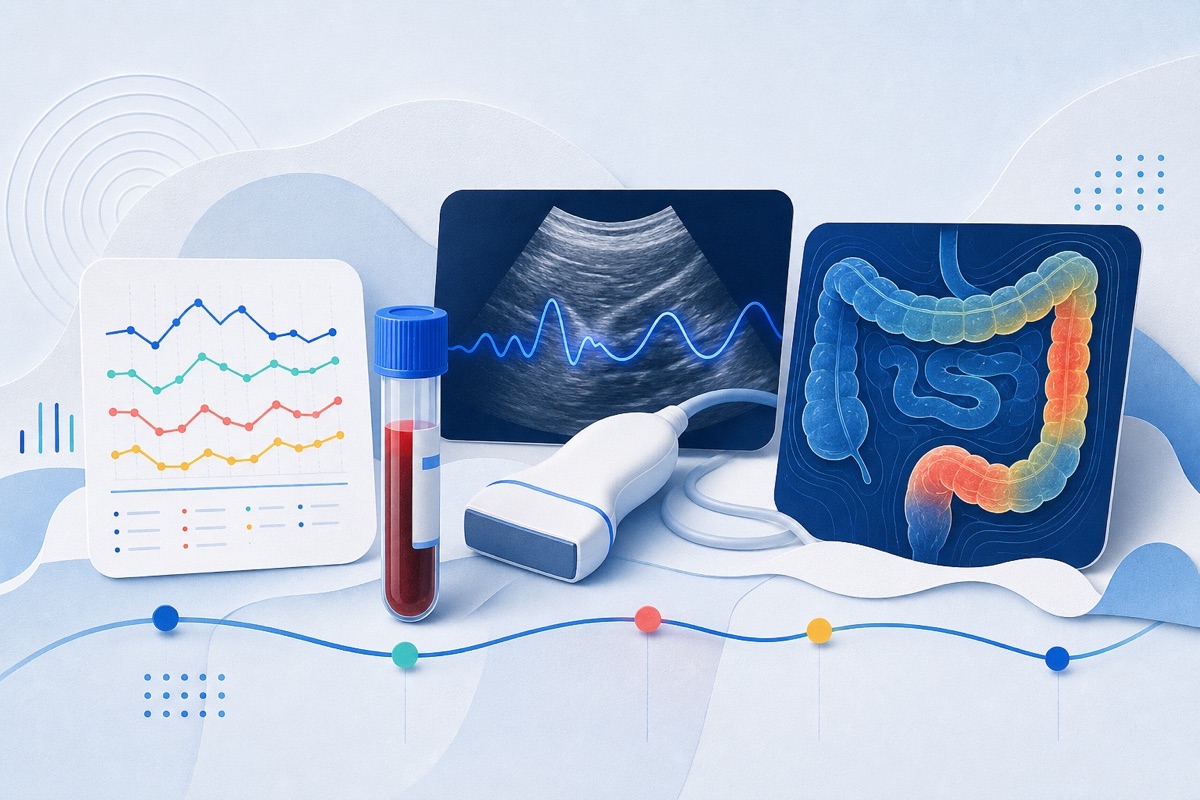
IUS offers a rapid, radiation-free way to detect active inflammation and common complications in IBD, which could improve initial ED assessment and reduce reliance on CT scans.
Who Should Pay Attention
Emergency and acute care clinicians, gastroenterologists, pediatric ED providers, and patients with IBD who frequently use ED services.
Study Snapshot
Story typeClinical Reference
Evidence typeResearch paper
Source depthJournal abstract
What To Know
The article summarizes evidence that IUS is sensitive and specific for active inflammation, with key sonographic signs including increased bowel wall thickness and hyperemia. It highlights IUS advantages for ED and pediatric settings: bedside speed, no radiation, and no required bowel prep.
The review notes IUS can be performed with cart-based and handheld devices and that appropriate clinician training is important for wider adoption.
Implementation and limits: The authors call for further studies to define best implementation strategies and to measure effects on clinical efficiency, radiation reduction, cost-effectiveness, and patient outcomes. This piece is an abstract-based review intended to familiarize emergency clinicians with IUS rather than a new primary trial report.
Keep In Mind
This classification and brief are drawn from the source abstract (review article) rather than a full primary research trial. The review emphasizes feasibility and promising diagnostic accuracy but notes that more outcome-focused studies are needed before IUS can be considered standard ED practice.
Source Details
Review the original publication for the complete reporting, methods, and context.
This Cure8 brief is based on source text from the linked article. Cure8 is informational only and is not a substitute for professional medical advice, diagnosis, or treatment.
Intestinal ultrasound is increasingly used to evaluate Crohn’s disease because it’s noninvasive, repeatable, and can detect activity and some complications—potentially reducing reliance on more invasive tests. Wider...
Knowing the type of Crohn’s disease helps explain where symptoms come from and what treatments or procedures might be considered. The article links specific symptoms and complications to each anatomical pattern of...
Point-of-care intestinal ultrasound (IUS) showed strong agreement with follow-up tests and often changed management the same day in a New Zealand IBD cohort. Patients and clinicians may be able to use IUS to monitor...