Research tools

Mri Enterography

MRI enterography articles covering small-bowel imaging, disease monitoring, strictures, complications, and IBD research. Research context emphasizes studies, trials, biomarkers, mechanisms, and emerging IBD science.

23 articles

Agomab Reports Positive Topline Data from STENOVA Open-Label Extension Study of Ontunisertib in Fibrostenosing Crohn's Disease

Patients with fibrostenosing Crohn’s disease have limited treatment options for the fibrotic strictures that can lead to procedures and surgery. These OLE findings suggest ontunisertib may be safe long-term and could...

Read Summary
Can simplified endoscopic score for Crohn’s disease be simpler? --Development and Validation of the Multimodal Activity Score for Crohn's Disease (MAS-CD)
Springer Science and Business Media LLC

Can simplified endoscopic score for Crohn’s disease be simpler? --Development and Validation of the Multimodal Activity Score for Crohn's Disease (MAS-CD)

A multimodal, simpler activity score could improve practical disease monitoring when full ileocolonoscopy isn’t possible and help standardize treat-to-target practice across centers.

Read Summary
Intestinal ultrasound versus magnetic resonance enterography for detecting small bowel Crohn's disease in children.
Journal of pediatric gastroenterology and nutrition

Intestinal ultrasound versus magnetic resonance enterography for detecting small bowel Crohn's disease in children.

Children with Crohn's and their clinicians often need noninvasive, accessible ways to monitor small-bowel disease. If validated elsewhere, IUS with the reported BWT thresholds could reduce reliance on MRE, which is...

Read Summary
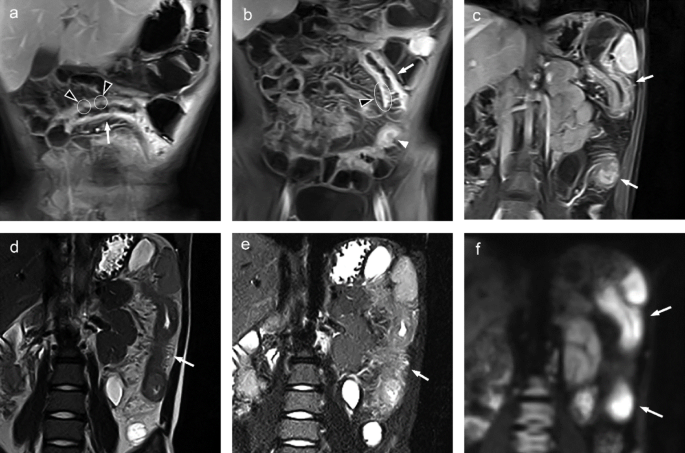
Clinical utility of magnetic resonance enterography for pediatric Crohn’s disease: a review with illustrative cases and a focus on Japan
Japanese Journal of Radiology

Clinical utility of magnetic resonance enterography for pediatric Crohn’s disease: a review with illustrative cases and a focus on Japan

MRE is a key radiation-free imaging tool for children with Crohn’s disease; this review summarizes its clinical utility and how it fits with other pediatric-focused diagnostic approaches in Japan.

Read Summary
Baseline Magnetic Resonance Enterography Stratifies Persistence Risk of Crohn's Disease Strictures.
Clinical gastroenterology and hepatology : the official clinical practice journal of the American Gastroenterological Association

Baseline Magnetic Resonance Enterography Stratifies Persistence Risk of Crohn's Disease Strictures.

Baseline MRE features may help predict which Crohn's strictures will not improve with advanced medical therapy, informing monitoring and surgical planning. Better stratification could guide decisions about earlier...

Read Summary
Not only bowel: opportunistic assessment of sarcopenia in pediatric ulcerative colitis patients undergoing magnetic resonance enterography.
Nutrition (Burbank, Los Angeles County, Calif.)

Not only bowel: opportunistic assessment of sarcopenia in pediatric ulcerative colitis patients undergoing magnetic resonance enterography.

Children with newly diagnosed ulcerative colitis in this study commonly had reduced muscle mass (sarcopenia) at diagnosis, and the degree of muscle loss correlated with higher disease activity and inflammation....

Read Summary
NOV-ERA - A Clinical Trial to Assess the Efficacy and Safety of Ontunisertib Compared to Placebo in Patients With Fibrostenosing Crohn's Disease
ClinicalTrials.gov

NOV-ERA - A Clinical Trial to Assess the Efficacy and Safety of Ontunisertib Compared to Placebo in Patients With Fibrostenosing Crohn's Disease

People with Crohn's disease who develop symptomatic intestinal strictures currently often need endoscopic dilation or surgery. This trial tests an investigational oral drug (ontunisertib) aiming to improve...

Read Summary
Multi-modal ensemble learning prediction of anti-TNF treatment response in pediatric patients with Crohn's disease using clinical, radiomic, and deep learning MR enterography features.
Inflammatory bowel diseases

Multi-modal ensemble learning prediction of anti-TNF treatment response in pediatric patients with Crohn's disease using clinical, radiomic, and deep learning MR enterography features.

Predicting who will respond to anti-TNF drugs could help avoid ineffective treatments, reduce delays to effective therapy, and personalize care for children with Crohn's disease.

Read Summary
Diagnostic accuracy of magnetic resonance enterography and intestinal ultrasound for treatment response assessment in Crohn's disease (MANTRA): protocol for a multicentre, non-randomised, multiple-arm, prospective cohort comparison study.
BMJ open

Diagnostic accuracy of magnetic resonance enterography and intestinal ultrasound for treatment response assessment in Crohn's disease (MANTRA): protocol for a multicentre, non-randomised, multiple-arm, prospective cohort comparison study.

This study could clarify which imaging test—MRE or IUS—is more accurate or appropriate for monitoring treatment response in Crohn's disease, potentially standardising follow-up and informing patient and clinician...

Read Summary
Relationship between sacroiliac joint involvement and intestinal disease activity in newly diagnosed Crohn's disease.
BMC gastroenterology

Relationship between sacroiliac joint involvement and intestinal disease activity in newly diagnosed Crohn's disease.

If you have newly diagnosed Crohn’s disease, this study suggests sacroiliac joint inflammation or structural SIJ changes can already be present and may relate to microscopic (histologic) intestinal activity.

Read Summary