
Evidence types

Basic Science

Basic science articles covering early-stage IBD research, disease mechanisms, lab findings, microbiome work, genetics, and experimental models.

Page 7 of 15 · 709 articles

“Targeted Delivery–Long-Acting Adhesion–Synergistic Treatment” Integrated Adhesive Bilayer Microgels Loaded with Costunolide for Ulcerative Colitis Therapy
ACS Applied Materials & Interfaces

“Targeted Delivery–Long-Acting Adhesion–Synergistic Treatment” Integrated Adhesive Bilayer Microgels Loaded with Costunolide for Ulcerative Colitis Therapy

This study describes a novel colon-targeted microgel delivery system carrying an anti-inflammatory natural compound that, in a mouse model, reduced colitis signs and altered gut bacteria — a potential new strategy for...

Read Summary
A spatial and temporal transcriptomic atlas of mouse intestinal regeneration in the jejunum
Nature Communications

A spatial and temporal transcriptomic atlas of mouse intestinal regeneration in the jejunum

This atlas maps when and where regenerative gene programs turn on in the intestine and highlights molecular features (like interferon responses and hypertranscription) that overlap with human Crohn’s disease, so it could...

Read Summary
Gut microbiota-derived propionate mediates the protective effects of green banana resistant starch on ulcerative colitis by inhibiting HDAC1 to promote HIF-1α acetylation.
Food research international (Ottawa, Ont.)

Gut microbiota-derived propionate mediates the protective effects of green banana resistant starch on ulcerative colitis by inhibiting HDAC1 to promote HIF-1α acetylation.

The study links a common dietary fiber (green banana resistant starch) to microbiota changes and production of propionate that protect the colonic barrier and reduce inflammation in a mouse model of ulcerative colitis.

Read Summary
Chemical Profiling of Fructus Ailanthi and a Network Pharmacology-Based Mechanistic Study in Ulcerative Colitis.
Current pharmaceutical design

Chemical Profiling of Fructus Ailanthi and a Network Pharmacology-Based Mechanistic Study in Ulcerative Colitis.

This study proposes specific plant compounds and molecular pathways that could be relevant to ulcerative colitis, which may guide future lab research and drug-discovery efforts. For people with UC, it points to...

Read Summary
Mechanism of Shao Kuiling Decoction in Treating Ulcerative Colitis: A Network Pharmacology and Molecular Docking Study.
Current computer-aided drug design

Mechanism of Shao Kuiling Decoction in Treating Ulcerative Colitis: A Network Pharmacology and Molecular Docking Study.

The study suggests molecular targets and pathways through which a traditional herbal formula might influence UC biology, offering testable hypotheses for future lab and clinical research.

Read Summary
Advancement in Inflammation-responsive Drug Delivery System for Chronic Inflammation.
Anti-inflammatory & anti-allergy agents in medicinal chemistry

Advancement in Inflammation-responsive Drug Delivery System for Chronic Inflammation.

Researchers are exploring ways to deliver drugs selectively to inflamed gut tissue in IBD to boost local effectiveness and reduce systemic side effects. Progress in smart nanoparticles and hydrogels could eventually...

Read Summary
Oxypalmatine alleviates ulcerative colitis through RAB8A-mediated inhibition of STAT1-driven pro-inflammatory macrophage polarization.
Phytomedicine : international journal of phytotherapy and phytopharmacology

Oxypalmatine alleviates ulcerative colitis through RAB8A-mediated inhibition of STAT1-driven pro-inflammatory macrophage polarization.

Researchers identified a plant-derived molecule (oxypalmatine) that reduced inflammation in a mouse colitis model by blocking pro-inflammatory macrophage activity through the RAB8A–STAT1 pathway. This suggests a...

Read Summary
Prunella vulgaris Polysaccharide Ameliorates DSS-Induced Ulcerative Colitis by Increasing the Abundance of Ligilactobacillus agilis to Inhibit Inflammation and Preserve Intestinal Barrier Integrity
Journal of Agricultural and Food Chemistry

Prunella vulgaris Polysaccharide Ameliorates DSS-Induced Ulcerative Colitis by Increasing the Abundance of Ligilactobacillus agilis to Inhibit Inflammation and Preserve Intestinal Barrier Integrity

A plant polysaccharide (PVP) reduced inflammation and preserved intestinal barrier proteins in a mouse model of ulcerative colitis, apparently by increasing a specific gut bacterium. This points to a microbiome-related...

Read Summary
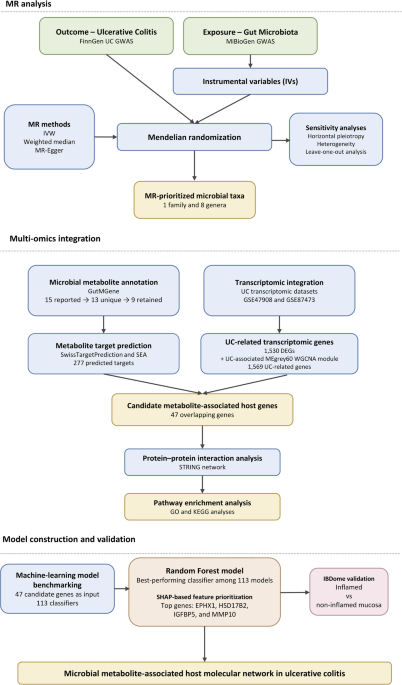
Integrative multi-omics analyses suggest a candidate microbial metabolite-associated host gene network in ulcerative colitis
Immunologic Research

Integrative multi-omics analyses suggest a candidate microbial metabolite-associated host gene network in ulcerative colitis

Researchers are working to link specific gut microbes and their metabolites to host molecular changes in ulcerative colitis. This study maps candidate microbe–metabolite–host gene connections that could point to new...

Read Summary
IBD-Derived Colonic Fibroblasts Exhibit an Osteopontin-Enriched Secretome, and Osteopontin Restrains Human Colonic Organoid Maturation
Europe PMC

IBD-Derived Colonic Fibroblasts Exhibit an Osteopontin-Enriched Secretome, and Osteopontin Restrains Human Colonic Organoid Maturation

The study identifies osteopontin as a stromal-secreted protein elevated in IBD-derived colonic fibroblasts and shows it can restrain epithelial maturation in human colonic organoids, a mechanistic insight that could be...

Read Summary
rfaG-dependent cell envelope biogenesis supports type 1 fimbrial expression and intestinal colonization in adherent-invasive Escherichia coli.
Microbiology (Reading, England)

rfaG-dependent cell envelope biogenesis supports type 1 fimbrial expression and intestinal colonization in adherent-invasive Escherichia coli.

The study highlights a bacterial gene that helps adherent-invasive E. coli (AIEC) colonize the gut — a mechanism that has been linked to Crohn's disease. Understanding how AIEC colonizes could guide future research into...

Read Summary
Stromal ARHGEF15 Correlates With Inflammatory EMT and Stromal-Immune Crosstalk During Inflammatory Bowel Disease-To-Colorectal Cancer Progression.
Bioinformatics and biology insights

Stromal ARHGEF15 Correlates With Inflammatory EMT and Stromal-Immune Crosstalk During Inflammatory Bowel Disease-To-Colorectal Cancer Progression.

People with IBD are at higher risk for colorectal cancer; identifying stromal genes that track inflammation-driven EMT could help researchers find biomarkers or targets that explain how chronic inflammation promotes...

Read Summary
Licochalcone B ameliorates DSS-induced ulcerative colitis in mice through inhibiting the PI3K/AKT signaling pathway and restoration of purine metabolism and intestinal barrier integrity
Springer Science and Business Media LLC

Licochalcone B ameliorates DSS-induced ulcerative colitis in mice through inhibiting the PI3K/AKT signaling pathway and restoration of purine metabolism and intestinal barrier integrity

Researchers identified licochalcone B as a compound that reduced inflammation and repaired gut barrier in a mouse colitis model by affecting PI3K/AKT signaling and purine metabolism. For people following IBD research,...

Read Summary
Parkinson's disease-associated LRRK2 G2019S enhances intestinal neutrophil extracellular trap formation through RAB10–myeloperoxidase signaling and promotes enteric α-synuclein accumulation
Springer Science and Business Media LLC

Parkinson's disease-associated LRRK2 G2019S enhances intestinal neutrophil extracellular trap formation through RAB10–myeloperoxidase signaling and promotes enteric α-synuclein accumulation

The work links a PD risk gene (LRRK2 G2019S) to increased intestinal NET formation and enteric α-synuclein in mouse colitis, suggesting a neutrophil-mediated inflammatory route by which gut inflammation and microbiota...

Read Summary
rfaG Escherichia coli -dependent cell envelope biogenesis supports type 1 fimbrial expression and intestinal colonization in adherent-invasive.
Microbiology (Reading, England)

rfaG Escherichia coli -dependent cell envelope biogenesis supports type 1 fimbrial expression and intestinal colonization in adherent-invasive.

AIEC bacteria have been linked to Crohn’s disease; this study identifies a bacterial gene (rfaG) that helps AIEC express adhesins and colonize the gut in experimental models, which could point to future research paths...

Read Summary
Bisphenol A aggravates colitis-associated intestinal epithelial injury: Mitochondrial dysfunction and CASP1-associated inflammatory signaling.
Ecotoxicology and environmental safety

Bisphenol A aggravates colitis-associated intestinal epithelial injury: Mitochondrial dysfunction and CASP1-associated inflammatory signaling.

The study links a common environmental chemical (BPA) to worse epithelial injury and inflammation in colitis models, highlighting a potential environmental contributor to IBD-relevant epithelial dysfunction and...

Read Summary
Exploring the impact of DEP on pediatric Crohn's disease using machine learning and molecular docking methods.
Frontiers in pediatrics

Exploring the impact of DEP on pediatric Crohn's disease using machine learning and molecular docking methods.

Researchers used machine learning and molecular docking plus small animal tests to link a common plasticizer (DEP) with molecular changes seen in pediatric Crohn’s disease. This could point to environmental exposures...

Read Summary
Commentary on "Polyethylene terephthalate microplastics exposure enhances the risk of ulcerative colitis: insights from multiomics integration, machine learning, and molecular docking reveal intestinal toxicity mechanisms".
International journal of surgery (London, England)

Commentary on "Polyethylene terephthalate microplastics exposure enhances the risk of ulcerative colitis: insights from multiomics integration, machine learning, and molecular docking reveal intestinal toxicity mechanisms".

Based on the title and source metadata, this appears to be a basic science related to Ulcerative colitis, Inflammatory bowel disease, and AI and data science. The original article is from International journal of surgery...

Read Summary
Nitrogen dioxide exposure promotes CD8+T cell infiltration and contributes to increased susceptibility to ulcerative colitis: An integrative multi‑omics, artificial intelligence, and mouse model study.
Journal of hazardous materials

Nitrogen dioxide exposure promotes CD8+T cell infiltration and contributes to increased susceptibility to ulcerative colitis: An integrative multi‑omics, artificial intelligence, and mouse model study.

The study suggests that air pollutant NO2 may promote a perforin-producing CD8+ T cell response linked to colonic inflammation in UC and highlights CDC25B as a potential mechanistic link—information that could guide...

Read Summary
Unraveling the pleiotropic roles of the mTOR-glycolytic axis in ulcerative colitis: from immunometabolic dysregulation to mucosal barrier remodeling
Frontiers in Immunology

Unraveling the pleiotropic roles of the mTOR-glycolytic axis in ulcerative colitis: from immunometabolic dysregulation to mucosal barrier remodeling

The review highlights metabolic pathways (mTOR–glycolysis) that drive inflammation and barrier dysfunction in ulcerative colitis, which could point to new kinds of targeted therapies beyond current immunosuppressive...

Read Summary
Formulation of Dipotassium Glycyrrhizinate loaded PVA polymeric nanoparticles Attenuate DSS-Induced Ulcerative Colitis via Modulation of Oxidative Stress, NF-κB/HMGB1 Signaling, and Mucosal Repair
Journal of Drug Delivery Science and Technology

Formulation of Dipotassium Glycyrrhizinate loaded PVA polymeric nanoparticles Attenuate DSS-Induced Ulcerative Colitis via Modulation of Oxidative Stress, NF-κB/HMGB1 Signaling, and Mucosal Repair

Based on the title and source metadata, this appears to be a basic science related to Ulcerative colitis, Inflammatory bowel disease, and Research and clinical trials. The original article is from Journal of Drug...

Read Summary
A genome catalog reveals the global landscape of the human gut archaeome and its relevance to inflammatory bowel disease
Europe PMC

A genome catalog reveals the global landscape of the human gut archaeome and its relevance to inflammatory bowel disease

The study expands the map of gut archaea and identifies archaeal species associated with IBD/UC, suggesting new microbial biomarkers and potential microbe–microbe interactions that might influence inflammation.

Read Summary
A Steroid-Sparing Combination Regimen of Low-Dose Atorvastatin and Reduced-Dose Prednisolone Maximizes Healing in Experimental Ulcerative Colitis
Springer Science and Business Media LLC

A Steroid-Sparing Combination Regimen of Low-Dose Atorvastatin and Reduced-Dose Prednisolone Maximizes Healing in Experimental Ulcerative Colitis

The study suggests a steroid‑sparing combination (low‑dose atorvastatin plus reduced prednisolone) may produce stronger anti‑inflammatory and antioxidant effects than either drug alone in an animal model of ulcerative...

Read Summary
Trichinella spiralis infection-induced ursodeoxycholic acid ameliorates colitis by regulating dendritic cells and macrophages via NLRP3 inflammasome signaling pathway
Springer Science and Business Media LLC

Trichinella spiralis infection-induced ursodeoxycholic acid ameliorates colitis by regulating dendritic cells and macrophages via NLRP3 inflammasome signaling pathway

This preclinical study suggests that a specific gut microbe (Bacteroides acidifaciens) and the bile acid UDCA can reduce inflammation in a mouse colitis model by improving barrier function and dampening NLRP3-driven...

Read Summary
Concerted changes in the pediatric single-cell intestinal ecosystem before and after anti-TNF blockade.
eLife

Concerted changes in the pediatric single-cell intestinal ecosystem before and after anti-TNF blockade.

Identifying baseline cellular states that predict disease course or response to anti‑TNF could help researchers develop predictive biomarkers and new therapeutic strategies for pediatric Crohn’s disease.

Read Summary
Phospholipid–Prednisolone Conjugates for Targeted IBD Therapy: Structural Design, Synthetic Approaches, Optimization, and Computational Evaluation
Molecules

Phospholipid–Prednisolone Conjugates for Targeted IBD Therapy: Structural Design, Synthetic Approaches, Optimization, and Computational Evaluation

The study outlines a strategy to target corticosteroids to inflamed intestinal tissue by exploiting PLA2 overexpression, which could reduce systemic steroid side effects if the approach translates to biological models...

Read Summary
Traditional Chinese Medicine-Derived Carbon Dots Nanozymes for Treating Inflammatory Bowel Disease : Current Challenges and Future Perspectives
European Cells and Materials

Traditional Chinese Medicine-Derived Carbon Dots Nanozymes for Treating Inflammatory Bowel Disease : Current Challenges and Future Perspectives

The review presents an emerging nanotechnology (TCM-derived carbon-dot nanozymes) that could offer new multitarget anti-inflammatory and antioxidant approaches for IBD, addressing limitations of current therapies and...

Read Summary
Uncovering the anti-inflammatory mechanism of Jiang-Huang-Qing-Yan-Yin (JHQYY) in inflammatory bowel disease through network pharmacology, molecular docking, and cellular verification
Food & medicine homology.

Uncovering the anti-inflammatory mechanism of Jiang-Huang-Qing-Yan-Yin (JHQYY) in inflammatory bowel disease through network pharmacology, molecular docking, and cellular verification

Researchers identified potential anti‑inflammatory mechanisms in a multi‑component herbal formula relevant to IBD pathways (NF‑κB, IL‑17) and showed in vitro reduction of pro‑inflammatory cytokines, which could guide...

Read Summary
Hylocerus polyrhizus ameliorates acetic acid-induced ulcerative colitis associated with modulation of TNF-α and oxidative stress markers
Pharmacological Research - Modern Chinese Medicine

Hylocerus polyrhizus ameliorates acetic acid-induced ulcerative colitis associated with modulation of TNF-α and oxidative stress markers

Based on the title and source metadata, this appears to be a basic science related to Ulcerative colitis, Inflammatory bowel disease, and Research and clinical trials. The original article is from Pharmacological...

Read Summary
Revealing dysregulation of intracellular HClO and H2S during ulcerative colitis with a sequentially activated fluorescent probe in dual near-infrared channels
Sensors and Actuators B: Chemical

Revealing dysregulation of intracellular HClO and H2S during ulcerative colitis with a sequentially activated fluorescent probe in dual near-infrared channels

Based on the title and source metadata, this appears to be a basic science related to Ulcerative colitis, Inflammatory bowel disease, and Research and clinical trials. The original article is from Sensors and Actuators...

Read Summary
Euphorbia humifusa Willd. alleviates ulcerative colitis by inhibiting lipid peroxidation via ACSL4/COX-2 axis
Journal of Ethnopharmacology

Euphorbia humifusa Willd. alleviates ulcerative colitis by inhibiting lipid peroxidation via ACSL4/COX-2 axis

Based on the title and source metadata, this appears to be a basic science related to Ulcerative colitis, Inflammatory bowel disease, and Research and clinical trials. The original article is from Journal of...

Read Summary
Pharmacokinetic characteristics of Bletilla Striata active components in rats and 1H NMR metabolomics study on ulcerative colitis
Fitoterapia

Pharmacokinetic characteristics of Bletilla Striata active components in rats and 1H NMR metabolomics study on ulcerative colitis

Based on the title and source metadata, this appears to be a basic science related to Ulcerative colitis, Inflammatory bowel disease, and Research and clinical trials. The original article is from Fitoterapia.

Read Summary
+ Colitis Ameliorates Murine Autoimmune Cholangitis Through Polarization of M2 Macrophages and Inhibition of CD8T-Cells.
In vivo (Athens, Greece)

+ Colitis Ameliorates Murine Autoimmune Cholangitis Through Polarization of M2 Macrophages and Inhibition of CD8T-Cells.

This mouse study suggests that acute colitis can alter liver immune responses—reducing CD8 T cells and shifting macrophages toward an anti-inflammatory M2 state—which may affect autoimmune cholangitis. That connection...

Read Summary
Orientin alleviates ulcerative colitis by regulating ferroptosis and glycolysis via the ROS/HIF-1α/GLUT1 signaling axis.
Journal of ethnopharmacology

Orientin alleviates ulcerative colitis by regulating ferroptosis and glycolysis via the ROS/HIF-1α/GLUT1 signaling axis.

People with UC may care because the study identifies a compound and a signaling pathway that lowered inflammation and tissue injury in a commonly used mouse model of colitis, suggesting potential future therapeutic...

Read Summary
Wumei Wan restores the colonic mucus barrier by modulating TGF-β/Smad signaling to promote goblet cell differentiation in ulcerative colitis
Journal of Ethnopharmacology

Wumei Wan restores the colonic mucus barrier by modulating TGF-β/Smad signaling to promote goblet cell differentiation in ulcerative colitis

Based on the title and source metadata, this appears to be a basic science related to Ulcerative colitis, Inflammatory bowel disease, and Research and clinical trials. The original article is from Journal of...

Read Summary
Swertiamarin promotes barrier function to alleviate ulcerative colitis by inducing autophagy via the PI3K/AKT/mTOR-signaling pathway
International Immunopharmacology

Swertiamarin promotes barrier function to alleviate ulcerative colitis by inducing autophagy via the PI3K/AKT/mTOR-signaling pathway

Based on the title and source metadata, this appears to be a basic science related to Ulcerative colitis, Inflammatory bowel disease, and Research and clinical trials. The original article is from International...

Read Summary
Potential hazard assessment of 6PPD-quinone in the context of ulcerative colitis: network toxicology, machine learning, transcriptomic analysis, and preliminary In vivo validation
Frontiers in Immunology

Potential hazard assessment of 6PPD-quinone in the context of ulcerative colitis: network toxicology, machine learning, transcriptomic analysis, and preliminary In vivo validation

The study suggests a common environmental pollutant could worsen intestinal inflammation in experimental colitis and identifies molecular pathways that might mediate that effect, which could be relevant to understanding...

Read Summary
Gut Microbiota and Metabolic Pathway Signatures for Inflammatory Bowel Disease Identified via Subject-Stratified Random Forest Based on the Longitudinal HMP2 Cohort
Genes

Gut Microbiota and Metabolic Pathway Signatures for Inflammatory Bowel Disease Identified via Subject-Stratified Random Forest Based on the Longitudinal HMP2 Cohort

The study provides a more rigorous, leakage-free machine-learning analysis of a major IBD microbiome cohort and proposes reproducible microbial and metabolic pathway candidates that could eventually help IBD diagnosis or...

Read Summary
Preparation and chemical characterization of polyphenol-rich extract from Tsaoko Fructus: alleviation of ulcerative colitis in mice by modulating gut microbiota and suppressing the JNK1-cJun signaling.
Phytomedicine : international journal of phytotherapy and phytopharmacology

Preparation and chemical characterization of polyphenol-rich extract from Tsaoko Fructus: alleviation of ulcerative colitis in mice by modulating gut microbiota and suppressing the JNK1-cJun signaling.

Researchers are exploring plant-derived polyphenols as potential anti-inflammatory agents for IBD. This preclinical study suggests a Tsaoko Fructus extract reduced colitis in mice, altered the gut microbiome toward...

Read Summary
From discovery to mechanism: novel anti-ulcerative colitis meroterpenoids act through the PI3K/IκB-α/MAPK pathway.
Marine life science & technology

From discovery to mechanism: novel anti-ulcerative colitis meroterpenoids act through the PI3K/IκB-α/MAPK pathway.

The study reports a newly discovered class of marine-derived meroterpenoids and identifies a lead compound that reduced inflammatory markers and improved colitis in mice, which could eventually inform new drug...

Read Summary
Colitis Ameliorates Murine Autoimmune Cholangitis Through Polarization of M2 Macrophages and Inhibition of CD8+ T-Cells.
In vivo (Athens, Greece)

Colitis Ameliorates Murine Autoimmune Cholangitis Through Polarization of M2 Macrophages and Inhibition of CD8+ T-Cells.

The study explores how gut inflammation might influence liver autoimmune disease, which is relevant because people with IBD can have associated autoimmune cholangitis conditions. Understanding immune and metabolic links...

Read Summary
Batatasin III alleviates inflammatory bowel disease by suppressing MMP7 and NFκB signaling in macrophages and restoring gut microbial balance
Scientific Reports

Batatasin III alleviates inflammatory bowel disease by suppressing MMP7 and NFκB signaling in macrophages and restoring gut microbial balance

The study identifies a new compound that reduced colitis severity in mice by acting on macrophage NF-κB signaling, lowering MMP7, improving epithelial barrier markers, and altering the gut microbiome — mechanisms...

Read Summary
