Research topics

Microbiome

Microbiome articles covering gut bacteria, microbial changes, microbiota research, and IBD disease mechanisms.

Page 11 of 12 · 570 articles

Fecal microbiota transplantation in ulcerative colitis: mucosal immune mechanisms and precision microbiota therapy
Frontiers in Immunology

Fecal microbiota transplantation in ulcerative colitis: mucosal immune mechanisms and precision microbiota therapy

FMT and precision microbiota therapies target the gut ecosystem, a modifiable factor in UC. For people with UC, this review explains potential mechanisms, where FMT has shown benefit in trials, and why it is still...


Read Summary
Current and emerging therapeutic strategies targeting adherent-invasive Escherichia coli in Crohn’s disease: a review
Gut Pathogens

Current and emerging therapeutic strategies targeting adherent-invasive Escherichia coli in Crohn’s disease: a review

Adherent-invasive E. coli (AIEC) is implicated in Crohn’s disease inflammation in some patients. This review maps possible ways to target AIEC specifically, which could lead to therapies that reduce infection-driven...

Read Summary
Lactobacillus johnsonii mediates the protective effects of pristimerin against ulcerative colitis and concomitant liver injury through remodeling hepatic lipid metabolism via LXRα-SCD1 axis.
Gut microbes

Lactobacillus johnsonii mediates the protective effects of pristimerin against ulcerative colitis and concomitant liver injury through remodeling hepatic lipid metabolism via LXRα-SCD1 axis.

The study identifies a gut bacteria–liver signaling axis (Lactobacillus johnsonii → hepatic LXRα–SCD1) that may explain how altered hepatic lipids contribute to UC and related liver injury, and shows pristimerin can...

Read Summary
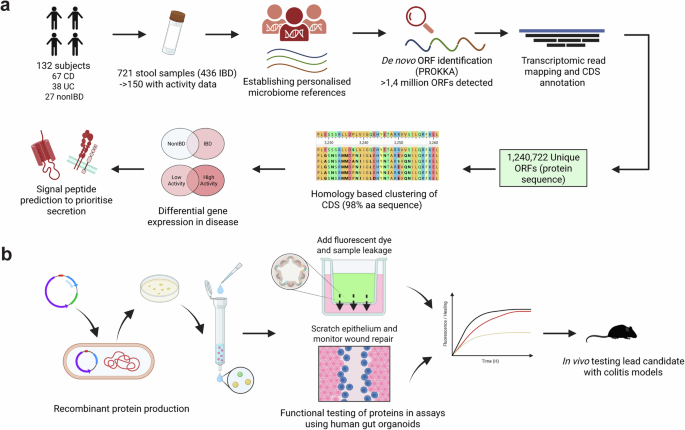
A microbiome meta-transcriptomics pipeline identifies a neutrophil elastase inhibitor that protects the colonic epithelial barrier
Signal Transduction and Targeted Therapy

A microbiome meta-transcriptomics pipeline identifies a neutrophil elastase inhibitor that protects the colonic epithelial barrier

Identifies a microbiome-derived protein that inhibits a protease linked to epithelial damage in IBD and shows protective effects in lab and mouse models, pointing to a new therapeutic strategy focused on barrier...

Read Summary
M2 macrophage-based biohybrid system regulates intestinal microbiota homeostasis and immunity for the treatment of inflammatory bowel disease.
Acta biomaterialia

M2 macrophage-based biohybrid system regulates intestinal microbiota homeostasis and immunity for the treatment of inflammatory bowel disease.

The study tests a multi-targeted biohybrid that could—if translated—help address inflammation, oxidative stress, and dysbiosis together, a combination that current single-target IBD treatments often do not address.

Read Summary
Probiotic‐Derived Vesicles Rectally Delivered via Thermo‐Gelling Copolymer Promote Mucosal Healing and Reduce Inflammation in Ulcerative Colitis
Advanced Science

Probiotic‐Derived Vesicles Rectally Delivered via Thermo‐Gelling Copolymer Promote Mucosal Healing and Reduce Inflammation in Ulcerative Colitis

This study describes a local rectal therapy that combines mesalamine with probiotic‑derived extracellular vesicles to promote mucosal healing and reduce inflammation in ulcerative colitis models, which could point toward...

Read Summary
Osbeckia opipara attenuates inflammation and reconstructs the intestinal barrier in ulcerative colitis by modulating the AHR/IL-22/STAT3 signaling axis.
Phytomedicine : international journal of phytotherapy and phytopharmacology

Osbeckia opipara attenuates inflammation and reconstructs the intestinal barrier in ulcerative colitis by modulating the AHR/IL-22/STAT3 signaling axis.

The study suggests a plant-derived AHR-activating mechanism that reduced inflammation and repaired the intestinal barrier in preclinical ulcerative colitis models, a pathway that could be relevant to future therapies or...

Read Summary
Mesenchymal Stem Cells and Their Exosomes as Novel Modulators of Gut Microbiota: Therapeutic Perspectives for Liver Diseases and Inflammatory Bowel Disease.
Microbial pathogenesis

Mesenchymal Stem Cells and Their Exosomes as Novel Modulators of Gut Microbiota: Therapeutic Perspectives for Liver Diseases and Inflammatory Bowel Disease.

The review suggests MSCs and their exosomes can change the gut microbiome, a factor implicated in IBD and liver disease, pointing to a potential new therapeutic approach. Patients and clinicians interested in future IBD...

Read Summary
Revisiting the Oral–Gut Axis: Microbial Symbiosis, Dysbiosis, and Bidirectional Links Between Periodontitis and Inflammatory Bowel Disease
Microorganisms

Revisiting the Oral–Gut Axis: Microbial Symbiosis, Dysbiosis, and Bidirectional Links Between Periodontitis and Inflammatory Bowel Disease

The oral microbiome can influence gut microbes and inflammation; understanding this link could lead to new diagnostic markers (saliva) or combined dental–gastroenterology care approaches relevant to people with IBD.

Read Summary
Endoplasmic reticulum stress in the logic of ulcerative colitis development
Experimental and Clinical Gastroenterology

Endoplasmic reticulum stress in the logic of ulcerative colitis development

ER stress in intestinal epithelial cells is proposed as a key molecular mechanism in UC development; targeting ER pathways (notably IRE1β) could eventually lead to new treatments that strengthen the gut barrier and...

Read Summary
Partial enteral nutrition combined with an exclusion diet promotes a healthy gut microbiome in patients with mild to moderately active ulcerative colitis: a quasi-experimental study.
Crohn's & colitis 360

Partial enteral nutrition combined with an exclusion diet promotes a healthy gut microbiome in patients with mild to moderately active ulcerative colitis: a quasi-experimental study.

Dietary strategies that change the gut microbiome are of interest because they might modify inflammation without drugs. This study suggests PEN+ED can shift the microbiome toward a healthier profile in UC, though...

Read Summary
Microplastics, Gut Dysbiosis, and Inflammatory Pathways in Ulcerative Colitis.
Journal of inflammation research

Microplastics, Gut Dysbiosis, and Inflammatory Pathways in Ulcerative Colitis.

If environmental microplastics contribute to gut dysbiosis and mucosal inflammation, this could help explain environmental triggers of ulcerative colitis and point toward prevention or microbiome-targeted interventions.

Read Summary
Gut microbiota dysbiosis in the pathogenesis of ulcerative colitis and the therapeutic efficacy of fecal microbiota transplantation: a meta-analysis
BMC Gastroenterology

Gut microbiota dysbiosis in the pathogenesis of ulcerative colitis and the therapeutic efficacy of fecal microbiota transplantation: a meta-analysis

This study synthesizes randomized trial evidence about the role of gut microbiota in ulcerative colitis and whether fecal microbiota transplantation (FMT) can help induce remission. People with UC may encounter FMT as a...

Read Summary
Dietary Tryptophan Supplementation Attenuates Lipopolysaccharide-Induced Acute Lung Injury in a Murine Model of Colitis.
Nutrients

Dietary Tryptophan Supplementation Attenuates Lipopolysaccharide-Induced Acute Lung Injury in a Murine Model of Colitis.

The study suggests dietary tryptophan might reduce bacterial-induced acute lung injury in the context of colitis by altering gut–lung immune signaling, which could be relevant to IBD patients who are at risk for...

Read Summary
Postbiotic Nagqu4580 Attenuates Ulcerative Colitis and Suppresses Ferroptosis in Association with the Microbiota-Tryptophan-AhR/Nrf2 Axis.
Nutrients

Postbiotic Nagqu4580 Attenuates Ulcerative Colitis and Suppresses Ferroptosis in Association with the Microbiota-Tryptophan-AhR/Nrf2 Axis.

This preclinical study suggests a fermented postbiotic product may protect the colon in a mouse model of ulcerative colitis by altering the microbiome and tryptophan metabolites and by reducing ferroptotic cell death....

Read Summary
Hollow Cu(2)O Nanozymes Enhance Probiotic Therapy for Colitis via Redox Homeostasis and TXNIP/NLRP3 Inflammasome Inhibition
PubMed Central

Hollow Cu(2)O Nanozymes Enhance Probiotic Therapy for Colitis via Redox Homeostasis and TXNIP/NLRP3 Inflammasome Inhibition

This study describes a new nanozyme approach that reduced inflammation and shifted the gut microbiome in mouse colitis models, suggesting a potential future strategy to boost probiotic therapy for IBD by targeting...

Read Summary
Dietary patterns, gut microbiota, and gastrointestinal disorders: mechanistic insights into irritable bowel syndrome and inflammatory bowel disease.
Reviews on environmental health

Dietary patterns, gut microbiota, and gastrointestinal disorders: mechanistic insights into irritable bowel syndrome and inflammatory bowel disease.

Diet is a modifiable factor that appears to change the gut microbiome and may affect symptoms and inflammation in both IBS and IBD; understanding which patterns help could guide practical dietary advice.

Read Summary
Insights into the mechanism of treatment of ulcerative colitis with pre- and post-processed dried ginger through perspective of metabolomics and intestinal microbiomics research.
Journal of pharmaceutical and biomedical analysis

Insights into the mechanism of treatment of ulcerative colitis with pre- and post-processed dried ginger through perspective of metabolomics and intestinal microbiomics research.

The study maps how two ginger preparations differently affect metabolism and the gut microbiome in a mouse model of ulcerative colitis, which could inform more targeted use of ginger-derived treatments if findings are...

Read Summary
TNFAIP1 as a novel therapeutic target in ulcerative colitis and salidroside as its potential inhibitor.
Biochimica et biophysica acta. Molecular basis of disease

TNFAIP1 as a novel therapeutic target in ulcerative colitis and salidroside as its potential inhibitor.

The study identifies a previously unrecognized protein (TNFAIP1) that appears to promote inflammation in ulcerative colitis and proposes a compound (Salidroside) that directly binds and inhibits it in lab and mouse...

Read Summary
Gegen Qinlian Decoction, a classic traditional Chinese medicine formula: a potential therapeutic strategy for ulcerative colitis and colorectal cancer
Frontiers in Pharmacology

Gegen Qinlian Decoction, a classic traditional Chinese medicine formula: a potential therapeutic strategy for ulcerative colitis and colorectal cancer

This review collects preclinical evidence that a traditional Chinese medicine formula (Gegen Qinlian Decoction) may act on inflammation, the gut barrier, immunity, and microbiota — all relevant to ulcerative colitis and...

Read Summary
Macrophage-driven inflammation in inflammatory bowel disease: mechanisms and therapeutic opportunities
Frontiers in Bioengineering and Biotechnology

Macrophage-driven inflammation in inflammatory bowel disease: mechanisms and therapeutic opportunities

Macrophages and innate immune signaling are central to how gut inflammation starts and persists in IBD; better understanding these pathways could point to new treatment strategies for people whose disease doesn’t fully...

Read Summary
Chitosan-coated and sodium phytate-crosslinked porous starch microspheres for oral delivery of celastrol in colitis therapy.
International journal of biological macromolecules

Chitosan-coated and sodium phytate-crosslinked porous starch microspheres for oral delivery of celastrol in colitis therapy.

The study describes a new oral-delivery microsphere that improved loading and gut-targeted release of celastrol and showed beneficial effects in a mouse colitis model and on gut microbiota. If translatable, this approach...

Read Summary
Harmonized metagenomic signatures of the gut microbiome reveal robust species, functions, and strain links to inflammatory bowel disease.
Gastroenterology

Harmonized metagenomic signatures of the gut microbiome reveal robust species, functions, and strain links to inflammatory bowel disease.

The study synthesizes many stool metagenomes to find consistent microbial species, functional pathways, and strain-level differences linked to IBD and to distinctions between Crohn’s disease and ulcerative...

Read Summary
Dendrobium huoshanense polysaccharides alleviate DSS-induced ulcerative colitis in mice: comparison between different parts of plant and role of GLP-1/GLP-1R axis.
Journal of ethnopharmacology

Dendrobium huoshanense polysaccharides alleviate DSS-induced ulcerative colitis in mice: comparison between different parts of plant and role of GLP-1/GLP-1R axis.

This study identifies a plant-derived polysaccharide (from the stem of Dendrobium huoshanense) that reduced inflammation and tissue injury in a mouse model of ulcerative colitis and points to GLP-1 signaling as a likely...

Read Summary
A bile acid-GPBAR1 network supports anti-inflammatory and anti-fibrotic benefits of probiotics in colitis.
Gut microbes

A bile acid-GPBAR1 network supports anti-inflammatory and anti-fibrotic benefits of probiotics in colitis.

Fibrosis and stricturing are key problems in Crohn’s disease with limited therapies; this study identifies a microbiota–bile acid–GPBAR1 pathway by which a specific probiotic mix reduced inflammation and fibrosis in...

Read Summary
Neglected kingdoms: the gut virome, mycobiome and their role in inflammatory bowel disease.
Gut microbes

Neglected kingdoms: the gut virome, mycobiome and their role in inflammatory bowel disease.

This review spotlights non-bacterial members of the gut microbiota (viruses and fungi) that may contribute to IBD by altering barrier function, immune responses, and interactions with bacteria. For people with IBD, these...

Read Summary
EB1010, a putative Christensenellaceae-derived microbial peptide, exhibits anti-inflammatory activity and therapeutic potential in ulcerative colitis.
Gut microbes

EB1010, a putative Christensenellaceae-derived microbial peptide, exhibits anti-inflammatory activity and therapeutic potential in ulcerative colitis.

Researchers are exploring microbiome-derived molecules as targeted, locally acting therapies for ulcerative colitis that might avoid systemic immunosuppression. EB1010 showed anti-inflammatory activity and...

Read Summary
Faecalibacterium prausnitzii Intestinal epithelial Syndecan-1 maintains mucosal homeostasis in inflammatory bowel disease by enhancingbiofilm formation.
Gut microbes

Faecalibacterium prausnitzii Intestinal epithelial Syndecan-1 maintains mucosal homeostasis in inflammatory bowel disease by enhancingbiofilm formation.

The study suggests a new host-directed mechanism that helps a common beneficial gut bacterium (Faecalibacterium prausnitzii) colonize and protect the gut lining, and identifies heparan sulfate as a potential way to...

Read Summary
Age-Related Microbial Differences in Newly Diagnosed Crohn's Disease Reveal the Distinct Enrichment of Oral-Associated Taxa in Pediatric Patients.
Gut and liver

Age-Related Microbial Differences in Newly Diagnosed Crohn's Disease Reveal the Distinct Enrichment of Oral-Associated Taxa in Pediatric Patients.

The study suggests that while Crohn's disease produces a shared dysbiotic signature at diagnosis, the specific microbes enriched differ by age — notably oral-associated taxa in children — which could affect research into...

Read Summary
Reconstructing the intestinal microbiota ecological network based on graph neural network and contrastive learning: Predicting key microbiota regulatory targets in Crohn's Disease.
Computational biology and chemistry

Reconstructing the intestinal microbiota ecological network based on graph neural network and contrastive learning: Predicting key microbiota regulatory targets in Crohn's Disease.

Researchers used machine learning to prioritize microbiome-related regulatory targets in Crohn's disease, which may guide future lab and clinical research into microbial pathways (like butyrate-related metabolism) that...

Read Summary
Multi-Omics Framework Integrating Genetics, Microbiome, Metabolism, and Immunity for Deciphering Ulcerative Colitis Pathogenesis and Diagnostic Biomarker Discovery.
FASEB journal : official publication of the Federation of American Societies for Experimental Biology

Multi-Omics Framework Integrating Genetics, Microbiome, Metabolism, and Immunity for Deciphering Ulcerative Colitis Pathogenesis and Diagnostic Biomarker Discovery.

Researchers used genetics, microbiome, metabolism, and immune profiling together to nominate biological pathways and a four-gene signature that might help diagnose or explain ulcerative colitis. If validated later, these...

Read Summary
Hollow Cu 2 O Nanozymes Enhance Probiotic Therapy for Colitis via Redox Homeostasis and TXNIP/NLRP3 Inflammasome Inhibition
Advanced Science

Hollow Cu 2 O Nanozymes Enhance Probiotic Therapy for Colitis via Redox Homeostasis and TXNIP/NLRP3 Inflammasome Inhibition

The study targets oxidative stress and the TXNIP/NLRP3 inflammasome axis, both implicated in IBD inflammation and barrier damage. If translatable, nanozyme-assisted probiotic therapy could offer a novel, targeted way to...

Read Summary
Gut microbiome in pediatric acute pancreatitis and Crohn's disease versus irritable bowel syndrome and healthy controls
Journal of Pediatric Gastroenterology and Nutrition

Gut microbiome in pediatric acute pancreatitis and Crohn's disease versus irritable bowel syndrome and healthy controls

The gut microbiome differed more in pediatric Crohn’s disease and acute pancreatitis than in IBS or healthy kids, suggesting microbial changes are stronger in organic inflammatory disease and could be targets for future...

Read Summary
Black tea-processed Toona sinensis leaves alleviate DSS-induced ulcerative colitis in mice by enriching flavonoids and modulating gut microbiota
Frontiers in Nutrition

Black tea-processed Toona sinensis leaves alleviate DSS-induced ulcerative colitis in mice by enriching flavonoids and modulating gut microbiota

The study identifies a food-processing method (black tea processing) that increased flavonoids and improved outcomes in a mouse model of colitis, suggesting that specific dietary preparations might influence gut...

Read Summary
A scoping review on emerging biomarkers in inflammatory bowel disease: Towards precision medicine in diagnosis and therapeutic management.
PloS one

A scoping review on emerging biomarkers in inflammatory bowel disease: Towards precision medicine in diagnosis and therapeutic management.

New, non-invasive biomarkers and AI-driven multi-omic approaches could make diagnosis and treatment of IBD more precise, helping patients avoid invasive tests and improving chances of choosing effective therapies sooner.

Read Summary