Evidence types

Basic Science

Basic science articles covering early-stage IBD research, disease mechanisms, lab findings, microbiome work, genetics, and experimental models.

Page 9 of 15 · 709 articles

Outer Membrane Protein A from Escherichia coli Nissle 1917 Vesicles Alleviates Colon Inflammation by Modulating Specific Inflammatory Signaling Pathway
Journal of Agricultural and Food Chemistry

Outer Membrane Protein A from Escherichia coli Nissle 1917 Vesicles Alleviates Colon Inflammation by Modulating Specific Inflammatory Signaling Pathway

The study identifies a specific bacterial protein (OmpA) on probiotic-derived vesicles that reduced inflammation in a mouse colitis model by inhibiting TLR4/NF-κB signaling and improving barrier function, suggesting a...
Read Summary
Tetrastigma hemsleyanum polysaccharides ameliorate inflammatory bowel disease via sphingosine-1-phosphate/sphingosine-1-phosphate receptor 2 -mediated gut vascular barrier repair.
Phytomedicine : international journal of phytotherapy and phytopharmacology

Tetrastigma hemsleyanum polysaccharides ameliorate inflammatory bowel disease via sphingosine-1-phosphate/sphingosine-1-phosphate receptor 2 -mediated gut vascular barrier repair.

This preclinical study suggests a plant-derived polysaccharide (THP) can repair the gut vascular barrier and reduce inflammation in experimental colitis via the S1P/S1PR2 pathway, pointing to a novel potential target for...

Read Summary
Self-Propelling WO3 Nanomotors Restore the Gut-Kidney Axis by Modulating Intestinal Homeostasis in Inflammatory Bowel Disease.
Advanced healthcare materials

Self-Propelling WO3 Nanomotors Restore the Gut-Kidney Axis by Modulating Intestinal Homeostasis in Inflammatory Bowel Disease.

The study presents a novel nanomaterial approach that aims to protect both inflamed intestines and kidneys by restoring intestinal barrier function and microbiome balance—mechanisms relevant to IBD-related systemic...

Read Summary
Target Relocalization-Driven Weakly Supervised Segmentation for Crohn's Disease via Auxiliary Anatomical Priors
Europe PMC

Target Relocalization-Driven Weakly Supervised Segmentation for Crohn's Disease via Auxiliary Anatomical Priors

Automated, annotation‑efficient lesion segmentation could speed image review and reduce labeling costs for Crohn’s disease imaging research and tool development. If robust, it may help create better AI tools to support...

Read Summary
A Centimeter-Scale, Peristaltic Human Intestinal Organoid with Integrated Neuro-Immune-Vascular Systems Recapitulates Enteritis and Orthotopic Colorectal Cancer
Europe PMC

A Centimeter-Scale, Peristaltic Human Intestinal Organoid with Integrated Neuro-Immune-Vascular Systems Recapitulates Enteritis and Orthotopic Colorectal Cancer

This model could improve how researchers study IBD inflammation and early colorectal cancer in a human-derived, multicellular system that reproduces neuromuscular function and immune responses. That may speed preclinical...

Read Summary
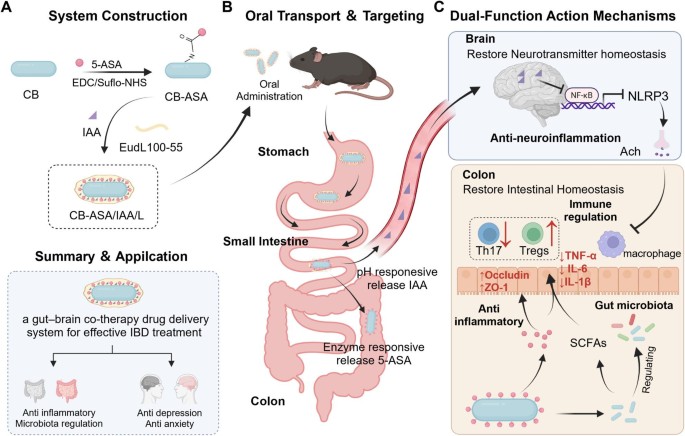
Probiotic-based sequential delivery system for gut-brain co-therapy against inflammatory bowel disease-associated anxiety/depression
Journal of Nanobiotechnology

Probiotic-based sequential delivery system for gut-brain co-therapy against inflammatory bowel disease-associated anxiety/depression

The study presents a novel probiotic-based delivery system that targets both intestinal inflammation and anxiety/depression through the gut–brain axis, a potentially relevant concept for people with IBD who commonly...

Read Summary
Blocking the m6Am methyltransferase PCIF1 in macrophages attenuates colitis progression by preventing neuronal damage.
Cellular & molecular immunology

Blocking the m6Am methyltransferase PCIF1 in macrophages attenuates colitis progression by preventing neuronal damage.

These results highlight a new cellular mechanism (macrophage-driven ECM changes) that may protect enteric neurons during intestinal inflammation — a process linked to symptoms and complications in IBD.

Read Summary
AUF1-Engineered Intestinal Organoids Enhance Epithelial Barrier Repair and Mucosal Regeneration in Experimental Colitis
openRxiv

AUF1-Engineered Intestinal Organoids Enhance Epithelial Barrier Repair and Mucosal Regeneration in Experimental Colitis

The work links a specific post-transcriptional regulator (AUF1) to barrier dysfunction in UC and demonstrates that AUF1-restored organoids can enhance mucosal repair in mice, suggesting a possible new regenerative...

Read Summary
Modulating immune toxicity in ulcerative colitis using a small molecule RAB27A inhibitor
Inflammatory Bowel Diseases

Modulating immune toxicity in ulcerative colitis using a small molecule RAB27A inhibitor

The report describes a novel small-molecule inhibitor (IMYX-3) targeting RAB27A to reduce neutrophil-mediated damage in ulcerative colitis models, which could point to a new therapeutic approach if later validated in...

Read Summary
3 Self-Propelling WONanomotors Restore the Gut-Kidney Axis by Modulating Intestinal Homeostasis in Inflammatory Bowel Disease.
Advanced healthcare materials

3 Self-Propelling WONanomotors Restore the Gut-Kidney Axis by Modulating Intestinal Homeostasis in Inflammatory Bowel Disease.

This study describes a novel nanoparticle "nanomachine" approach aimed at fixing gut microbial and barrier dysfunction in IBD models and, by doing so, reducing secondary kidney injury—an intersection (gut–kidney axis)...

Read Summary
Celastrol ameliorates ulcerative colitis by inhibiting HSP90-mediated necroptosis of intestinal epithelial cells
Frontiers in Pharmacology

Celastrol ameliorates ulcerative colitis by inhibiting HSP90-mediated necroptosis of intestinal epithelial cells

The study suggests a new mechanism—blocking HSP90-mediated necroptosis of intestinal epithelial cells—that may reduce inflammation and tissue damage in ulcerative colitis, which could guide early drug-discovery efforts.

Read Summary
Gut microbiota-derived metabolites target C5AR1/KDM2A/HCAR3 axis in inflammatory bowel disease: a multi-machine learning algorithms and molecular docking study
Frontiers in Cellular and Infection Microbiology

Gut microbiota-derived metabolites target C5AR1/KDM2A/HCAR3 axis in inflammatory bowel disease: a multi-machine learning algorithms and molecular docking study

The study proposes new biomarker candidates (C5AR1, KDM2A, HCAR3) and microbiota-derived metabolites that might interact with those targets. If validated, that could guide future diagnostic tests or microbiome-targeted...

Read Summary
Evaluation of the immunomodulatory effects of novel phosphinic acid derivatives in vitro and in a murine colitis model.
Biomedicine & pharmacotherapy = Biomedecine & pharmacotherapie

Evaluation of the immunomodulatory effects of novel phosphinic acid derivatives in vitro and in a murine colitis model.

Researchers are exploring new small molecules that might modulate T cells in IBD. This study found lab evidence of T‑cell inhibition for several compounds but no therapeutic benefit in a mouse colitis model, so these...

Read Summary
An inflammatory bowel disease-linked lncRNA suppresses transcription factor T-BET expression in T cells to limit intestinal inflammation.
Immunity

An inflammatory bowel disease-linked lncRNA suppresses transcription factor T-BET expression in T cells to limit intestinal inflammation.

People with IBD may care because this study connects a genetic risk region to a molecular mechanism that restrains inflammation in T cells, offering a potential new biological clue about disease causes and future...

Read Summary
Analysis of multiplexed SERS-based lateral flow assays: turning qualitative into quantitative for inflammatory bowel disease monitoring.
The Analyst

Analysis of multiplexed SERS-based lateral flow assays: turning qualitative into quantitative for inflammatory bowel disease monitoring.

Quantitative, rapid stool tests could make it easier to track intestinal inflammation without central lab delays. If translated to clinical use, SERS-enhanced lateral-flow assays might allow more frequent, point-of-care...

Read Summary
Sodium acetate attenuates ulcerative colitis by reducing intestinal epithelial apoptosis and remodeling gut microbiota
Frontiers in Microbiology

Sodium acetate attenuates ulcerative colitis by reducing intestinal epithelial apoptosis and remodeling gut microbiota

The study suggests acetate (sodium acetate) can protect intestinal cells and reshape the gut microbiota in preclinical models of ulcerative colitis, pointing to a potential microbiome-linked therapeutic avenue that might...

Read Summary
Dietary tryptophan ameliorates metalaxyl-induced colitis by restoring microbial tryptophan metabolism and aryl hydrocarbon receptor activation
Frontiers in Nutrition

Dietary tryptophan ameliorates metalaxyl-induced colitis by restoring microbial tryptophan metabolism and aryl hydrocarbon receptor activation

This study suggests an environmental fungicide can disrupt gut microbes and reduce beneficial microbial tryptophan metabolites, promoting colitis in mice; dietary tryptophan reversed those effects in the model.

Read Summary
α,α-Dicyanoolefin-Based Chemiluminophore with Conical Intersection for High-Contrast Imaging of Peroxynitrite in Ulcerative Colitis
Analytical Chemistry

α,α-Dicyanoolefin-Based Chemiluminophore with Conical Intersection for High-Contrast Imaging of Peroxynitrite in Ulcerative Colitis

A new chemiluminescent probe may help researchers detect and visualize peroxynitrite, a reactive species linked to inflammation in ulcerative colitis, which could aid research into disease mechanisms and early detection...

Read Summary
Adaptive graph learning of microbial phylogeny enables accurate and interpretable microbiome-based host phenotype prediction.
Applied and environmental microbiology

Adaptive graph learning of microbial phylogeny enables accurate and interpretable microbiome-based host phenotype prediction.

The study introduces a phylogeny-aware AI method that may improve detection and interpretation of microbiome signatures linked to IBD and colorectal cancer, which could help research into microbial biomarkers relevant to...

Read Summary
6 Blocking the mAm methyltransferase PCIF1 in macrophages attenuates colitis progression by preventing neuronal damage.
Cellular & molecular immunology

6 Blocking the mAm methyltransferase PCIF1 in macrophages attenuates colitis progression by preventing neuronal damage.

The work suggests a new mechanism linking macrophage-driven ECM remodeling to protection of enteric neurons and reduced colitis in preclinical models, which could point to future therapies aimed at preventing neuronal...

Read Summary
A modern toolbox to elucidate the role of the human microbiome in modulating mycobacterial gut infections
Open Biology

A modern toolbox to elucidate the role of the human microbiome in modulating mycobacterial gut infections

The review outlines new research tools for investigating whether mycobacteria contribute to Crohn’s disease and how the microbiome might influence infection and intestinal inflammation, which could eventually inform...

Read Summary
Cold-Induced Elevation of 3-Hydroxypropionate Exacerbates Colitis by Remodeling Gut Microbiota and Impairing Mitochondrial Respiration in Intestinal Epithelial Cells
Metabolites

Cold-Induced Elevation of 3-Hydroxypropionate Exacerbates Colitis by Remodeling Gut Microbiota and Impairing Mitochondrial Respiration in Intestinal Epithelial Cells

The study suggests a specific microbial metabolite, 3‑HPA, can link cold exposure to worse colitis by changing the microbiome and harming epithelial cell mitochondria and barrier function — a possible new mechanistic...

Read Summary
NEAT1 modulates neutrophil functions via glycolysis to restrain mucosal inflammation in ulcerative colitis
Frontiers in Immunology

NEAT1 modulates neutrophil functions via glycolysis to restrain mucosal inflammation in ulcerative colitis

The study links NEAT1, a long noncoding RNA, to neutrophil-driven mucosal inflammation in ulcerative colitis and suggests NEAT1 affects neutrophil activity via glycolysis. That points to a new molecular pathway that...

Read Summary
Ultrasound-Activated Janus Heterojunction-Mediated Enhanced Cascade Nanozyme for Inflammatory Bowel Disease Therapy.
ACS applied materials & interfaces

Ultrasound-Activated Janus Heterojunction-Mediated Enhanced Cascade Nanozyme for Inflammatory Bowel Disease Therapy.

The study describes a new ultrasound-activated nanozyme that reduced intestinal inflammation and promoted mucosal repair in preclinical IBD models by scavenging ROS and modulating the gut microbiota—an approach that...

Read Summary
Tea polysaccharide-stabilized selenium nanoparticles exert anti-inflammatory effects on ulcerative colitis via up-regulation of selenoenzymes and suppressing the NLRP3/Caspase-1/IL-1β pathway
Journal of Functional Foods

Tea polysaccharide-stabilized selenium nanoparticles exert anti-inflammatory effects on ulcerative colitis via up-regulation of selenoenzymes and suppressing the NLRP3/Caspase-1/IL-1β pathway

Based on the title and source metadata, this appears to be a basic science related to Ulcerative colitis, Inflammatory bowel disease, and Research and clinical trials. The original article is from Journal of Functional...

Read Summary
Rehmannia glutinosa Extracts Enhances Ketone Bodies Expression and Alleviates Ulcerative Colitis as A Novel Ketogenic Functional Food.
Food science & nutrition

Rehmannia glutinosa Extracts Enhances Ketone Bodies Expression and Alleviates Ulcerative Colitis as A Novel Ketogenic Functional Food.

This study suggests a plant extract might boost ketone-body levels and reduce colitis-like inflammation in a mouse model — a concept that could inform future dietary or therapeutic research for ulcerative colitis but is...

Read Summary
Arctic Fox-Derived Lactiplantibacillus plantarum J3 Alleviates Colitis in Mice in Association with Strengthening of the Intestinal Barrier and Reshaping of the Intestinal Flora
Life

Arctic Fox-Derived Lactiplantibacillus plantarum J3 Alleviates Colitis in Mice in Association with Strengthening of the Intestinal Barrier and Reshaping of the Intestinal Flora

This preclinical study suggests a fox-derived Lactiplantibacillus plantarum strain can reduce inflammation and improve intestinal barrier markers in cell and mouse models of colitis, which could inform future...

Read Summary
Fabrication of Microcrystalline Cellulose/ZnO Quantum Dots with Enhanced Zinc Bioavailability for Alleviating DSS-Induced Ulcerative Colitis in Mice
ACS Applied Materials & Interfaces

Fabrication of Microcrystalline Cellulose/ZnO Quantum Dots with Enhanced Zinc Bioavailability for Alleviating DSS-Induced Ulcerative Colitis in Mice

The paper reports a materials-based strategy to improve zinc delivery and bioavailability that reduced dose while preserving beneficial effects in a mouse colitis model—relevant because zinc supports intestinal health...

Read Summary
Recombinant human Thymosin β4 ameliorates experimental colitis and intestinal fibrosis through suppression of mineralocorticoid receptor signaling
Molecular Biomedicine

Recombinant human Thymosin β4 ameliorates experimental colitis and intestinal fibrosis through suppression of mineralocorticoid receptor signaling

This preclinical study identifies Thymosin β4 as a protective factor in intestinal inflammation and fibrosis and suggests rhTβ4 could be explored as a new therapeutic approach for IBD by targeting mineralocorticoid...

Read Summary
Chemical characterization of aconite polysaccharide and its ameliorative effect on ulcerative colitis by regulating gut microbiota and THDCA-driven TGR5/cAMP/PKA/NLRP3 pathway.
Journal of pharmaceutical analysis

Chemical characterization of aconite polysaccharide and its ameliorative effect on ulcerative colitis by regulating gut microbiota and THDCA-driven TGR5/cAMP/PKA/NLRP3 pathway.

This research suggests a new, preclinical microbiome- and metabolite-based pathway (APA-1 → THDCA → TGR5/cAMP/PKA → NLRP3) that reduced inflammation in a mouse model of ulcerative colitis, which could guide future...

Read Summary
A scalable microarrayed organoid platform for precision modeling of intestinal epithelial damage and recovery.
Cell reports methods

A scalable microarrayed organoid platform for precision modeling of intestinal epithelial damage and recovery.

An organoid platform that models epithelial injury and recovery could help researchers test treatments and biomarkers more precisely and at scale, accelerating work relevant to Crohn’s disease and other IBDs.

Read Summary
Lactobacillus brevis ZFM820 modulates intestinal ecological sulfur homeostasis to alleviate Desulfovibrio-driven colitis.
Food & function

Lactobacillus brevis ZFM820 modulates intestinal ecological sulfur homeostasis to alleviate Desulfovibrio-driven colitis.

The study suggests a new probiotic strategy that targets both microbial H2S production and host detoxification pathways — processes implicated in some IBD-related dysbiosis — which could inform future microbiome-directed...

Read Summary
Suppressing FUT8 with a Novel Small Molecule Inhibitor Ameliorates Inflammation in Murine T Cell-mediated Colitis Models.
Cellular and molecular gastroenterology and hepatology

Suppressing FUT8 with a Novel Small Molecule Inhibitor Ameliorates Inflammation in Murine T Cell-mediated Colitis Models.

This study identifies FUT8, an enzyme that adds core fucose to N-glycans, as a possible new target to reduce pro-inflammatory T-cell responses in IBD. For people with IBD, new mechanisms in preclinical research may...

Read Summary
Methylglyoxal Attenuates Mycobacterium avium subspecies paratuberculosis (MAP)-Induced Pro-Inflammatory Macrophage Programming Associated with NRF-2 Antioxidant Responses and Reduced MCT4/Lactate-Linked Inflammatory Markers.
International journal of molecular sciences

Methylglyoxal Attenuates Mycobacterium avium subspecies paratuberculosis (MAP)-Induced Pro-Inflammatory Macrophage Programming Associated with NRF-2 Antioxidant Responses and Reduced MCT4/Lactate-Linked Inflammatory Markers.

This study explores a potential mechanism linking a MAP infection model to inflammatory and metabolic pathways relevant to Crohn’s disease and tests whether methylglyoxal can lessen inflammatory programming in...

Read Summary
Exploration of novel costunolide derivatives bearing indole/indoline as anti-ulcerative colitis agents by targeting JAK2-STAT3 pathways.
Bioorganic chemistry

Exploration of novel costunolide derivatives bearing indole/indoline as anti-ulcerative colitis agents by targeting JAK2-STAT3 pathways.

This study reports early-stage lab and mouse evidence for new small molecules that target the JAK2–STAT3 immune signaling pathway, a pathway relevant to inflammation in ulcerative colitis. If findings are confirmed in...

Read Summary

A microbiota-responsive polyfunctional cytotoxic CD4+ T-cell state promotes mucosal inflammation in ulcerative colitis

The study describes a microbiota-responsive cytotoxic CD4+ T‑cell state that associates with worse mucosal inflammation and reduced response to common biologic therapies in ulcerative colitis, suggesting a possible...

Read Summary
Ingestible Hydrogel-Encapsulated Optogenetic Yeast Controlled by Wearable Electronics Enables Programmable IL-10 Delivery for Inflammatory Bowel Disease Therapy.
ACS applied materials & interfaces

Ingestible Hydrogel-Encapsulated Optogenetic Yeast Controlled by Wearable Electronics Enables Programmable IL-10 Delivery for Inflammatory Bowel Disease Therapy.

This work explores a novel, programmable way to deliver anti-inflammatory protein therapy (IL-10) directly in the gut using engineered yeast and wearable electronics. If further developed and translated, it could offer a...

Read Summary
Ecological assembly of mucosal and fecal microbiomes in ulcerative colitis across genes, functions, and species
Frontiers in Microbiology

Ecological assembly of mucosal and fecal microbiomes in ulcerative colitis across genes, functions, and species

This paper offers a multi-layered ecological perspective on UC-associated microbiome changes that could help researchers identify which microbial functions or taxa are driven more by random processes versus selection in...

Read Summary