Medication classes

Anti-TNF

Anti-TNF articles covering treatments such as infliximab, adalimumab, certolizumab, and golimumab in IBD care. Medication context emphasizes treatment decisions, safety, approvals, and therapy access.

Page 3 of 6 · 241 articles

Ustekinumab combined with upadacitinib promotes endoscopic healing in moderate-to-severe Crohn's disease with anti-TNF-α failure.
Revista espanola de enfermedades digestivas

Ustekinumab combined with upadacitinib promotes endoscopic healing in moderate-to-severe Crohn's disease with anti-TNF-α failure.

Patients with moderate-to-severe Crohn's disease who do not respond to anti-TNF drugs have limited options. This study suggests combining ustekinumab with upadacitinib may improve endoscopic healing versus either drug...

Read Summary
Time trends of pediatric inflammatory bowel disease in Catalonia from 2011 to 2023. Population-based cohort study.
Revista espanola de enfermedades digestivas

Time trends of pediatric inflammatory bowel disease in Catalonia from 2011 to 2023. Population-based cohort study.

Trends in treatments for children with IBD can affect hospitalization and surgical needs. Noting rising use of biologics (infliximab) alongside fewer hospitalizations may be important for families and clinicians tracking...

Read Summary
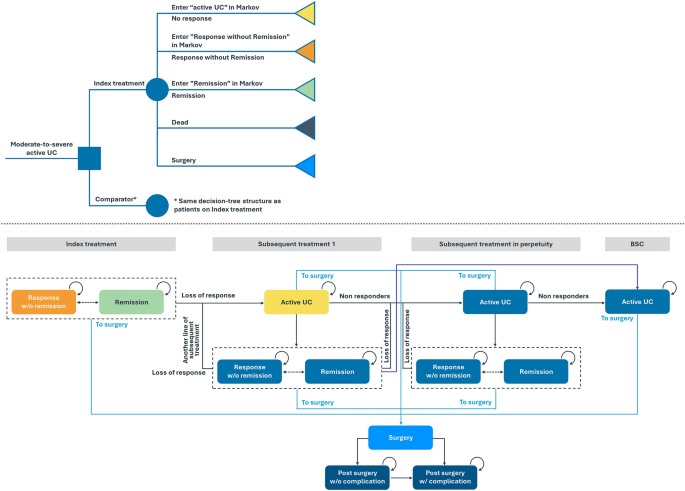
Comparative Cost-Effectiveness of Advanced Treatment Sequences for Moderately to Severely Active Ulcerative Colitis in Japan
Advances in Therapy

Comparative Cost-Effectiveness of Advanced Treatment Sequences for Moderately to Severely Active Ulcerative Colitis in Japan

This study models comparative cost-effectiveness across many advanced therapy sequences for moderate–severe ulcerative colitis in Japan; its findings could influence how health systems and clinicians consider first- and...

Read Summary
Pregnancy safety of biologics in inflammatory bowel disease: A systematic review and network meta-analysis.
Therapeutic advances in gastroenterology

Pregnancy safety of biologics in inflammatory bowel disease: A systematic review and network meta-analysis.

People with IBD often need biologic therapy during their reproductive years. This review compiles comparative evidence about pregnancy risks with different biologics to inform decisions about continuing or switching...

Read Summary
Beyond class switching in multi-refractory inflammatory bowel disease: Nine case reports and review of literature
World Journal of Gastrointestinal Pharmacology and Therapeutics

Beyond class switching in multi-refractory inflammatory bowel disease: Nine case reports and review of literature

For people with multi-refractory Crohn’s disease or ulcerative colitis, adding a JAK inhibitor to an existing biologic (advanced combination therapy) may convert partial responses into deeper remission in selected cases,...

Read Summary
Switching Between Anti-TNFs and Other Biologic Drugs in Paediatric Inflammatory Bowel Disease: A Narrative Review and Practical Clinical Guide.
Journal of inflammation research

Switching Between Anti-TNFs and Other Biologic Drugs in Paediatric Inflammatory Bowel Disease: A Narrative Review and Practical Clinical Guide.

Switching biologics is a frequent and consequential decision in children with IBD; using TDM and a mechanism‑based approach can help choose whether to optimize, switch within class, or change drug class.

Read Summary
Evolving patient journey in the management of active perianal fistulizing Crohn's disease: A temporal perspective.
Colorectal disease : the official journal of the Association of Coloproctology of Great Britain and Ireland

Evolving patient journey in the management of active perianal fistulizing Crohn's disease: A temporal perspective.

The findings show earlier and more frequent use of imaging, endoscopic assessment, anti-TNF therapy, and seton placement for active perianal fistulizing Crohn’s disease over recent years — practices that may affect...

Read Summary
Impaired memory B-cell formation after mRNA-based COVID-19 booster vaccination in patients with inflammatory bowel disease receiving anti-TNF treatment
Europe PMC

Impaired memory B-cell formation after mRNA-based COVID-19 booster vaccination in patients with inflammatory bowel disease receiving anti-TNF treatment

The study suggests that anti‑TNF treatment in IBD is associated with weaker and less cross‑reactive antibody and memory B‑cell responses after COVID‑19 booster vaccination, which may reduce durability of protection and...

Read Summary
Dual biologic therapy in inflammatory bowel disease, a retrospective cohort study of vedolizumab and anti-tumor necrosis factor alpha therapy in children.
Journal of pediatric gastroenterology and nutrition

Dual biologic therapy in inflammatory bowel disease, a retrospective cohort study of vedolizumab and anti-tumor necrosis factor alpha therapy in children.

This study reports that combining an anti-TNF-α drug with vedolizumab helped many children with IBD who failed single-biologic therapy achieve clinical, endoscopic, and histologic improvement. It also notes serious...

Read Summary
Real-World Patterns of Immunomodulator Use in Patients with Inflammatory Bowel Disease Receiving Biologic Therapy Under a 54-Week Reimbursement Cap: A 12-Year Retrospective Single-Center Cohort from Taiwan.
Journal of inflammation research

Real-World Patterns of Immunomodulator Use in Patients with Inflammatory Bowel Disease Receiving Biologic Therapy Under a 54-Week Reimbursement Cap: A 12-Year Retrospective Single-Center Cohort from Taiwan.

This study looks at how immunomodulators are actually used with biologic drugs in real-world practice when a national reimbursement policy forces biologic interruptions.

Read Summary
Early ileocaecal resection versus biologics therapy for localized Crohn disease: A systematic review and meta-analysis.
Colorectal disease : the official journal of the Association of Coloproctology of Great Britain and Ireland

Early ileocaecal resection versus biologics therapy for localized Crohn disease: A systematic review and meta-analysis.

This review directly compares surgery-first versus biologic-first strategies for localized ileocaecal Crohn's disease and suggests early resection can lower later treatment needs and leave some patients off medication,...

Read Summary
A Receptor-Mediated Endolysosomal Recycling Chimera Enables Catalytic TNF-α Degradation for Sustained Treatment of Mucosal Inflammation.
Advanced materials (Deerfield Beach, Fla.)

A Receptor-Mediated Endolysosomal Recycling Chimera Enables Catalytic TNF-α Degradation for Sustained Treatment of Mucosal Inflammation.

This study reports a new engineered platform that can catalytically degrade TNF‑α, the same inflammatory cytokine targeted by several IBD therapies. If translated to humans, it could offer longer‑lasting mucosal...

Read Summary
A Multicenter, Prospective, Long-term, Observational Registry of Pediatric Patients With Inflammatory Bowel Disease
ClinicalTrials.gov

A Multicenter, Prospective, Long-term, Observational Registry of Pediatric Patients With Inflammatory Bowel Disease

This registry will track long-term safety and clinical outcomes in children with IBD, with a focus on infliximab (an anti‑TNF biologic) versus non‑biologic therapies. Long follow-up could help identify uncommon or late...

Read Summary
Comparative performance of NAR, SII and PIV in predicting infliximab primary non-response in biologic-naïve ulcerative colitis patients
The Egyptian Journal of Internal Medicine

Comparative performance of NAR, SII and PIV in predicting infliximab primary non-response in biologic-naïve ulcerative colitis patients

If you or a patient is about to start infliximab for ulcerative colitis, routine blood counts may help identify those unlikely to respond to induction therapy; a high negative predictive value suggests these markers...

Read Summary
Longitudinal visceral adipose heterogeneity supports digital health stratification of infliximab response loss in Crohn disease
Springer Science and Business Media LLC

Longitudinal visceral adipose heterogeneity supports digital health stratification of infliximab response loss in Crohn disease

If validated, an imaging-derived adipose heterogeneity biomarker could help predict who will lose response to infliximab after induction, potentially guiding earlier treatment decisions and personalized monitoring for...

Read Summary
Clinical trajectories after preoperative traditional Chinese medicine in biologic-refractory surgery- intended acute severe ulcerative colitis: an exploratory retrospective case series
Frontiers in Immunology

Clinical trajectories after preoperative traditional Chinese medicine in biologic-refractory surgery- intended acute severe ulcerative colitis: an exploratory retrospective case series

This paper explores whether individualized integrative management including traditional Chinese medicine might influence outcomes in patients with biologic‑refractory, surgery‑intended acute severe ulcerative colitis — a...

Read Summary
Aminosalicylate use Increases Corticosteroid Exposure and Decreases Biologic Durability in Pediatric Crohn's Disease.
Clinical gastroenterology and hepatology : the official clinical practice journal of the American Gastroenterological Association

Aminosalicylate use Increases Corticosteroid Exposure and Decreases Biologic Durability in Pediatric Crohn's Disease.

This study suggests that using 5‑ASA drugs early in children with Crohn’s disease was common but linked to more steroid use, delayed biologic treatment, and lower biologic durability — outcomes that matter for long‑term...

Read Summary
Living with Primary Immunodeficiencies: CVID—Enteropathy from the Perspective of a Gastroenterologist
Journal of Human Immunity

Living with Primary Immunodeficiencies: CVID—Enteropathy from the Perspective of a Gastroenterologist

CVID-related enteropathy can resemble celiac disease or IBD, carries high morbidity and mortality, and often does not respond to standard immunoglobulin therapy — patients and clinicians need awareness of its distinct...

Read Summary
Tacrolimus Bridging and Combination Therapy Following Infliximab and JAK Inhibitor Failure in Ulcerative Colitis: A Case Series.
JGH open : an open access journal of gastroenterology and hepatology

Tacrolimus Bridging and Combination Therapy Following Infliximab and JAK Inhibitor Failure in Ulcerative Colitis: A Case Series.

Patients with UC who fail both anti-TNF and JAK inhibitor therapies have limited options. This report suggests tacrolimus can be used as a short-term bridge or in combination to reach another maintenance drug, with many...

Read Summary
The impact of ustekinumab and tumor necrosis factor antagonists on extraintestinal manifestations of Crohn's disease: a systematic review and meta-analysis.
Frontiers in pharmacology

The impact of ustekinumab and tumor necrosis factor antagonists on extraintestinal manifestations of Crohn's disease: a systematic review and meta-analysis.

Extraintestinal symptoms such as fatigue and joint pain significantly affect quality of life in Crohn's disease. This review suggests ustekinumab may help reduce fatigue and arthritis/arthralgia more than TNF antagonists...

Read Summary
Upadacitinib effectively suppresses IL13RA2 expression in primary human intestinal fibroblasts derived from Crohn's disease tissue.
Biochemical pharmacology

Upadacitinib effectively suppresses IL13RA2 expression in primary human intestinal fibroblasts derived from Crohn's disease tissue.

The study identifies a cellular mechanism (JAK1-STAT6 pathway) by which upadacitinib can lower IL13RA2 — a molecule tied to inflammation and anti-TNF resistance — which could help explain how JAK inhibitors work in IBD...

Read Summary
Early infliximab levels and clearance predict outcomes in acute severe ulcerative colitis.
Translational gastroenterology and hepatology

Early infliximab levels and clearance predict outcomes in acute severe ulcerative colitis.

Based on the title and source metadata, this appears to be a clinical study related to Ulcerative colitis, Inflammatory bowel disease, and Infliximab. The original article is from Translational gastroenterology and...

Read Summary
Novel Agents on the Therapeutic Horizon For Paediatric Inflammatory Bowel Diseases: An Analysis of Clinical Trials Registries.
Paediatric drugs

Novel Agents on the Therapeutic Horizon For Paediatric Inflammatory Bowel Diseases: An Analysis of Clinical Trials Registries.

Children with IBD often wait years for medicines to be approved after adult approvals; this review shows many ongoing paediatric trials for biologics and small molecules that could improve treatment options.

Read Summary
Treatment persistence after switching between anti-tumor necrosis factor agents and tofacitinib in ulcerative colitis: A nationwide claims-based cohort study in South Korea.
Therapeutic advances in gastroenterology

Treatment persistence after switching between anti-tumor necrosis factor agents and tofacitinib in ulcerative colitis: A nationwide claims-based cohort study in South Korea.

Patients and clinicians considering sequencing of advanced UC therapies may care because this study reports differences in how long patients stayed on second-line treatment depending on the order of anti-TNF agents and...

Read Summary
Evaluation of pharmacokinetic metrics and pharmacodynamic biomarkers associated with endoscopic healing in pediatric Crohn's disease patients treated with anti-tumor necrosis factor biologics.
Crohn's & colitis 360

Evaluation of pharmacokinetic metrics and pharmacodynamic biomarkers associated with endoscopic healing in pediatric Crohn's disease patients treated with anti-tumor necrosis factor biologics.

Identifies candidate drug‑level and immune biomarker cut‑points linked with endoscopic healing in pediatric Crohn's disease, which could help guide dosing or treatment changes if validated.

Read Summary
Comparative risk of postoperative complications in ulcerative colitis patients following preoperative advanced therapies: a network meta-analysis with meta-regression.
Journal of Crohn's & colitis

Comparative risk of postoperative complications in ulcerative colitis patients following preoperative advanced therapies: a network meta-analysis with meta-regression.

This study addresses whether being on biologic or small‑molecule IBD drugs before colorectal surgery affects short‑term postoperative complications — a practical concern for patients and clinicians planning surgery.

Read Summary
Circulating microRNAs as biomarkers of disease activity and treatment response in Crohn’s disease patients receiving infliximab or vedolizumab: a longitudinal cohort study
Frontiers in Medicine

Circulating microRNAs as biomarkers of disease activity and treatment response in Crohn’s disease patients receiving infliximab or vedolizumab: a longitudinal cohort study

If validated, blood microRNAs could become noninvasive biomarkers to help track inflammation and predict biochemical response to infliximab or vedolizumab in Crohn’s disease, complementing CRP and fecal calprotectin.

Read Summary
A dysregulated stromal remodelling programme characterises prior anti-TNF failure in ulcerative colitis
openRxiv

A dysregulated stromal remodelling programme characterises prior anti-TNF failure in ulcerative colitis

The study suggests a specific stromal and MAPK/EGFR signalling programme linked to prior anti‑TNF failure in ulcerative colitis, which could help explain why some patients are less responsive to later therapies and point...

Read Summary
A Study of Vedolizumab Intravenous (IV) and Adalimumab or Vedolizumab and Ustekinumab in Adults With Crohn's Disease
ClinicalTrials.gov

A Study of Vedolizumab Intravenous (IV) and Adalimumab or Vedolizumab and Ustekinumab in Adults With Crohn's Disease

Patients and clinicians are interested in whether combining two targeted biologic therapies can induce stronger endoscopic healing for people with difficult-to-treat Crohn's disease, and whether benefit can be maintained...

Read Summary
Impact of Prior Biologic Mechanism of Action on Anti-TNF Effectiveness in Inflammatory Bowel Disease: An ENEIDA Registry Study.
Alimentary pharmacology & therapeutics

Impact of Prior Biologic Mechanism of Action on Anti-TNF Effectiveness in Inflammatory Bowel Disease: An ENEIDA Registry Study.

The study addresses a practical question for people with IBD: whether sequencing anti-TNF therapy after a biologic from a different class affects how well the anti-TNF works. Shorter durability — especially in ulcerative...

Read Summary