All topics

Diet and lifestyle

Nutrition, food, supplements, exercise, sleep, stress, and lifestyle research for Crohn's disease and IBD.

Page 13 of 24 · 1124 articles

A Centimeter-Scale, Peristaltic Human Intestinal Organoid with Integrated Neuro-Immune-Vascular Systems Recapitulates Enteritis and Orthotopic Colorectal Cancer
Europe PMC

A Centimeter-Scale, Peristaltic Human Intestinal Organoid with Integrated Neuro-Immune-Vascular Systems Recapitulates Enteritis and Orthotopic Colorectal Cancer

This model could improve how researchers study IBD inflammation and early colorectal cancer in a human-derived, multicellular system that reproduces neuromuscular function and immune responses. That may speed preclinical...
Read Summary
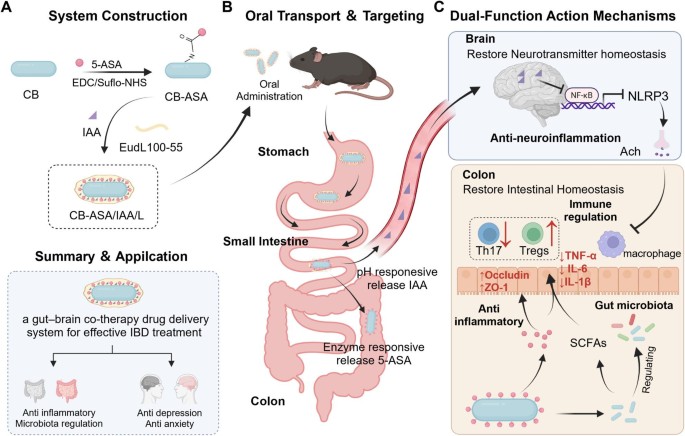
Probiotic-based sequential delivery system for gut-brain co-therapy against inflammatory bowel disease-associated anxiety/depression
Journal of Nanobiotechnology

Probiotic-based sequential delivery system for gut-brain co-therapy against inflammatory bowel disease-associated anxiety/depression

The study presents a novel probiotic-based delivery system that targets both intestinal inflammation and anxiety/depression through the gut–brain axis, a potentially relevant concept for people with IBD who commonly...

Read Summary
GLP-1 receptor agonist therapy is associated with increased symptomatic remission in ulcerative colitis: a matched cohort study.
Inflammatory bowel diseases

GLP-1 receptor agonist therapy is associated with increased symptomatic remission in ulcerative colitis: a matched cohort study.

This study suggests commonly used GLP-1 receptor agonists (semaglutide, liraglutide) were associated with higher symptomatic and endoscopic remission in ulcerative colitis compared with matched controls. If validated,...

Read Summary
Inflammatory bowel disease treatment: Mechanisms to clinical translation (Review).
International journal of molecular medicine

Inflammatory bowel disease treatment: Mechanisms to clinical translation (Review).

The article reviews current and emerging IBD treatments and the biological reasons they may work — useful for patients wanting to understand treatment options and future directions. It highlights therapies beyond...

Read Summary
Celastrol ameliorates ulcerative colitis by inhibiting HSP90-mediated necroptosis of intestinal epithelial cells
Frontiers in Pharmacology

Celastrol ameliorates ulcerative colitis by inhibiting HSP90-mediated necroptosis of intestinal epithelial cells

The study suggests a new mechanism—blocking HSP90-mediated necroptosis of intestinal epithelial cells—that may reduce inflammation and tissue damage in ulcerative colitis, which could guide early drug-discovery efforts.

Read Summary
Gut microbiota-derived metabolites target C5AR1/KDM2A/HCAR3 axis in inflammatory bowel disease: a multi-machine learning algorithms and molecular docking study
Frontiers in Cellular and Infection Microbiology

Gut microbiota-derived metabolites target C5AR1/KDM2A/HCAR3 axis in inflammatory bowel disease: a multi-machine learning algorithms and molecular docking study

The study proposes new biomarker candidates (C5AR1, KDM2A, HCAR3) and microbiota-derived metabolites that might interact with those targets. If validated, that could guide future diagnostic tests or microbiome-targeted...

Read Summary
Prediction of Dietary Intervention Efficacy in Mild Ulcerative Colitis Patients Based on Fecal Microbiome Signatures
ClinicalTrials.gov

Prediction of Dietary Intervention Efficacy in Mild Ulcerative Colitis Patients Based on Fecal Microbiome Signatures

Researchers are testing whether baseline fecal microbiome profiles can predict who with mild ulcerative colitis will benefit from a specific prebiotic supplement. If validated, this approach could move dietary therapy...

Read Summary
Sodium acetate attenuates ulcerative colitis by reducing intestinal epithelial apoptosis and remodeling gut microbiota
Frontiers in Microbiology

Sodium acetate attenuates ulcerative colitis by reducing intestinal epithelial apoptosis and remodeling gut microbiota

The study suggests acetate (sodium acetate) can protect intestinal cells and reshape the gut microbiota in preclinical models of ulcerative colitis, pointing to a potential microbiome-linked therapeutic avenue that might...

Read Summary
Dietary tryptophan ameliorates metalaxyl-induced colitis by restoring microbial tryptophan metabolism and aryl hydrocarbon receptor activation
Frontiers in Nutrition

Dietary tryptophan ameliorates metalaxyl-induced colitis by restoring microbial tryptophan metabolism and aryl hydrocarbon receptor activation

This study suggests an environmental fungicide can disrupt gut microbes and reduce beneficial microbial tryptophan metabolites, promoting colitis in mice; dietary tryptophan reversed those effects in the model.

Read Summary
Biomaterial-Based Microbiota Strategies for Targeting the Intestinal Immune Microenvironment in Inflammatory Bowel Disease.
European journal of pharmacology

Biomaterial-Based Microbiota Strategies for Targeting the Intestinal Immune Microenvironment in Inflammatory Bowel Disease.

Microbiota-targeting treatments are an active area of IBD research, and biomaterials may help overcome delivery challenges that limit current microbiome therapies. Advances here could improve how well these approaches...

Read Summary
Adaptive graph learning of microbial phylogeny enables accurate and interpretable microbiome-based host phenotype prediction.
Applied and environmental microbiology

Adaptive graph learning of microbial phylogeny enables accurate and interpretable microbiome-based host phenotype prediction.

The study introduces a phylogeny-aware AI method that may improve detection and interpretation of microbiome signatures linked to IBD and colorectal cancer, which could help research into microbial biomarkers relevant to...

Read Summary
Perceived Familial Risk, Dietary Beliefs, and Self-Reported Family Dietary Changes Among Unaffected First-Degree Relatives of Individuals with Inflammatory Bowel Disease: A Mixed Methods Study in Greece
Gastroenterology Insights

Perceived Familial Risk, Dietary Beliefs, and Self-Reported Family Dietary Changes Among Unaffected First-Degree Relatives of Individuals with Inflammatory Bowel Disease: A Mixed Methods Study in Greece

Unaffected family members often worry about their own risk and may make dietary changes based on beliefs rather than evidence. Understanding these perceptions can help clinicians give clearer, balanced guidance about...

Read Summary
A modern toolbox to elucidate the role of the human microbiome in modulating mycobacterial gut infections
Open Biology

A modern toolbox to elucidate the role of the human microbiome in modulating mycobacterial gut infections

The review outlines new research tools for investigating whether mycobacteria contribute to Crohn’s disease and how the microbiome might influence infection and intestinal inflammation, which could eventually inform...

Read Summary
Cold-Induced Elevation of 3-Hydroxypropionate Exacerbates Colitis by Remodeling Gut Microbiota and Impairing Mitochondrial Respiration in Intestinal Epithelial Cells
Metabolites

Cold-Induced Elevation of 3-Hydroxypropionate Exacerbates Colitis by Remodeling Gut Microbiota and Impairing Mitochondrial Respiration in Intestinal Epithelial Cells

The study suggests a specific microbial metabolite, 3‑HPA, can link cold exposure to worse colitis by changing the microbiome and harming epithelial cell mitochondria and barrier function — a possible new mechanistic...

Read Summary
Chronotherapy in Inflammatory Bowel Disease: Biological Rationale, Human Evidence, and a Clinical Implementation Framework.
Digestive diseases and sciences

Chronotherapy in Inflammatory Bowel Disease: Biological Rationale, Human Evidence, and a Clinical Implementation Framework.

Timing of therapies and daily behaviors may affect drug metabolism, immune activity, and symptom patterns in IBD. Considering when treatments are given could potentially improve response, reduce toxicity, and help...

Read Summary
Ultrasound-Activated Janus Heterojunction-Mediated Enhanced Cascade Nanozyme for Inflammatory Bowel Disease Therapy.
ACS applied materials & interfaces

Ultrasound-Activated Janus Heterojunction-Mediated Enhanced Cascade Nanozyme for Inflammatory Bowel Disease Therapy.

The study describes a new ultrasound-activated nanozyme that reduced intestinal inflammation and promoted mucosal repair in preclinical IBD models by scavenging ROS and modulating the gut microbiota—an approach that...

Read Summary
Sialidase inhibitor modulates gut microbiota and enhances mucosal protection in the treatment of ulcerative colitis
mSystems

Sialidase inhibitor modulates gut microbiota and enhances mucosal protection in the treatment of ulcerative colitis

The study suggests a targeted microbiome-based drug (sialidase inhibitor) may protect the mucus barrier and improve symptoms in ulcerative colitis without the broad disruption caused by antibiotics, which could be...

Read Summary
Beyond Inflammation: Sarcopenia and Disease Phenotype Predict Unfavourable Course in Crohn’s Disease—A Retrospective Observational Study
Biomedicines

Beyond Inflammation: Sarcopenia and Disease Phenotype Predict Unfavourable Course in Crohn’s Disease—A Retrospective Observational Study

Sarcopenia (low muscle mass) was linked with worse outcomes in Crohn’s disease and, combined with fecal calprotectin and disease behaviour, formed a score that better predicted unfavourable courses. Identifying at-risk...

Read Summary
Rehmannia glutinosa Extracts Enhances Ketone Bodies Expression and Alleviates Ulcerative Colitis as A Novel Ketogenic Functional Food.
Food science & nutrition

Rehmannia glutinosa Extracts Enhances Ketone Bodies Expression and Alleviates Ulcerative Colitis as A Novel Ketogenic Functional Food.

This study suggests a plant extract might boost ketone-body levels and reduce colitis-like inflammation in a mouse model — a concept that could inform future dietary or therapeutic research for ulcerative colitis but is...

Read Summary
Comprehensively validated µSPE-HPLC-MS/MS method for high-throughput clinical monitoring of Janus kinase inhibitor drugs approved for inflammatory bowel disease treatment
Scientific Reports

Comprehensively validated µSPE-HPLC-MS/MS method for high-throughput clinical monitoring of Janus kinase inhibitor drugs approved for inflammatory bowel disease treatment

Reliable, high-throughput lab methods are a prerequisite for therapeutic drug monitoring (TDM). For people with IBD on JAK inhibitors, validated assays can enable exposure measurement needed for future precision dosing...

Read Summary
Experimental models of spondyloarthritis: Pathophysiological insights and translational challenges.
Journal of autoimmunity

Experimental models of spondyloarthritis: Pathophysiological insights and translational challenges.

The review connects animal-model discoveries (IL-23/IL-17 and TNF pathways, gut–joint interactions) to therapies and research priorities relevant to people with SpA and IBD-associated arthritis.

Read Summary
Fabrication of Microcrystalline Cellulose/ZnO Quantum Dots with Enhanced Zinc Bioavailability for Alleviating DSS-Induced Ulcerative Colitis in Mice
ACS Applied Materials & Interfaces

Fabrication of Microcrystalline Cellulose/ZnO Quantum Dots with Enhanced Zinc Bioavailability for Alleviating DSS-Induced Ulcerative Colitis in Mice

The paper reports a materials-based strategy to improve zinc delivery and bioavailability that reduced dose while preserving beneficial effects in a mouse colitis model—relevant because zinc supports intestinal health...

Read Summary
Disrupted terminal bilirubin catabolism links Lachnospiraceae depletion to inflammatory bowel disease
Frontiers in Microbiology

Disrupted terminal bilirubin catabolism links Lachnospiraceae depletion to inflammatory bowel disease

Identifies specific gut bacteria and fecal bilirubin metabolites that may link microbial loss to increased oxidative burden in IBD; suggests new biomarker candidates and targets for functional follow-up.

Read Summary
Oral probiotic delivery-based therapeutic strategies for inflammatory bowel disease.
Asian journal of pharmaceutical sciences

Oral probiotic delivery-based therapeutic strategies for inflammatory bowel disease.

People with IBD may be interested because probiotics are being explored as a safer, non-immunosuppressive approach to help modulate gut microbiota and reduce inflammation, but effective oral delivery remains a key...

Read Summary
Chemical characterization of aconite polysaccharide and its ameliorative effect on ulcerative colitis by regulating gut microbiota and THDCA-driven TGR5/cAMP/PKA/NLRP3 pathway.
Journal of pharmaceutical analysis

Chemical characterization of aconite polysaccharide and its ameliorative effect on ulcerative colitis by regulating gut microbiota and THDCA-driven TGR5/cAMP/PKA/NLRP3 pathway.

This research suggests a new, preclinical microbiome- and metabolite-based pathway (APA-1 → THDCA → TGR5/cAMP/PKA → NLRP3) that reduced inflammation in a mouse model of ulcerative colitis, which could guide future...

Read Summary
Early life exposures association with later diagnosis of spondyloarthritis: A population-based case-control study.
The Journal of rheumatology

Early life exposures association with later diagnosis of spondyloarthritis: A population-based case-control study.

If confirmed, the results suggest early-life exposures that perturb the gut microbiome may influence later risk of spondyloarthritis, which could be relevant for parents and clinicians weighing risks and benefits of...

Read Summary
Multiple paths to health: A scoping review of dietary interventions for adults with Crohn's disease and ulcerative colitis.
Therapeutic advances in gastroenterology

Multiple paths to health: A scoping review of dietary interventions for adults with Crohn's disease and ulcerative colitis.

Many people with IBD try dietary changes to manage symptoms. This review summarizes what published adult studies report and points toward whole-food and Mediterranean-style patterns as commonly supported approaches.

Read Summary