All topics

Diet and lifestyle

Nutrition, food, supplements, exercise, sleep, stress, and lifestyle research for Crohn's disease and IBD.

Page 8 of 24 · 1124 articles

Resveratrol suppresses ulcerative colitis and colitis-associated colorectal cancer via modulating the miR-31-5p/SATB2 axis
World Journal of Gastrointestinal Oncology

Resveratrol suppresses ulcerative colitis and colitis-associated colorectal cancer via modulating the miR-31-5p/SATB2 axis

The paper identifies a molecular pathway (miR-31-5p/SATB2) linked to UC progression to colitis-associated cancer and reports that resveratrol modulates this axis in mice, suggesting a potential preventive mechanism worth...

Read Summary
Glutathione peroxidase in inflammatory bowel disease: From ferroptosis, immunity, and microbiota regulation to targeted nanomedicines.
Life sciences

Glutathione peroxidase in inflammatory bowel disease: From ferroptosis, immunity, and microbiota regulation to targeted nanomedicines.

GPX and selenium-related pathways may be important to how oxidative stress, ferroptosis, and the microbiome contribute to IBD. Understanding these mechanisms could guide future therapies.

Read Summary
In vivo and molecular docking studies of Micromeria imbricata var. imbricata extract reveal alleviation of the DSS-induced IBD phenotype via interaction with key inflammatory mediators.
Journal of ethnopharmacology

In vivo and molecular docking studies of Micromeria imbricata var. imbricata extract reveal alleviation of the DSS-induced IBD phenotype via interaction with key inflammatory mediators.

People with IBD may hear about botanical treatments; this study provides preclinical data that Micromeria imbricata extracts showed beneficial effects in a mouse colitis model and identified compounds that dock to...

Read Summary
Small but mighty: the human mycobiome as an immunopharmacological regulator of inflammation and autoimmunity.
International immunopharmacology

Small but mighty: the human mycobiome as an immunopharmacological regulator of inflammation and autoimmunity.

Fungi in the gut appear to influence immune pathways implicated in IBD and other autoimmune diseases, suggesting new therapeutic targets and microbiome-based interventions that could affect disease activity.

Read Summary
Smartly engineered biomaterials drive immune remodeling: A new paradigm for precise treatment of inflammatory bowel disease.
International immunopharmacology

Smartly engineered biomaterials drive immune remodeling: A new paradigm for precise treatment of inflammatory bowel disease.

This paper outlines research strategies aiming to deliver drugs more precisely to inflamed gut tissue and to reshape immune-cell behavior — advances that could eventually lead to safer, more targeted IBD treatments. It’s...

Read Summary
Macrophage plasticity as a therapeutic target in inflammatory bowel disease: Immunomodulatory and regenerative strategies.
International immunopharmacology

Macrophage plasticity as a therapeutic target in inflammatory bowel disease: Immunomodulatory and regenerative strategies.

Macrophages are central regulators of intestinal inflammation and repair; understanding their diversity and how to modulate them could lead to new, more targeted treatments for Crohn's disease and ulcerative colitis.

Read Summary
Extreme temperature events and hospitalizations for 59 autoimmune diseases in Korea: A nationwide outcome-wide, time-stratified, case-crossover study.
Environmental research

Extreme temperature events and hospitalizations for 59 autoimmune diseases in Korea: A nationwide outcome-wide, time-stratified, case-crossover study.

Short periods of extreme heat may modestly increase the chance of hospitalization for IBD and Crohn’s disease. Patients and clinicians should be aware that temperature extremes could be a trigger for worsening disease...

Read Summary
A robustness-first cross-disease framework supports a candidate shared microbial redox axis and disease-specific metabolic divergence in colorectal cancer, Crohn's disease, and liver cirrhosis.
mSystems

A robustness-first cross-disease framework supports a candidate shared microbial redox axis and disease-specific metabolic divergence in colorectal cancer, Crohn's disease, and liver cirrhosis.

Researchers found a candidate shared microbial signal across colorectal cancer, Crohn’s disease, and liver cirrhosis that points to redox-related microbial functions; this could guide future biomarker or experimental...

Read Summary
Therapeutic response to exclusive enteral nutrition correlates with suppressed IL-17 signaling activity and diminished IL-1β secretion in pediatric Crohn's disease
Frontiers in Nutrition

Therapeutic response to exclusive enteral nutrition correlates with suppressed IL-17 signaling activity and diminished IL-1β secretion in pediatric Crohn's disease

Shows molecular correlates (reduced IL‑17 signaling and IL‑1β) linked with mucosal healing after exclusive enteral nutrition in children with Crohn's disease, which may help researchers develop biomarkers or understand...

Read Summary
Engineered microvesicle-mediated multimodal therapy resolves ulcerative colitis via synergistic immunoregulation, barrier restoration, and microbiota remodeling
Materials today. Bio

Engineered microvesicle-mediated multimodal therapy resolves ulcerative colitis via synergistic immunoregulation, barrier restoration, and microbiota remodeling

Based on the title and source metadata, this appears to be a basic science related to Ulcerative colitis, Inflammatory bowel disease, and Microbiome. The original article is from Materials today. Bio.

Read Summary
Immune–microbe interactions in pediatric ulcerative colitis: clinical features, pathogenesis, and novel targeted therapeutic strategies
Frontiers in Immunology

Immune–microbe interactions in pediatric ulcerative colitis: clinical features, pathogenesis, and novel targeted therapeutic strategies

PUC often behaves differently and more aggressively than adult-onset UC; understanding pediatric‑specific causes and treatments could lead to better, more effective therapies for children.

Read Summary
Microbiota-Dependent Alleviation of Ulcerative Colitis by Liubao Tea: Integrated Insights into SCFA and Arachidonic Acid Metabolism
Foods (Basel, Switzerland)

Microbiota-Dependent Alleviation of Ulcerative Colitis by Liubao Tea: Integrated Insights into SCFA and Arachidonic Acid Metabolism

Based on the title and source metadata, this appears to be a basic science related to Ulcerative colitis, Inflammatory bowel disease, and Microbiome. The original article is from Foods (Basel, Switzerland).

Read Summary
Faecal multiplex PCR testing and its clinical utility in inflammatory bowel disease: a systematic review and meta-analysis
Frontline Gastroenterology

Faecal multiplex PCR testing and its clinical utility in inflammatory bowel disease: a systematic review and meta-analysis

Better detection of enteric infections during suspected IBD flares could help avoid unnecessary escalation of immunosuppressive therapy and guide appropriate antibiotic use. This review suggests MPCR finds more pathogens...

Read Summary
Integrated Multi-Omics Reveals Complementary Luminal and Mucosal Host–Microbiome Interactions Associated with Disease Activity and Phenotype in Paediatric Inflammatory Bowel Disease
Microorganisms

Integrated Multi-Omics Reveals Complementary Luminal and Mucosal Host–Microbiome Interactions Associated with Disease Activity and Phenotype in Paediatric Inflammatory Bowel Disease

The study shows that fecal (luminal) and mucosal microbiome and metabolite profiles capture different aspects of pediatric IBD—activity versus phenotype—so combined sampling may give a fuller picture for research and...

Read Summary
Aspects of inflammatory bowel disease during the COVID-19 pandemic and general considerations☆ Aspectos y consideraciones generales en la enfermedad inflamatoria intestinal durante la pandemia por COVID-19
Revista de gastroenterologia de Mexico (English)

Aspects of inflammatory bowel disease during the COVID-19 pandemic and general considerations☆ Aspectos y consideraciones generales en la enfermedad inflamatoria intestinal durante la pandemia por COVID-19

People with IBD and their clinicians need to know whether common IBD treatments change COVID-19 risk or should be stopped. This review provides practical recommendations (continue most maintenance drugs; avoid systemic...

Read Summary
Goblet cell heterogeneity and plasticity in ulcerative colitis: implications for mucus barrier reconstitution
Cell & Bioscience

Goblet cell heterogeneity and plasticity in ulcerative colitis: implications for mucus barrier reconstitution

The mucus layer and goblet cells are central to colonic barrier function; understanding goblet cell diversity and plasticity could point to new ways to restore the mucus barrier in UC and improve disease control.

Read Summary
6PPDQ exposure enhances susceptibility to ulcerative colitis by disturbing MMP9, PTGS2, and PPARG homeostasis: an integrative network toxicology and in vivo study.
Chemico-biological interactions

6PPDQ exposure enhances susceptibility to ulcerative colitis by disturbing MMP9, PTGS2, and PPARG homeostasis: an integrative network toxicology and in vivo study.

The work highlights a widespread tire-derived contaminant (6PPDQ) that may worsen colitis in a mouse model by disturbing key molecular pathways; this raises questions about whether environmental pollutants could...

Read Summary
Nucleotide-binding oligomerization domain 2-independent colonization by Turicimonas muris induced by high-fat diet protects against dextran sodium sulfate-induced colitis
Clinical and Experimental Immunology

Nucleotide-binding oligomerization domain 2-independent colonization by Turicimonas muris induced by high-fat diet protects against dextran sodium sulfate-induced colitis

This study identifies a specific gut microbe (Turicimonas muris) and an immune pathway link by which a high-fat diet reduced experimental colitis severity in mice, suggesting diet–microbiome interactions can strongly...

Read Summary
Orally administered 5-ASA-loaded full-active nanodrug for targeted therapy of inflammatory bowel disease
Materials Today Advances

Orally administered 5-ASA-loaded full-active nanodrug for targeted therapy of inflammatory bowel disease

The paper describes a new nanodelivery method that improves targeted delivery of 5‑ASA in preclinical models, which could eventually address limitations of oral mesalazine formulations for colonic inflammation.

Read Summary
Exploring the link between rural aerobiomes and the geographic variability seen in inflammatory bowel disease: mechanistic insights from a novel animal model
International Journal of Colorectal Disease

Exploring the link between rural aerobiomes and the geographic variability seen in inflammatory bowel disease: mechanistic insights from a novel animal model

This study suggests airborne, soil-associated microbes can change the gut microbiome and reduce colitis severity in mice — a possible explanation for lower ulcerative colitis rates in rural areas. If similar effects...

Read Summary
Dioscin activates myeloid AMPK to restore Lgr5⁺ stem cell homeostasis and promote mucosal repair in ulcerative colitis.
Pharmacological research

Dioscin activates myeloid AMPK to restore Lgr5⁺ stem cell homeostasis and promote mucosal repair in ulcerative colitis.

This study suggests a new preclinical approach to help the gut lining heal in ulcerative colitis by targeting macrophage metabolism (myeloid AMPK) rather than directly treating epithelial cells. That could matter for...

Read Summary
Enhancing intracellular ROS scavenging by chondroitin sulfate-modified ceria nanozymes for the treatment of inflammatory bowel disease and enteropathic arthritis.
International journal of biological macromolecules

Enhancing intracellular ROS scavenging by chondroitin sulfate-modified ceria nanozymes for the treatment of inflammatory bowel disease and enteropathic arthritis.

This paper describes a novel nanozyme that reduced oxidative stress and inflammation in preclinical models of colitis and enteropathic arthritis — a possible future therapeutic approach that targets ROS in inflamed gut...

Read Summary
Preoperative myopenia is associated with postoperative complications and endoscopic recurrence after ileocolic resection in Crohn's disease.
Therapeutic advances in gastroenterology

Preoperative myopenia is associated with postoperative complications and endoscopic recurrence after ileocolic resection in Crohn's disease.

Low muscle mass before ileocolic resection appears linked to higher short-term surgical complications and higher rates of endoscopic recurrence — information that could affect preoperative assessment and planning for...

Read Summary
Global research trends in enteric nervous system and gut microbiota: a bibliometric analysis (2005-2025).
Frontiers in cellular and infection microbiology

Global research trends in enteric nervous system and gut microbiota: a bibliometric analysis (2005-2025).

The ENS–gut microbiota field intersects with IBD research through shared mechanisms (neuroinflammation, neuro‑immune interactions) and potential microbiota‑based therapies, so mapping trends helps patients and clinicians...

Read Summary
Patient Perspectives to Inform Co-creation of Wearable-Derived Digital Biomarkers for Early Flare Detection and Management in IBD: A Survey-Based Study.
Digestive diseases and sciences

Patient Perspectives to Inform Co-creation of Wearable-Derived Digital Biomarkers for Early Flare Detection and Management in IBD: A Survey-Based Study.

Wearable-derived digital biomarkers aim to detect flares earlier and reduce reliance on questionnaires; patients' acceptance is essential for real-world use. High reported willingness suggests patient-centered...

Read Summary
Microplastics and inflammatory bowel disease: dissecting the evidence from observational links to potential causal mechanisms.
Intestinal research

Microplastics and inflammatory bowel disease: dissecting the evidence from observational links to potential causal mechanisms.

Microplastics are a widespread environmental exposure that this review links to biological changes relevant to IBD — intestinal barrier damage, microbiome shifts, and immune activation — so patients and clinicians may...

Read Summary
Fecal microbiota transplantation for the decolonization of mucosal adherent-invasive Escherichia coli in Crohn’s disease: an open-label pilot study
Nature Communications

Fecal microbiota transplantation for the decolonization of mucosal adherent-invasive Escherichia coli in Crohn’s disease: an open-label pilot study

The study suggests FMT can clear mucosal adherent‑invasive E. coli (AIEC) in some people with Crohn’s disease and alters mucosal microbiome features linked to inflammation, which could be relevant to microbiome‑targeted...

Read Summary
The Inflamed Intestinal Barrier as a Formulation Variable in Oral Nanocarrier Design: Evidence-Informed Principles for Mucus Interaction, Epithelial Access, and Translational Testing
Pharmaceutics

The Inflamed Intestinal Barrier as a Formulation Variable in Oral Nanocarrier Design: Evidence-Informed Principles for Mucus Interaction, Epithelial Access, and Translational Testing

The intestinal barrier changes in inflammation and can alter how oral nanocarriers interact with mucus and epithelium; understanding this is important for designing delivery systems that achieve local therapeutic benefit...

Read Summary
Beyond inflammation: the residual burden as the next target in inflammatory bowel disease
Nature Reviews Gastroenterology & Hepatology

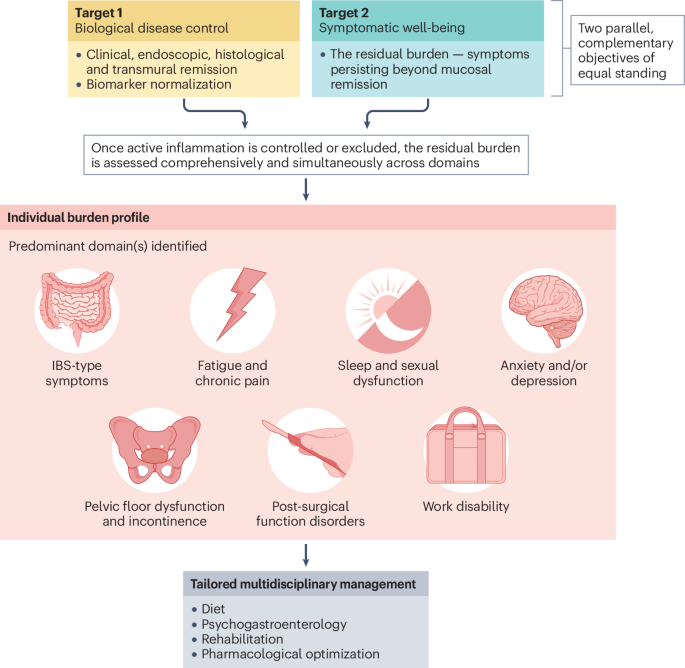
Beyond inflammation: the residual burden as the next target in inflammatory bowel disease

Many people with IBD remain symptomatic even when tests show little or no inflammation; recognising these persistent symptoms as a separate treatment target could improve quality of life. This reframes care to address...

Read Summary
Investigating the Role of Sodium Butyrate in Mouse Models of IBD: A Multimodal Structural and Functional MRI Study.
Neural plasticity

Investigating the Role of Sodium Butyrate in Mouse Models of IBD: A Multimodal Structural and Functional MRI Study.

This study shows that sodium butyrate, a metabolite produced by gut bacteria, changed brain imaging measures and reduced inflammation in mice with experimental IBD, supporting the idea that gut-derived compounds can...

Read Summary
A novel Bacillus megaterium/ω-3 PUFA synbiotic attenuates colon inflammation and promotes a pro-resolving macrophage profile ex-vivo.
Frontiers in immunology

A novel Bacillus megaterium/ω-3 PUFA synbiotic attenuates colon inflammation and promotes a pro-resolving macrophage profile ex-vivo.

The study suggests a probiotic–ω‑3 combination (a synbiotic) might boost the anti‑inflammatory, pro‑resolving effects of ω‑3s in colonic tissue—potentially relevant for people with ulcerative colitis looking for adjunct...

Read Summary
Gut microbiota-derived metabolites and IL-22 signaling in inflammatory bowel disease: context-dependent regulation of mucosal repair and inflammation.
Frontiers in immunology

Gut microbiota-derived metabolites and IL-22 signaling in inflammatory bowel disease: context-dependent regulation of mucosal repair and inflammation.

IL-22 links microbial metabolites to epithelial repair and inflammation; clarifying these pathways could inform future therapies or dietary/microbiome approaches to promote mucosal healing without worsening inflammation.

Read Summary
Probiotic-Derived Extracellular Vesicles as Potential Nano-Immunotherapeutic Platforms in IBD: A Clinician's Perspective.
International journal of nanomedicine

Probiotic-Derived Extracellular Vesicles as Potential Nano-Immunotherapeutic Platforms in IBD: A Clinician's Perspective.

This review highlights a new, non-live microbiome-based therapy approach (probiotic-derived EVs) that could in future modulate gut immunity and barrier function without using live microbes. For people with IBD, such...

Read Summary
Association of nutritional indices with early clinical remission in patients with moderate-to-severe ulcerative colitis treated with vedolizumab.
Therapeutic advances in gastroenterology

Association of nutritional indices with early clinical remission in patients with moderate-to-severe ulcerative colitis treated with vedolizumab.

Simple, routinely measured nutritional scores were associated with early (14-week) remission on vedolizumab in patients with moderate-to-severe UC, which could help identify patients more likely to respond early to this...

Read Summary
Blautia wexlerae ameliorates ulcerative colitis via metabolic remodeling of the gut microbiota.
Cell reports

Blautia wexlerae ameliorates ulcerative colitis via metabolic remodeling of the gut microbiota.

The study links a specific gut microbe and its metabolite to reduced inflammation and improved barrier function in ulcerative colitis models and cohort comparisons, suggesting a potential new microbiome-targeted therapy...

Read Summary
Glutaredoxin 1 facilitates colitis recovery by controlling glutathionylation and activity of STAT6 in M2 macrophages
Cell Communication and Signaling

Glutaredoxin 1 facilitates colitis recovery by controlling glutathionylation and activity of STAT6 in M2 macrophages

The study proposes a new redox-regulatory pathway (Grx1–STAT6) that helps M2 macrophages drive tissue repair and colitis recovery in preclinical models, pointing to a possible new therapeutic target to promote...

Read Summary
Influence of socioeconomic development on incidence and disease phenotype in inflammatory bowel disease: a population-based incident study across 16 regions.
Clinical gastroenterology and hepatology : the official clinical practice journal of the American Gastroenterological Association

Influence of socioeconomic development on incidence and disease phenotype in inflammatory bowel disease: a population-based incident study across 16 regions.

Differences in urbanisation and socioeconomic development may help explain rising IBD rates in newly industrialised regions and point to where earlier diagnosis and healthcare planning might be needed. The association...

Read Summary
Mechanism-guided Mn 3 O 4 /GDY nanoplatform intercepts neutrophil- driven oxidative amplification to treat inflammatory bowel disease
Europe PMC

Mechanism-guided Mn 3 O 4 /GDY nanoplatform intercepts neutrophil- driven oxidative amplification to treat inflammatory bowel disease

The study proposes a new oral nanoparticle that targets neutrophil-driven oxidative stress linked to mucosal barrier damage, a mechanism relevant to IBD pathology. If translatable, this approach could add a new modality...

Read Summary