
All topics

Diet and lifestyle

Nutrition, food, supplements, exercise, sleep, stress, and lifestyle research for Crohn's disease and IBD.

Page 10 of 24 · 1124 articles

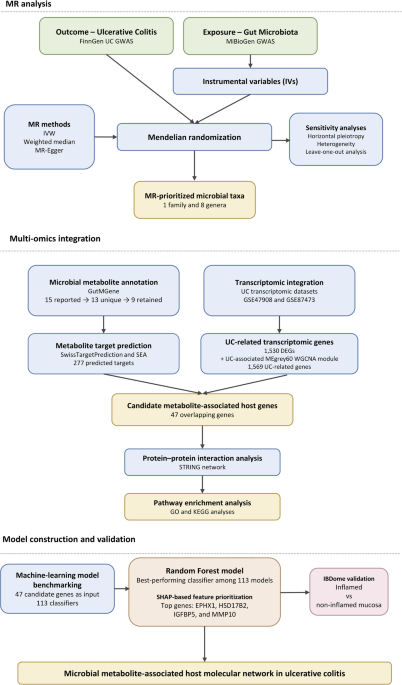
Integrative multi-omics analyses suggest a candidate microbial metabolite-associated host gene network in ulcerative colitis
Immunologic Research

Integrative multi-omics analyses suggest a candidate microbial metabolite-associated host gene network in ulcerative colitis

Researchers are working to link specific gut microbes and their metabolites to host molecular changes in ulcerative colitis. This study maps candidate microbe–metabolite–host gene connections that could point to new...


Read Summary
Piezo1 in intestinal epithelial cells plays a critical role in the mechanobiological positive feedback underlying intestinal fibrosis.
Journal of Crohn's & colitis

Piezo1 in intestinal epithelial cells plays a critical role in the mechanobiological positive feedback underlying intestinal fibrosis.

The study identifies Piezo1 in intestinal epithelial cells as a potential driver of intestinal fibrosis in IBD via a stiffness → ROS → partial EMT pathway, and suggests targeting Piezo1 or ROS could reduce fibrosis in...

Read Summary
Licochalcone B ameliorates DSS-induced ulcerative colitis in mice through inhibiting the PI3K/AKT signaling pathway and restoration of purine metabolism and intestinal barrier integrity
Springer Science and Business Media LLC

Licochalcone B ameliorates DSS-induced ulcerative colitis in mice through inhibiting the PI3K/AKT signaling pathway and restoration of purine metabolism and intestinal barrier integrity

Researchers identified licochalcone B as a compound that reduced inflammation and repaired gut barrier in a mouse colitis model by affecting PI3K/AKT signaling and purine metabolism. For people following IBD research,...

Read Summary
Sarcopenia in patients with active ulcerative colitis: associations with serum metabolites and gut microbiota
Frontiers in Nutrition

Sarcopenia in patients with active ulcerative colitis: associations with serum metabolites and gut microbiota

Sarcopenia (loss of muscle mass/strength) was common among hospitalized adults with active UC and linked to inflammation, changes in blood metabolites (bile acids, acylcarnitines), and shifts in the gut microbiome.

Read Summary
Exploring the impact of DEP on pediatric Crohn's disease using machine learning and molecular docking methods.
Frontiers in pediatrics

Exploring the impact of DEP on pediatric Crohn's disease using machine learning and molecular docking methods.

Researchers used machine learning and molecular docking plus small animal tests to link a common plasticizer (DEP) with molecular changes seen in pediatric Crohn’s disease. This could point to environmental exposures...

Read Summary
Sweet tea polysaccharides alleviate inflammation and regulate intestinal homeostasis via the gut-liver axis in ulcerative colitis mice
Journal of Functional Foods

Sweet tea polysaccharides alleviate inflammation and regulate intestinal homeostasis via the gut-liver axis in ulcerative colitis mice

Based on the title and source metadata, this appears to be a clinical study related to Ulcerative colitis, Inflammatory bowel disease, and Diet and lifestyle. The original article is from Journal of Functional Foods.

Read Summary
Protease-serpin-microbiome interactions in inflammatory bowel disease: toward integrated biomarkers of gut health.
Gut microbes

Protease-serpin-microbiome interactions in inflammatory bowel disease: toward integrated biomarkers of gut health.

Protease and serpin activity affect the gut barrier, immunity, and microbial ecology—processes central to IBD. Integrating these pathways could help identify biomarkers or targets that explain why IBD varies between...

Read Summary
Preventive Effects of Fermented Yak Milk-Derived Lacticaseibacillus paracasei CD12-1 Against DSS-Induced Colitis in Mice
Foods

Preventive Effects of Fermented Yak Milk-Derived Lacticaseibacillus paracasei CD12-1 Against DSS-Induced Colitis in Mice

Preclinical results suggest a fermented yak milk–derived probiotic strain may protect against colitis in mice by improving barrier function, lowering inflammatory cytokines, and changing the gut microbiome—mechanisms...

Read Summary
Bacillus Probiotic Spores in Supporting the Treatment of Chronic Inflammatory Bowel Disease
ClinicalTrials.gov

Bacillus Probiotic Spores in Supporting the Treatment of Chronic Inflammatory Bowel Disease

Patients and clinicians often seek adjunctive options to improve symptoms, quality of life, or reduce treatment burden. This trial tests whether Bacillus spore probiotics added to standard care can provide measurable...

Read Summary
Accurately Profiling the Changes and Functions of Key Microflora in the Whole Intestinal Microenvironment Based on the Visual Sampling Capsule Endoscopy in Patients With Inflammatory Bowel Disease
ClinicalTrials.gov

Accurately Profiling the Changes and Functions of Key Microflora in the Whole Intestinal Microenvironment Based on the Visual Sampling Capsule Endoscopy in Patients With Inflammatory Bowel Disease

Mapping microbes and metabolites directly from different gut regions could reveal location-specific changes linked to IBD activity and help researchers develop better biomarkers or targeted treatments.

Read Summary
Comparison Between Artificial Intelligence and Standard Reading to Investigate Suspected Crohn Disease: the SCAI STUDY
ClinicalTrials.gov

Comparison Between Artificial Intelligence and Standard Reading to Investigate Suspected Crohn Disease: the SCAI STUDY

Faster, reliable reading of capsule endoscopy videos could shorten diagnostic delays and make small-bowel evaluation easier for people with suspected Crohn’s disease. If AI preserves accuracy while reducing review time,...

Read Summary
Microbiome-Derived Tryptophan Metabolites Regulate AhR Signaling to Restore Epithelial Barrier Integrity in Inflammatory Bowel Disease.
MicrobiologyOpen

Microbiome-Derived Tryptophan Metabolites Regulate AhR Signaling to Restore Epithelial Barrier Integrity in Inflammatory Bowel Disease.

Microbial tryptophan metabolites may help restore the intestinal barrier via AhR signaling, a process that could reduce inflammation and symptom-driving permeability in IBD. Understanding this pathway could point to...

Read Summary
Unraveling the pleiotropic roles of the mTOR-glycolytic axis in ulcerative colitis: from immunometabolic dysregulation to mucosal barrier remodeling
Frontiers in Immunology

Unraveling the pleiotropic roles of the mTOR-glycolytic axis in ulcerative colitis: from immunometabolic dysregulation to mucosal barrier remodeling

The review highlights metabolic pathways (mTOR–glycolysis) that drive inflammation and barrier dysfunction in ulcerative colitis, which could point to new kinds of targeted therapies beyond current immunosuppressive...

Read Summary
Genetic and Epidemiologic Studies on Crohn’s Disease in Patients from Djibouti: Relationship Between CARD15/NOD2 Gene Mutations and Clinical/Demographic Factors
Europe PMC

Genetic and Epidemiologic Studies on Crohn’s Disease in Patients from Djibouti: Relationship Between CARD15/NOD2 Gene Mutations and Clinical/Demographic Factors

This study explores genetic risk variants (NOD2/CARD15) and local environmental factors (khat use) among young adults with IBD in Djibouti — information that may help explain regional differences in Crohn’s disease and...

Read Summary
A genome catalog reveals the global landscape of the human gut archaeome and its relevance to inflammatory bowel disease
Europe PMC

A genome catalog reveals the global landscape of the human gut archaeome and its relevance to inflammatory bowel disease

The study expands the map of gut archaea and identifies archaeal species associated with IBD/UC, suggesting new microbial biomarkers and potential microbe–microbe interactions that might influence inflammation.

Read Summary
Probiotics Accelerate Microbiota and Metabolic Pathway Recovery Following Colonoscopy Bowel Preparation in Ulcerative Colitis.
Medical science monitor : international medical journal of experimental and clinical research

Probiotics Accelerate Microbiota and Metabolic Pathway Recovery Following Colonoscopy Bowel Preparation in Ulcerative Colitis.

People with UC have lower baseline gut microbial diversity and slower recovery after PEG bowel preparation; improving recovery of beneficial microbes could matter for symptom stability and gut health. This study suggests...

Read Summary
A Steroid-Sparing Combination Regimen of Low-Dose Atorvastatin and Reduced-Dose Prednisolone Maximizes Healing in Experimental Ulcerative Colitis
Springer Science and Business Media LLC

A Steroid-Sparing Combination Regimen of Low-Dose Atorvastatin and Reduced-Dose Prednisolone Maximizes Healing in Experimental Ulcerative Colitis

The study suggests a steroid‑sparing combination (low‑dose atorvastatin plus reduced prednisolone) may produce stronger anti‑inflammatory and antioxidant effects than either drug alone in an animal model of ulcerative...

Read Summary
Trichinella spiralis infection-induced ursodeoxycholic acid ameliorates colitis by regulating dendritic cells and macrophages via NLRP3 inflammasome signaling pathway
Springer Science and Business Media LLC

Trichinella spiralis infection-induced ursodeoxycholic acid ameliorates colitis by regulating dendritic cells and macrophages via NLRP3 inflammasome signaling pathway

This preclinical study suggests that a specific gut microbe (Bacteroides acidifaciens) and the bile acid UDCA can reduce inflammation in a mouse colitis model by improving barrier function and dampening NLRP3-driven...

Read Summary
Microbiome Therapies in Inflammatory Bowel Disease, Diabetes and Obesity: From Mechanistic Insights to Clinical Translation.
Cardiovascular & hematological agents in medicinal chemistry

Microbiome Therapies in Inflammatory Bowel Disease, Diabetes and Obesity: From Mechanistic Insights to Clinical Translation.

Microbiome-based treatments target inflammation and microbial balance — central issues in IBD — and could offer new therapeutic options. This review collates clinical and mechanistic evidence but warns that results are...

Read Summary
Association Between Ultra-Processed Foods and Clinical Relapse in Crohn's Disease: A Systematic Review and Meta-Analysis.
Journal of the Academy of Nutrition and Dietetics

Association Between Ultra-Processed Foods and Clinical Relapse in Crohn's Disease: A Systematic Review and Meta-Analysis.

The review found higher ultra-processed food intake was linked to increased odds of Crohn’s disease relapse — a potentially actionable signal because diet can be changed. However, the evidence certainty is very low, so...

Read Summary
Phospholipid–Prednisolone Conjugates for Targeted IBD Therapy: Structural Design, Synthetic Approaches, Optimization, and Computational Evaluation
Molecules

Phospholipid–Prednisolone Conjugates for Targeted IBD Therapy: Structural Design, Synthetic Approaches, Optimization, and Computational Evaluation

The study outlines a strategy to target corticosteroids to inflamed intestinal tissue by exploiting PLA2 overexpression, which could reduce systemic steroid side effects if the approach translates to biological models...

Read Summary
Traditional Chinese Medicine-Derived Carbon Dots Nanozymes for Treating Inflammatory Bowel Disease : Current Challenges and Future Perspectives
European Cells and Materials

Traditional Chinese Medicine-Derived Carbon Dots Nanozymes for Treating Inflammatory Bowel Disease : Current Challenges and Future Perspectives

The review presents an emerging nanotechnology (TCM-derived carbon-dot nanozymes) that could offer new multitarget anti-inflammatory and antioxidant approaches for IBD, addressing limitations of current therapies and...

Read Summary
Dietary acrylamide exposure increases susceptibility to ulcerative colitis: A comprehensive analysis from network toxicology to in vivo experimental validation
Food and Chemical Toxicology

Dietary acrylamide exposure increases susceptibility to ulcerative colitis: A comprehensive analysis from network toxicology to in vivo experimental validation

Based on the title and source metadata, this appears to be a clinical study related to Ulcerative colitis, Inflammatory bowel disease, and Diet and lifestyle. The original article is from Food and Chemical Toxicology.

Read Summary
Orientin alleviates ulcerative colitis by regulating ferroptosis and glycolysis via the ROS/HIF-1α/GLUT1 signaling axis.
Journal of ethnopharmacology

Orientin alleviates ulcerative colitis by regulating ferroptosis and glycolysis via the ROS/HIF-1α/GLUT1 signaling axis.

People with UC may care because the study identifies a compound and a signaling pathway that lowered inflammation and tissue injury in a commonly used mouse model of colitis, suggesting potential future therapeutic...

Read Summary
Lactiplantibacillus plantarum as a multifunctional probiotic for inflammatory bowel disease: Mechanisms, synbiotic strategies, and delivery systems.
Synthetic and systems biotechnology

Lactiplantibacillus plantarum as a multifunctional probiotic for inflammatory bowel disease: Mechanisms, synbiotic strategies, and delivery systems.

This review highlights probiotic and synbiotic approaches centered on L. plantarum that aim to rebalance gut microbiota and support the intestinal barrier—areas of direct interest to people with IBD seeking adjunctive,...

Read Summary
Swertiamarin promotes barrier function to alleviate ulcerative colitis by inducing autophagy via the PI3K/AKT/mTOR-signaling pathway
International Immunopharmacology

Swertiamarin promotes barrier function to alleviate ulcerative colitis by inducing autophagy via the PI3K/AKT/mTOR-signaling pathway

Based on the title and source metadata, this appears to be a basic science related to Ulcerative colitis, Inflammatory bowel disease, and Research and clinical trials. The original article is from International...

Read Summary
The use of digital health tools in the management of inflammatory bowel disease: a systematic review.
Minerva gastroenterology

The use of digital health tools in the management of inflammatory bowel disease: a systematic review.

Digital health tools could offer more continuous monitoring and self-management support for people with IBD, potentially helping detect flares earlier and improve quality of life. This review collects existing evidence...

Read Summary
Gut Microbiota and Metabolic Pathway Signatures for Inflammatory Bowel Disease Identified via Subject-Stratified Random Forest Based on the Longitudinal HMP2 Cohort
Genes

Gut Microbiota and Metabolic Pathway Signatures for Inflammatory Bowel Disease Identified via Subject-Stratified Random Forest Based on the Longitudinal HMP2 Cohort

The study provides a more rigorous, leakage-free machine-learning analysis of a major IBD microbiome cohort and proposes reproducible microbial and metabolic pathway candidates that could eventually help IBD diagnosis or...

Read Summary
Building on Routinely Collected Health Data for Precision Population Care in Inflammatory Bowel Disease.
Healthcare quarterly (Toronto, Ont.)

Building on Routinely Collected Health Data for Precision Population Care in Inflammatory Bowel Disease.

Identifying common multimorbidity patterns and using machine learning to predict premature mortality could help health systems and clinicians prioritize integrated care for people with IBD, potentially improving outcomes...

Read Summary
Preparation and chemical characterization of polyphenol-rich extract from Tsaoko Fructus: alleviation of ulcerative colitis in mice by modulating gut microbiota and suppressing the JNK1-cJun signaling.
Phytomedicine : international journal of phytotherapy and phytopharmacology

Preparation and chemical characterization of polyphenol-rich extract from Tsaoko Fructus: alleviation of ulcerative colitis in mice by modulating gut microbiota and suppressing the JNK1-cJun signaling.

Researchers are exploring plant-derived polyphenols as potential anti-inflammatory agents for IBD. This preclinical study suggests a Tsaoko Fructus extract reduced colitis in mice, altered the gut microbiome toward...

Read Summary
Letter to the Editor: Salidroside in ulcerative colitis - neuroimmune regulatory mechanisms and clinical translation prospects
World Journal of Gastroenterology

Letter to the Editor: Salidroside in ulcerative colitis - neuroimmune regulatory mechanisms and clinical translation prospects

The letter highlights salidroside as a potential multi-target agent that could modulate neuro-immune interactions and protect the gut barrier — mechanisms relevant to ulcerative colitis. Patients and clinicians may see...

Read Summary