All topics

Medications

Biologics, small molecules, steroids, biosimilars, approvals, and treatment access updates.

Page 10 of 26 · 1221 articles

Glucagon like peptide 1 receptor agonists in patients with inflammatory bowel disease: safety, clinical effectiveness and anti-inflammatory mechanisms.
Frontiers in gastroenterology (Lausanne, Switzerland)

Glucagon like peptide 1 receptor agonists in patients with inflammatory bowel disease: safety, clinical effectiveness and anti-inflammatory mechanisms.

Many people with IBD also have overweight or obesity; GLP-1 receptor agonists are being used for weight loss and may affect inflammation and IBD outcomes. This review summarizes current evidence on safety, effectiveness,...

Read Summary
Pregnancy safety of biologics in inflammatory bowel disease: A systematic review and network meta-analysis.
Therapeutic advances in gastroenterology

Pregnancy safety of biologics in inflammatory bowel disease: A systematic review and network meta-analysis.

People with IBD often need biologic therapy during their reproductive years. This review compiles comparative evidence about pregnancy risks with different biologics to inform decisions about continuing or switching...

Read Summary
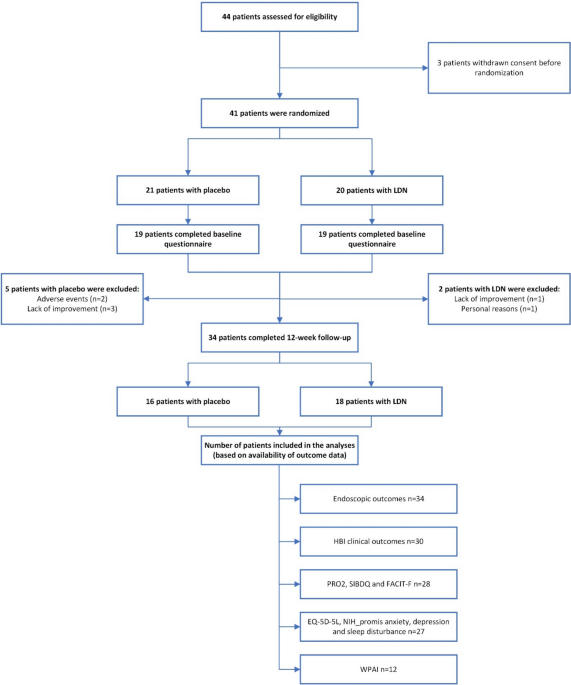
Low-Dose Naltrexone in Crohn’s Disease: A Prematurely Terminated Randomized Trial Showing Reduced Fatigue Without Clinical or Endoscopic Benefit
Digestive Diseases and Sciences

Low-Dose Naltrexone in Crohn’s Disease: A Prematurely Terminated Randomized Trial Showing Reduced Fatigue Without Clinical or Endoscopic Benefit

Many patients and clinicians seek safer, non-immunosuppressive options for Crohn’s disease. This randomized trial found LDN did not induce endoscopic or clinical remission, though it may reduce fatigue—information that...

Read Summary
Ustekinumab Treatment Persistence in Ulcerative Colitis Patients Unresponsive to Biologic Treatment: A Single-Center Real-World Experience
Uludağ Üniversitesi Tıp Fakültesi Dergisi

Ustekinumab Treatment Persistence in Ulcerative Colitis Patients Unresponsive to Biologic Treatment: A Single-Center Real-World Experience

This study provides real‑world data on how long biologic‑experienced UC patients stay on ustekinumab, which helps patients and clinicians set expectations about drug persistence and factors that might influence stopping...

Read Summary
Beyond class switching in multi-refractory inflammatory bowel disease: Nine case reports and review of literature
World Journal of Gastrointestinal Pharmacology and Therapeutics

Beyond class switching in multi-refractory inflammatory bowel disease: Nine case reports and review of literature

For people with multi-refractory Crohn’s disease or ulcerative colitis, adding a JAK inhibitor to an existing biologic (advanced combination therapy) may convert partial responses into deeper remission in selected cases,...

Read Summary
Letter to the Editor: Can upadacitinib dose escalation redefine treatment strategies in refractory inflammatory bowel disease?
World Journal of Gastrointestinal Pharmacology and Therapeutics

Letter to the Editor: Can upadacitinib dose escalation redefine treatment strategies in refractory inflammatory bowel disease?

Patients who lose response to standard upadacitinib dosing may have a practical option—dose re‑escalation—that could improve symptoms and reduce steroid needs according to a small retrospective cohort summarized here.

Read Summary
An Observational Study to Learn About Velsipity After Long Term Use in Patients With Ulcerative Colitis
ClinicalTrials.gov

An Observational Study to Learn About Velsipity After Long Term Use in Patients With Ulcerative Colitis

Long-term, real-world safety data help patients and clinicians understand risks — especially serious infections — when a newer ulcerative colitis drug is used in routine practice. This registry entry shows Pfizer is...

Read Summary
Evolution of surgical risk in Crohn's disease: impact of the biologic therapy era on time to first surgery in a Bosnian tertiary referral center.
European journal of gastroenterology & hepatology

Evolution of surgical risk in Crohn's disease: impact of the biologic therapy era on time to first surgery in a Bosnian tertiary referral center.

The findings suggest that early biologic and immunomodulator treatment may reduce the need for first surgery in Crohn's disease, which is directly relevant to treatment planning and expectations for people with IBD.

Read Summary
Switching Between Anti-TNFs and Other Biologic Drugs in Paediatric Inflammatory Bowel Disease: A Narrative Review and Practical Clinical Guide.
Journal of inflammation research

Switching Between Anti-TNFs and Other Biologic Drugs in Paediatric Inflammatory Bowel Disease: A Narrative Review and Practical Clinical Guide.

Switching biologics is a frequent and consequential decision in children with IBD; using TDM and a mechanism‑based approach can help choose whether to optimize, switch within class, or change drug class.

Read Summary
Evolving patient journey in the management of active perianal fistulizing Crohn's disease: A temporal perspective.
Colorectal disease : the official journal of the Association of Coloproctology of Great Britain and Ireland

Evolving patient journey in the management of active perianal fistulizing Crohn's disease: A temporal perspective.

The findings show earlier and more frequent use of imaging, endoscopic assessment, anti-TNF therapy, and seton placement for active perianal fistulizing Crohn’s disease over recent years — practices that may affect...

Read Summary
Impaired memory B-cell formation after mRNA-based COVID-19 booster vaccination in patients with inflammatory bowel disease receiving anti-TNF treatment
Europe PMC

Impaired memory B-cell formation after mRNA-based COVID-19 booster vaccination in patients with inflammatory bowel disease receiving anti-TNF treatment

The study suggests that anti‑TNF treatment in IBD is associated with weaker and less cross‑reactive antibody and memory B‑cell responses after COVID‑19 booster vaccination, which may reduce durability of protection and...

Read Summary
Intestinal Ultrasound Predicts Primary Non-Response and Maintenance Relapse in Upadacitinib-Treated Active Crohn's Disease: A Multicenter, Prospective Cohort Study.
Alimentary pharmacology & therapeutics

Intestinal Ultrasound Predicts Primary Non-Response and Maintenance Relapse in Upadacitinib-Treated Active Crohn's Disease: A Multicenter, Prospective Cohort Study.

If you or your clinician are using upadacitinib for Crohn’s, intestinal ultrasound early in treatment may help predict who will not respond and who is more likely to relapse on maintenance dosing, potentially guiding...

Read Summary
Dual biologic therapy in inflammatory bowel disease, a retrospective cohort study of vedolizumab and anti-tumor necrosis factor alpha therapy in children.
Journal of pediatric gastroenterology and nutrition

Dual biologic therapy in inflammatory bowel disease, a retrospective cohort study of vedolizumab and anti-tumor necrosis factor alpha therapy in children.

This study reports that combining an anti-TNF-α drug with vedolizumab helped many children with IBD who failed single-biologic therapy achieve clinical, endoscopic, and histologic improvement. It also notes serious...

Read Summary
A Steroid-Sparing Combination Regimen of Low-Dose Atorvastatin and Reduced-Dose Prednisolone Maximizes Healing in Experimental Ulcerative Colitis
Springer Science and Business Media LLC

A Steroid-Sparing Combination Regimen of Low-Dose Atorvastatin and Reduced-Dose Prednisolone Maximizes Healing in Experimental Ulcerative Colitis

The study suggests a steroid‑sparing combination (low‑dose atorvastatin plus reduced prednisolone) may produce stronger anti‑inflammatory and antioxidant effects than either drug alone in an animal model of ulcerative...

Read Summary
Novel Therapeutic Strategies and Biomarkers in the Management of Inflammatory Bowel Disease: A Narrative Review.
Cureus

Novel Therapeutic Strategies and Biomarkers in the Management of Inflammatory Bowel Disease: A Narrative Review.

This narrative review surveys novel biomarkers and therapeutic strategies for adult IBD, topics that could affect diagnosis, monitoring, and future treatment options for people with Crohn's disease or ulcerative colitis.

Read Summary
A Phase 2 Safety and Efficacy Study of Tulisokibart (MK-7240/PRA023) in Subjects With Moderately to Severely Active Ulcerative Colitis (MK-7240-005)
ClinicalTrials.gov

A Phase 2 Safety and Efficacy Study of Tulisokibart (MK-7240/PRA023) in Subjects With Moderately to Severely Active Ulcerative Colitis (MK-7240-005)

This registry entry describes a completed Phase 2 study of a new IV drug (tulisokibart) for moderate–severe ulcerative colitis, including safety endpoints and a companion diagnostic — information patients may want when...

Read Summary
Real-World Patterns of Immunomodulator Use in Patients with Inflammatory Bowel Disease Receiving Biologic Therapy Under a 54-Week Reimbursement Cap: A 12-Year Retrospective Single-Center Cohort from Taiwan.
Journal of inflammation research

Real-World Patterns of Immunomodulator Use in Patients with Inflammatory Bowel Disease Receiving Biologic Therapy Under a 54-Week Reimbursement Cap: A 12-Year Retrospective Single-Center Cohort from Taiwan.

This study looks at how immunomodulators are actually used with biologic drugs in real-world practice when a national reimbursement policy forces biologic interruptions.

Read Summary
Inflammatory and Immune Pathways Driving Tumor Necrosis Factor Inhibitor Resistance in Ulcerative Colitis.
Journal of inflammation research

Inflammatory and Immune Pathways Driving Tumor Necrosis Factor Inhibitor Resistance in Ulcerative Colitis.

If you or someone you care for is not responding to anti‑TNF drugs for ulcerative colitis, this review explains biological reasons why that may happen and points toward research directions that could lead to better tests...

Read Summary
Phospholipid–Prednisolone Conjugates for Targeted IBD Therapy: Structural Design, Synthetic Approaches, Optimization, and Computational Evaluation
Molecules

Phospholipid–Prednisolone Conjugates for Targeted IBD Therapy: Structural Design, Synthetic Approaches, Optimization, and Computational Evaluation

The study outlines a strategy to target corticosteroids to inflamed intestinal tissue by exploiting PLA2 overexpression, which could reduce systemic steroid side effects if the approach translates to biological models...

Read Summary
Early ileocaecal resection versus biologics therapy for localized Crohn disease: A systematic review and meta-analysis.
Colorectal disease : the official journal of the Association of Coloproctology of Great Britain and Ireland

Early ileocaecal resection versus biologics therapy for localized Crohn disease: A systematic review and meta-analysis.

This review directly compares surgery-first versus biologic-first strategies for localized ileocaecal Crohn's disease and suggests early resection can lower later treatment needs and leave some patients off medication,...

Read Summary
Switching to the IL-23 Inhibitor Guselkumab for People With Active IBD Who Previously Used Ustekinumab (SHIFT-IBD)
ClinicalTrials.gov

Switching to the IL-23 Inhibitor Guselkumab for People With Active IBD Who Previously Used Ustekinumab (SHIFT-IBD)

People with IBD who don’t respond well to ustekinumab may need alternative options. This study will track how patients fare after switching to guselkumab in routine clinical care and report rates of deep remission at one...

Read Summary