This project investigates how estrogen receptor signaling in intestinal epithelial cells drives sex-specific responses to injury and inflammation that may influence ulcerative colitis risk and progression.

The study links a common dietary compound (oxalate) to worsened intestinal inflammation in IBD and identifies reduced gut oxalate-transport gene activity and microbiome differences as possible mechanisms—findings that...
The study shows that fecal (luminal) and mucosal microbiome and metabolite profiles capture different aspects of pediatric IBD—activity versus phenotype—so combined sampling may give a fuller picture for research and...
People with IBD and their clinicians need to know whether common IBD treatments change COVID-19 risk or should be stopped. This review provides practical recommendations (continue most maintenance drugs; avoid systemic...
The work identifies factors that predict loss of response to infliximab and suggests maintenance drug levels are the strongest predictor, which could influence monitoring strategies for people with Crohn's disease on...
Digestive and liver disease : official journal of the Italian Society of Gastroenterology and the Italian Association for the Study of the Liver· via Europe PMC
Based on the title and source metadata, this appears to be a clinical study related to Crohn's disease, Inflammatory bowel disease, and Research and clinical trials. The original article is from Digestive and liver...
Targeting IL‑1 is a promising route to reduce gut inflammation in IBD, but existing IL‑1 drugs face delivery and stability challenges. Nanocarriers could improve how these agents reach inflamed intestinal tissue, which...
Delivery method affects daily life and adherence. If you use or may use risankizumab, the on-body injector in this study was highly acceptable to most patients and caused mostly mild, local skin reactions, which may make...
Researchers identified COPZ1 as a shared ferroptosis-related hub gene in Crohn’s disease, ulcerative colitis, and periodontitis, which could point to a new molecular pathway linking gut and oral inflammation and a...
The study suggests a common plant compound (oxalate) may build up in the intestines of people with IBD because transporter proteins are reduced, potentially worsening inflammation. If confirmed, this could influence...
People with IBD in this study had much worse quality of life and a high burden of other medical and mental-health conditions; addressing these comorbidities could improve daily functioning and outcomes.
If you have isolated perianal fistulizing Crohn’s disease, this large multicenter cohort shows about one-third later developed luminal Crohn’s disease over long-term follow-up, but many did not — underscoring variable...
This paper links preclinical models and a short Phase 2a trial to show a candidate SIK2/SIK3 inhibitor (GLPG3970) produced anti-inflammatory and mucus-restoring signatures in IBD tissues. If findings hold in larger...
Imaging found increased visceral fat in children with Crohn's despite normal BMI, which could reveal inflammation-related risk not apparent from weight alone. Visceral adiposity was linked to markers of inflammation and...
This study identifies a specific gut microbe (Turicimonas muris) and an immune pathway link by which a high-fat diet reduced experimental colitis severity in mice, suggesting diet–microbiome interactions can strongly...
Depression and GI diseases often co-occur; knowing which tends to appear first — and that this varies by subtype — can help clinicians prioritize screening and integrated care.
Genetic variation in MYO9B has been linked to Crohn’s disease, ulcerative colitis, and celiac disease. This study suggests a plausible epithelial-cell mechanism — altered microvilli and RhoA signaling — that could help...
Monogenic causes (especially IL-10RA mutations) are common in infant-onset IBD and are linked to more severe disease and higher mortality; early genetic testing and consideration of HSCT may change prognosis.
A non-invasive test (intestinal ultrasound) that predicts whether patients stay on biologic therapy could reduce the need for frequent endoscopy and help guide monitoring decisions.
People with Crohn’s disease who develop kidney failure sometimes face limited dialysis options. This paper suggests peritoneal dialysis may work for some patients—especially those in sustained remission—but also shows...
This study suggests that cumulative infliximab exposure over time (AUC) — not just trough levels — may predict infection risk in people with IBD. That could affect how clinicians use therapeutic drug monitoring to...
The paper provides genetic evidence that acute pancreatitis and Crohn’s disease share polygenic risk and converge on immune and inflammatory pathways; this may explain some observed comorbidity and points to biological...
Knowing how IBD burden has changed over time and varies across states helps patients, clinicians, and health systems anticipate needs for diagnosis, specialized care, and resource planning. Rising Crohn’s burden in some...
IBD patients and clinicians may see more treatment options in the future if Lilly’s pipeline programs (notably mirikizumab and oral α4β7 inhibitors) succeed.
The 5-year PROFILE follow-up is presented as strong evidence that early, effective therapy (in this case infliximab plus an immunomodulator) can change the long-term course of Crohn’s disease by lowering surgery rates...
Cure8 found this source from magzter.com, but the page could not be read reliably yet. It is tagged for Crohn's disease, Inflammatory bowel disease, and Research and clinical trials. Open the original article for the...
The review directly compares randomized-trial evidence for JAK inhibitors in moderate-to-severe Crohn's disease and highlights which regimens (notably upadacitinib) showed the most consistent efficacy signals,...
Non-invasive blood biomarkers that predict who will respond to therapy could help personalize treatment and avoid ineffective medications. This study identifies plasma miR-145 and miR-191 as potential predictors of...
If validated, a genetic marker (IL12B rs6887695) might help predict which patients are more likely to benefit from ustekinumab, potentially informing personalized treatment choices in IBD.
If confirmed, starting anti‑TNF therapy (infliximab) early plus an immunomodulator may reduce surgeries, hospital admissions, and progression to complicated disease behavior over 5 years compared with a traditional...
This trial is testing risankizumab in children with moderate-to-severe Crohn’s disease to learn how the drug behaves in kids, whether it’s safe, and whether it reduces disease activity — information that could expand...
This trial tests a safe, non-drug supplement (GlcNAc) as a precision-medicine approach for Crohn's disease based on a genetic variant that affects glycosylation. If successful, it could offer a new, well-tolerated...
This analysis directly addresses treatments commonly used for perianal fistulizing Crohn’s disease and compares biologic anti-TNF drugs with emerging mesenchymal stem cell therapy, information that could affect treatment...
A national pediatric IBD registry from Colombia summarizes diagnosis age, disease types, treatment patterns (including rising biologic use), and outcomes—information that can inform families and clinicians about regional...
Low muscle mass before ileocolic resection appears linked to higher short-term surgical complications and higher rates of endoscopic recurrence — information that could affect preoperative assessment and planning for...
Wearable-derived digital biomarkers aim to detect flares earlier and reduce reliance on questionnaires; patients' acceptance is essential for real-world use. High reported willingness suggests patient-centered...
Trials testing intestinal ultrasound–guided treat-to-target strategies and late-stage therapies could change how Crohn’s disease is monitored and treated if they show improved outcomes.
This article explains why two widely used IBD drugs from AbbVie (Skyrizi and Rinvoq) are central to the company’s growth and describes ongoing development efforts that could expand treatment options and indications in...
Obituaries that mention Crohn’s disease can help the IBD community by acknowledging lived experience, caregiving burdens, and directing support to relevant charities. They also humanize long-term disease impact.
The study suggests FMT can clear mucosal adherent‑invasive E. coli (AIEC) in some people with Crohn’s disease and alters mucosal microbiome features linked to inflammation, which could be relevant to microbiome‑targeted...
People with IBD who are treated with anti‑TNFα drugs commonly develop inflammatory or infectious skin problems. This study aims to clarify whether Staphylococcus aureus is more abundant in those lesions and whether its...
This trial studies adalimumab safety and pediatric dosing in children with moderate–severe Crohn's disease, which is directly relevant to families and clinicians considering anti-TNF therapy for pediatric IBD.
Intestinal ultrasound can assess IBD inflammation without radiation but interpretation varies by operator. Developing AI tools to measure bowel wall thickness and other features could standardize and speed image...
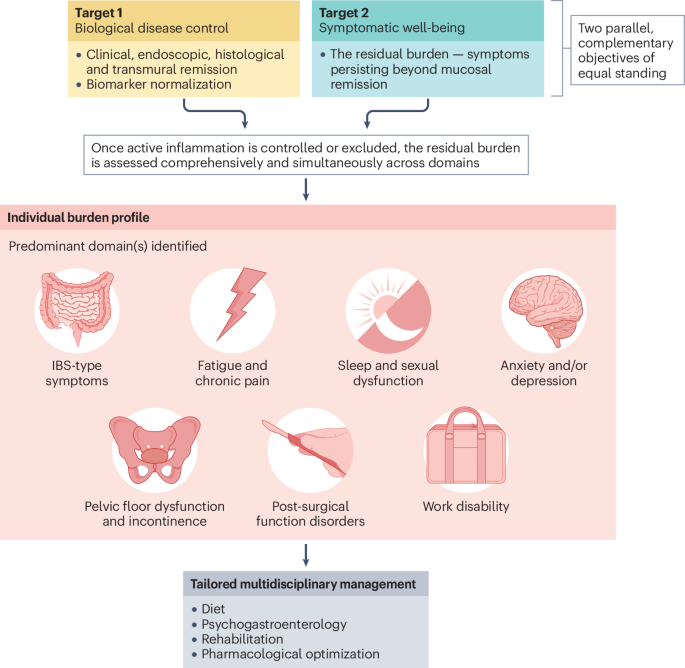
Many people with IBD remain symptomatic even when tests show little or no inflammation; recognising these persistent symptoms as a separate treatment target could improve quality of life. This reframes care to address...
Work participation and sick leave affect daily life, income, and quality of life for people with IBD. Understanding when sick leave is more common can help patients, employers, and clinicians plan support around...
ITB can closely mimic Crohn’s disease, so this study is relevant because it describes diagnostic test yields and illustrates that targeted TB testing and therapeutic trials of antituberculosis treatment can help...
Based on the title and source metadata, this appears to be a clinical study related to Crohn's disease, Inflammatory bowel disease, and Research and clinical trials. The original article is from Gastroenterology &...
Based on the title and source metadata, this appears to be a patient education related to Crohn's disease, Inflammatory bowel disease, and Tests and monitoring. The original article is from Gastroenterology & hepatology.