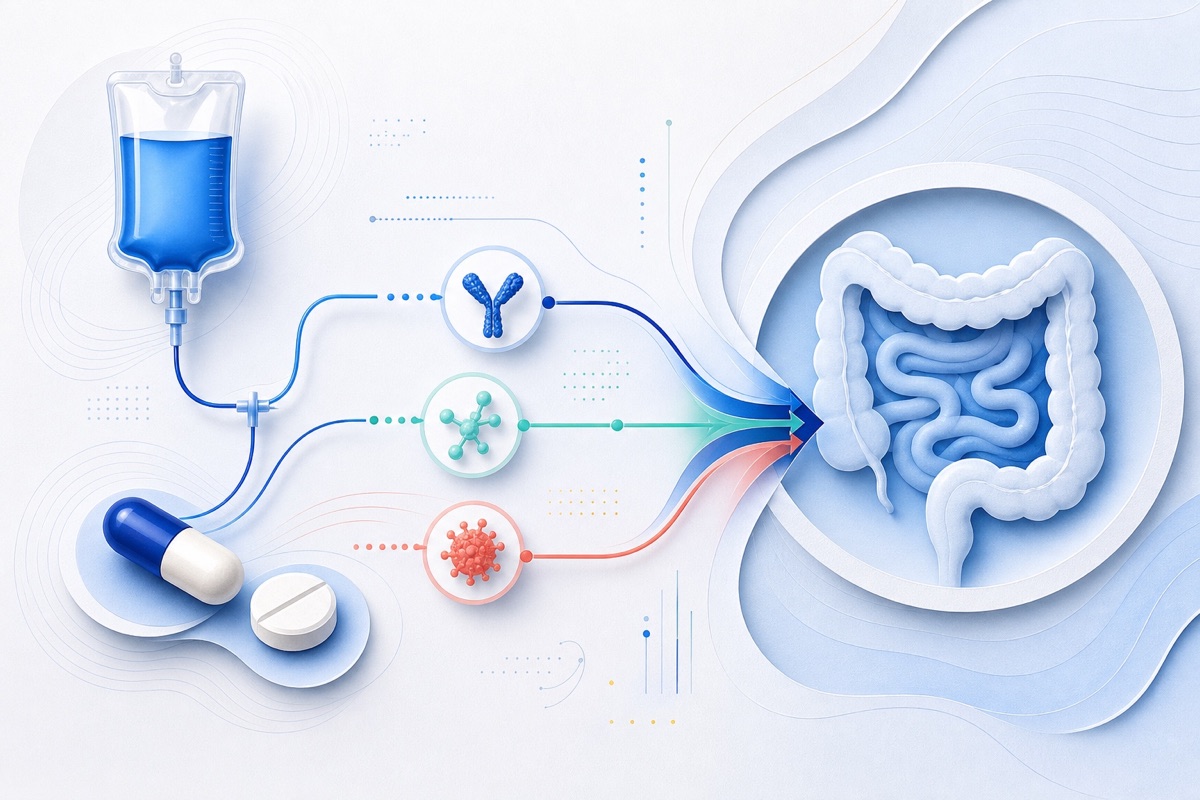
AI Model Predicts Stoma Risk After Crohn’s Disease Surgery
A predictive model for temporary stoma could influence surgical planning for people with Crohn’s disease, helping tailor decisions and expectations around intestinal resection.
Evidence types
Clinical study articles covering observational research, trial reports, and human data relevant to Crohn's disease and IBD.
Page 11 of 11 · 520 articles
A predictive model for temporary stoma could influence surgical planning for people with Crohn’s disease, helping tailor decisions and expectations around intestinal resection.
Researchers and clinicians studying Crohn’s disease want to understand whether distinct patient subgroups exist that could affect outcomes or responses. Identifying subpopulations can guide future research into...
People with Crohn's disease who have an ileostomy need reliable, noninvasive tools to monitor for postoperative small-bowel inflammation. This study suggests fecal calprotectin measured from ileostomy output may help...
The study suggests a surgical change—removing the mesentery during Crohn’s operations—may significantly reduce early recurrence in the intestinal lining, which could mean fewer repeat surgeries and hospital readmissions...
Some people with Crohn’s have ongoing GI symptoms despite little visible inflammation. This study suggests the gut microbiome—particularly sulfur-producing bacteria—may be a reason, and diet could be a potential target...
Arthralgia and other extraintestinal symptoms may signal higher risk of developing peripheral arthritis in people with Crohn disease. Recognizing early joint pain could prompt closer monitoring or earlier rheumatology...
Cure8 found this source from gut.bmj.com, but the page could not be read reliably yet. It is tagged for Crohn's disease, Inflammatory bowel disease, and Research and clinical trials. Open the original article for the...
A validated AI biomarker that predicts which IBD treatments are likely to work could reduce trial-and-error in treatment choices, potentially shortening time to effective therapy for people with Crohn's disease or...
People with Crohn’s disease who have an ileostomy have limited noninvasive ways to monitor small-bowel inflammation. This study suggests measuring fecal calprotectin from ileostomy output could help detect postoperative...
Based on the title and source metadata, this appears to be a clinical study related to Crohn's disease, Inflammatory bowel disease, and Diet and lifestyle. The original article is from msn.com.
Cure8 found this source from onlinelibrary.wiley.com, but the page could not be read reliably yet. It is tagged for Crohn's disease and Procedures and surgery. Open the original article for the full details.
People with both psoriasis and hidradenitis suppurativa appear to have higher overall morbidity and a greater observed risk of Crohn’s disease. Genetic findings suggest shared biological pathways that could affect how...
This suggests an existing antibiotic, vancomycin, may help a specific group of IBD patients who also have primary sclerosing cholangitis (PSC), including some who did not respond to other IBD treatments. If confirmed in...
This study suggests a common genetic marker (HLA‑DQA1*05) may help explain why some children stop responding to anti‑TNF drugs and could eventually guide who might benefit from adding methotrexate or closer monitoring.
A noninvasive wearable that tracks inflammation markers could let people with IBD and their clinicians detect rising disease activity earlier and potentially act before symptoms develop. This may make monitoring less...
Cure8 found this source from medpagetoday.com, but the page could not be read reliably yet. It is tagged for Crohn's disease, Inflammatory bowel disease, and Diet and lifestyle. Open the original article for the full...
Researchers are exploring whether gut microbes differ in patients who develop fibrous strictures — a common, surgery-prone complication of Crohn’s disease — because that could help predict risk or point to new prevention...
This article describes implantable vagus nerve stimulators being studied as a way to reduce inflammation in autoimmune diseases, including Crohn’s disease. If effective, these devices could offer a non-drug option or...
A test that more accurately predicts which IBD patients with pre-cancerous bowel changes will develop cancer could help target surveillance and treatment to those at higher risk and reduce unnecessary procedures for...
The study identifies a specific bacterial protein region (flagellin epitope) that many Crohn’s patients make antibodies to, which could help diagnose disease and predict who may develop complications.
Diet is a modifiable factor that may influence inflammation and the gut microbiome. If the Mediterranean diet is linked with lower disease activity and inflammatory markers in newly diagnosed Crohn’s disease, patients...
Based on the title and source metadata, this appears to be a clinical study related to Research and clinical trials. The original article is from msn.com.
If you have Crohn’s disease, this study suggests following a Mediterranean-style diet may be linked with lower inflammation and a gentler disease course, and it could positively change the gut microbiome and metabolites.
Researchers are trying to find blood biomarkers and a risk score that could predict who will develop Crohn’s disease before symptoms appear, which might enable earlier interventions or prevention in the future.
People with celiac disease may have higher risks for several digestive cancers and for inflammatory bowel diseases (Crohn’s and UC) according to this large French cohort study. Knowing these associations can help...
The study suggests a possible link between psoriasis, leaky gut, and Crohn’s disease—topics that could help explain why some people with psoriasis report more gut problems. People with psoriasis or IBD may find the...
Based on the title and source metadata, this appears to be a clinical study related to Research and clinical trials. The original article is from msn.com.
Patients with Crohn’s disease and other IBD forms may see new research directions aimed at blocking immune cell proliferation by targeting nucleotide metabolism. This is early-stage, preclinical work presented at a...
The story describes a new drug mechanism (dCK inhibition) that reduced inflammation in an IBD mouse model, which could point to a different way to target overactive immune cells in Crohn’s disease. It’s early-stage...
Perianal fistulas are serious, hard-to-treat complications in pediatric Crohn disease. The study suggests starting anti-TNFα therapy early — especially for kids with perianal lesions — may lower the chance of developing...
This review summarizes who gets Crohn’s disease, likely causes, and modifiable risk factors (notably smoking). That context helps patients and clinicians understand disease origins and the basis for some preventive...
The study suggests starting anti-TNF drugs early in children with Crohn's could strongly lower the chance of developing anal fistulas, a serious complication that often requires surgery. Preventing fistulas can reduce...
Skin disease (hidradenitis suppurativa) may be more common in people with IBD—particularly Crohn disease—and could be linked with more severe intestinal complications. Awareness can prompt coordinated care between...
Cure8 found this source from academic.oup.com, but the page could not be read reliably yet. It is tagged for Inflammatory bowel disease, Crohn's disease, and Research and clinical trials. Open the original article for...
This model aims to identify healthy first‑degree relatives at higher risk of developing Crohn’s disease before symptoms start, which could enable earlier monitoring or preventive strategies. The score uses simple...
Some people with Crohn's disease still have symptoms even when inflammation is under control. This study suggests sulfur-producing gut bacteria and their metabolites might explain those lingering symptoms and point to...
The review brings together evidence that genetics, immune responses, the gut microbiome, and environmental triggers interact to cause Crohn's disease and ulcerative colitis.
Many people with Crohn’s disease continue to have symptoms even when inflammation is absent. This study suggests the gut microbiome — specifically sulfur-producing bacteria and hydrogen sulfide production — might explain...
Fatigue is common in people with Crohn’s disease and ulcerative colitis and can persist even when standard measures say the disease is in remission. This study suggests stricter definitions of remission don’t necessarily...
Perianal fistula complications are serious and difficult to treat. This study suggests starting anti-TNFα therapy early in pediatric Crohn disease may substantially lower the risk of developing these complications,...