All topics

Mental health and quality of life

Anxiety, depression, fatigue impact, adherence, social life, and quality-of-life news.

Page 3 of 6 · 246 articles

Transitional care in pediatric inflammatory bowel disease: current strategies and future directions - a narrative review.
Przeglad gastroenterologiczny

Transitional care in pediatric inflammatory bowel disease: current strategies and future directions - a narrative review.

Transition from pediatric to adult IBD care is a high-risk period; structured programs and better communication can improve adherence and reduce relapse and hospitalization risk for young people with IBD.

Read Summary
Assessment of kinesiophobia in ulcerative colitis: a case-control study highlighting functional and psychological implications.
Revista da Associacao Medica Brasileira (1992)

Assessment of kinesiophobia in ulcerative colitis: a case-control study highlighting functional and psychological implications.

Fear of movement was more common and more severe in people with ulcerative colitis in this study. Addressing kinesiophobia could help increase physical activity and improve function and quality of life for people with...

Read Summary
Association between life satisfaction and selected socio-demographic factors and social and professional activity - a comparative study between patients with Crohn's disease and patients with ulcerative colitis.
Przeglad gastroenterologiczny

Association between life satisfaction and selected socio-demographic factors and social and professional activity - a comparative study between patients with Crohn's disease and patients with ulcerative colitis.

Life satisfaction and social/work impacts are central to daily functioning for people with IBD. Knowing which social factors relate to lower satisfaction can help patients, caregivers, and clinicians spot who may need...

Read Summary
Symptom Management Experiences of People Living With Crohn's Disease Through a Journey Map: A Qualitative Study.
Journal of clinical nursing

Symptom Management Experiences of People Living With Crohn's Disease Through a Journey Map: A Qualitative Study.

A patient-centered journey map identifies changing symptom, psychological, and social needs at different stages of Crohn's disease. That can help clinicians and care teams target education, mental-health support, and...

Read Summary
Effects of exercise therapy on quality of life in patients with inflammatory bowel disease: a network meta-analysis
Frontiers in Physiology

Effects of exercise therapy on quality of life in patients with inflammatory bowel disease: a network meta-analysis

Exercise is a low-cost, accessible intervention that may improve quality of life and reduce symptoms in people with IBD. This pooled analysis suggests some exercise types — especially regular continuous aerobic exercise...

Read Summary
Translation and Spanish validation of the Quality of Life Questionnaire for patients with perianal fistula in Crohn's disease (Sp CAF-QoL Scale).
Revista espanola de enfermedades digestivas

Translation and Spanish validation of the Quality of Life Questionnaire for patients with perianal fistula in Crohn's disease (Sp CAF-QoL Scale).

Perianal fistulas in Crohn's disease significantly affect quality of life, and this study provides an initially validated Spanish tool to measure that impact, enabling better assessment in Spanish-speaking patients and...

Read Summary
Disorders of Gut-Brain Interaction like symptoms in Children with Inflammatory Bowel Disease: A Multicenter Prospective Study from the Pediatric IBD Porto Group of the ESPGHAN.
The American journal of gastroenterology

Disorders of Gut-Brain Interaction like symptoms in Children with Inflammatory Bowel Disease: A Multicenter Prospective Study from the Pediatric IBD Porto Group of the ESPGHAN.

Children with IBD can have persistent gut–brain interaction symptoms even when inflammation is quiescent; these symptoms are linked with worse quality of life and higher anxiety. Recognizing DGBI-like symptoms may help...

Read Summary
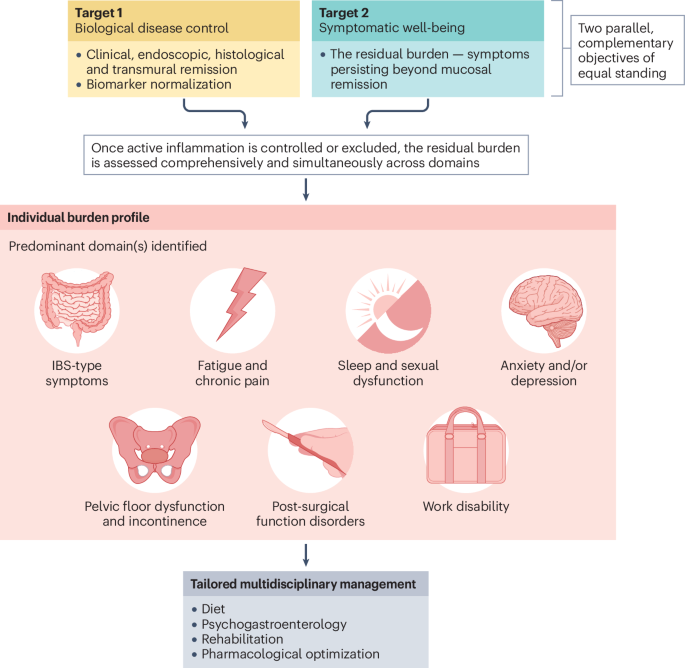
Treatable traits in inflammatory bowel disease: a conceptual framework for personalized care.
EClinicalMedicine

Treatable traits in inflammatory bowel disease: a conceptual framework for personalized care.

A treatable-traits approach could help tailor IBD care to each patient by targeting specific biological, comorbid, and psychosocial drivers of disease and quality-of-life impairment, potentially improving how we choose...

Read Summary
Artificial Intelligence in the Nutritional Management of Inflammatory Bowel Disease: A Scoping Review.
Journal of multidisciplinary healthcare

Artificial Intelligence in the Nutritional Management of Inflammatory Bowel Disease: A Scoping Review.

AI could help identify dietary patterns, predict which patients might benefit from specific nutrition approaches, and provide personalized nutrition support — potentially improving inflammation and gut microbiome...

Read Summary
Extraintestinal manifestations have a negative impact on Quality of Life of patients with Inflammatory Bowel Disease
Digestion

Extraintestinal manifestations have a negative impact on Quality of Life of patients with Inflammatory Bowel Disease

Extraintestinal manifestations are common in IBD and — according to this study — linked to significantly worse quality of life across social, systemic, intestinal, and emotional domains. Recognizing and treating EIMs may...

Read Summary
Factors associated with preference for in-person versus remote consultations in inflammatory bowel disease in the United Kingdom: secondary analysis of an online survey.
European journal of gastroenterology & hepatology

Factors associated with preference for in-person versus remote consultations in inflammatory bowel disease in the United Kingdom: secondary analysis of an online survey.

Patients and clinics are still deciding how much care can be done remotely. Knowing who prefers in-person versus remote visits helps tailor care so patients receive the visit type they need and want, and supports...

Read Summary
Hierarchical correlates of sexual dysfunction in inflammatory bowel disease: Psychological burden outweighs disease activity and sarcopenia.
Journal of psychosomatic research

Hierarchical correlates of sexual dysfunction in inflammatory bowel disease: Psychological burden outweighs disease activity and sarcopenia.

Sexual dysfunction is common in IBD and—according to this study—appears more strongly linked to psychological and demographic factors than to disease activity or muscle loss. Recognizing and treating mental-health issues...

Read Summary
Feasibility, Acceptability, and Preliminary Effects of a Nurse-Delivered Self-Management Program for Individuals with Inflammatory Bowel Disease: A Pilot Randomized Controlled Trial
Digestive Diseases and Sciences

Feasibility, Acceptability, and Preliminary Effects of a Nurse-Delivered Self-Management Program for Individuals with Inflammatory Bowel Disease: A Pilot Randomized Controlled Trial

Self‑management programs delivered by nurses may help people with IBD improve daily functioning, confidence in managing their condition, and quality of life even when inflammation markers don’t change. That matters...

Read Summary
Underevaluation of bowel urgency in clinical care: patient experiences and outcomes in ulcerative colitis: a retrospective cohort study
Inflammatory Bowel Diseases

Underevaluation of bowel urgency in clinical care: patient experiences and outcomes in ulcerative colitis: a retrospective cohort study

Bowel urgency is a common symptom that may predict higher risk of treatment escalation, hospitalization, or surgery in UC even when bleeding and stool frequency look controlled. Better assessment of urgency in clinic...

Read Summary
‘We need to highlight as a community that these are avoidable’: exploring clinician perspectives on healthcare access and avoidable admissions in inflammatory bowel disease
Frontline Gastroenterology

‘We need to highlight as a community that these are avoidable’: exploring clinician perspectives on healthcare access and avoidable admissions in inflammatory bowel disease

Avoidable unplanned hospital admissions are common and costly for people with IBD. This study suggests many such admissions stem from healthcare access and service delivery problems—not just disease severity—so system...

Read Summary
Inflammatory Bowel Disease and Its Unique Impact on Body Image: A Qualitative Exploration.
Journal of clinical psychology

Inflammatory Bowel Disease and Its Unique Impact on Body Image: A Qualitative Exploration.

Body-image concerns in IBD are linked with poorer mental health, eating behaviours, and overall quality of life. Understanding these experiences can help clinicians and support services better address emotional and...

Read Summary
Impact of pediatric vs. adult diagnosed IBD on achievement of health care autonomy in emerging adults: a cross-sectional study
Crohn s & Colitis 360

Impact of pediatric vs. adult diagnosed IBD on achievement of health care autonomy in emerging adults: a cross-sectional study

Emerging adults with IBD face distinct challenges managing care. The study shows people diagnosed as children may know about their disease but still need help with practical self-management tasks — a gap that can affect...

Read Summary
Effect of continuity of patient care on quality of life and psychological state in patients with inflammatory bowel disease: a systematic review and meta-analysis of randomized controlled trials
PeerJ

Effect of continuity of patient care on quality of life and psychological state in patients with inflammatory bowel disease: a systematic review and meta-analysis of randomized controlled trials

People with Crohn’s disease or ulcerative colitis often experience anxiety, depression, and reduced quality of life; this review suggests that continuity of care programs can help improve those outcomes.

Read Summary
Effect of physician prescribed information to the inflammatory bowel disease patients on quality of life and disease relapse: a randomised control trial
PubMed Central

Effect of physician prescribed information to the inflammatory bowel disease patients on quality of life and disease relapse: a randomised control trial

The study suggests that a physician-endorsed, librarian-developed information prescription may improve quality of life and reduce short-term relapse in people with IBD, a non-pharmacological approach that could be...

Read Summary
Exploring bidirectional causal relationships between ulcerative colitis and depression via the gut-brain axis: A Mendelian randomization study with plasma protein mediator analysis.
Journal of affective disorders

Exploring bidirectional causal relationships between ulcerative colitis and depression via the gut-brain axis: A Mendelian randomization study with plasma protein mediator analysis.

People with ulcerative colitis commonly experience depression; understanding whether the relationship is causal and which blood proteins might mediate it could help researchers develop biomarkers or new therapies...

Read Summary
Macrophage-driven inflammation in inflammatory bowel disease: mechanisms and therapeutic opportunities
Frontiers in Bioengineering and Biotechnology

Macrophage-driven inflammation in inflammatory bowel disease: mechanisms and therapeutic opportunities

Macrophages and innate immune signaling are central to how gut inflammation starts and persists in IBD; better understanding these pathways could point to new treatment strategies for people whose disease doesn’t fully...

Read Summary

Linking Clinical Disease Activity to Quality of Life in Ulcerative Colitis: Serial Mediation by Patient Activation and Comfort.

This study shows that patients' comfort partly explains how clinical disease activity affects quality of life in ulcerative colitis, suggesting comfort-focused nursing care could help patients feel better even when...

Read Summary

Microbiome-driven alterations in tryptophan metabolism contribute to behavioral comorbidities in the Muc2 knockout mouse model of chronic colitis.

IBD is increasingly linked with anxiety, depression, and cognitive symptoms; this study suggests gut microbes may change tryptophan metabolism in colitis and contribute to those brain-related symptoms, which could point...

Read Summary